

The craft towns on Fergana Valley handicraft tours in Uzbekistan include Rishtan, where ceramics connect a visitor's journey with working neighbourhoods and family workshops. Mamadali Topvoldiev mahalla in Rishtan district received tourist-mahalla status in July 2025. A ceremony, craft exhibition and domestic tourism fair accompanied the designation. Pottery production, teaching and individual workshops form parts of the wider town’s craft setting.
Rishtan's significance is not confined to that designation. The town is associated with pottery, while nearby Margilan has a different craft identity based on silk textiles. Together they offer a way to explore the Fergana Valley through materials and skills: clay shaped and fired in one place, threads dyed and woven in another. Each has its own practitioners and methods.
A named mahalla and its new designation
Mamadali Topvoldiev mahalla is a neighbourhood community in Rishtan district. It received tourist-mahalla status in July 2025, with representatives of the Tourism Committee, the Hunarmand artisans’ association and regional and district authorities attending the ceremony. The designation concerns this named local community. Rishtan’s wider pottery traditions involve makers and workshops elsewhere in the town as well as those within the mahalla.
Saad Al-Qaddumi, president of the World Crafts Council, attended the ceremony. A craft exhibition and domestic tourism fair formed part of the opening programme. Makers displayed their work alongside the organisations involved in tourism and craft development. The event joined a named neighbourhood initiative with the presentation of ceramics and other local products, placing current production within the community’s visitor programme.
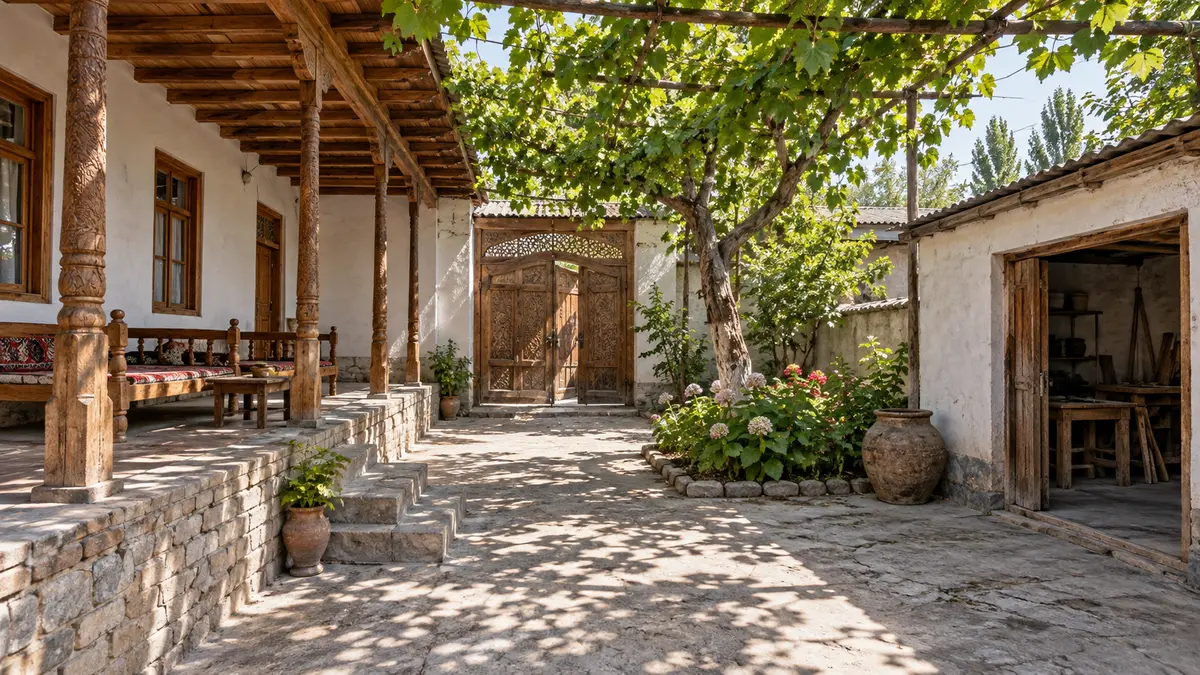
Mamadali Topvoldiev mahalla provides a neighbourhood setting for the tourism initiative. Individual workshops have their own potters, tools and production schedules within Rishtan’s wider craft life. Some spaces are used for shaping and decoration, others for storing materials or displaying completed objects. Visitors encounter the work through the particular demonstration, lesson or display arranged with the maker.
Rishtan's craft story also extends beyond a ceremony. Workshop activity includes obtaining materials, preparing clay, shaping vessels, decorating surfaces, firing and selling finished pieces. Different stages happen at different times. A display of completed bowls may be available when a kiln is not firing, and a potter may be decorating work that was shaped earlier.
Clay, colour and the ceramic object
Rishtan ceramics use local red clay, with decoration often in blue and azure tones. Bowls, jugs and vases are among the forms made, and floral ornament appears on their surfaces. Shape and decoration vary between individual objects and makers. A broad bowl offers a different area for a design from a jug’s curved body, neck and handle, while both belong to the town’s ceramic production.
A ceramic vessel has both a shape and a surface. The rim, foot, depth and wall of a bowl affect how it can be used. Decoration may emphasize the centre, the border or the division between them. A repeated motif can be compared across several objects, while differences in brushwork and composition can be studied within a single workshop. Looking at the whole vessel and then its smaller details gives more information than selecting a piece solely by its dominant colour.
The material also passes through different states. Wet clay can be shaped; drying removes moisture; firing changes the body into a durable ceramic material. A decorated or glazed surface introduces further decisions about materials and heat. The precise sequence depends on the workshop's process, so a demonstration should be described according to what the potter actually does rather than assigned an assumed universal recipe.
Legends about the origins of pottery belong to the town’s remembered traditions. Contemporary workshops present another part of Rishtan’s craft life: makers prepare clay, shape vessels and decorate surfaces before firing. The material on a workbench and the objects leaving a kiln occupy different stages of that process. Oral stories can accompany a demonstration, with their status as legends kept clear alongside the visible work.
Inside a workshop: tools, stages and attention
A pottery workshop brings several kinds of work together. Shaping establishes the form, decoration organizes the surface, and firing requires a separate equipment and temperature process. A maker who decorates a bowl is carrying out a different task from one who prepares a new batch of clay. The finished object contains the results of those tasks even when a visitor sees only one of them.
Work on a wheel is particularly recognizable because the clay rotates while the potter controls its wall and opening. Hand-built work uses another relationship between material and movement. Brushes and other decorating tools may be used after the form has reached the appropriate stage. Neither a wheel demonstration nor a short painting session reproduces the entire production process.
Rishtan’s International Ceramics Centre contains more than twenty workshops, master-apprentice activity and a museum devoted to the history of traditional local ceramics. The workshops provide settings for present-day production and teaching. The museum presents older forms and collected objects. Within the centre, several makers work in their own spaces, with their individual skills and designs represented alongside the shared regional tradition.
Useful questions for a workshop visit
- Which stages of making happen in this workshop?
- Who designed and decorated the object being shown?
- What materials and firing process does the maker use?
- Is the displayed vessel intended for food, decoration or another purpose?
- How is fragile finished work packed for transport?
These questions concern the object and its production. They leave the maker room to explain their own method and avoid assigning a technique from one workshop to another merely because both are located in Rishtan.
How ceramic knowledge is passed on
UNESCO inscribed the ceramic arts of Uzbekistan on the Representative List of the Intangible Cultural Heritage of Humanity in 2023. Its description concerns a national practice with different regional expressions. Rishtan is part of that broader craft landscape, rather than the sole location of Uzbek ceramic production.
Ceramic forms in Uzbekistan include food and water containers, jugs, toys and tandir ovens. Their manufacture involves preparing clay and shaping it for the intended use. Children and younger learners acquire skills through observation, practice and teaching, often within family workshops. Educational activities provide other settings for learning. The practice includes knowledge of materials and production as well as the finished vessels and objects.
A master-apprentice relationship organizes the learning of such skills over time. The apprentice sees how a task is done, repeats it and receives correction. Consistency in shaping or decoration requires more than recognizing a motif. It includes control of a material, the timing of different stages and the ability to repeat a method without assuming that every batch behaves identically.
Workshops can also preserve individual styles. A family connection does not erase differences between makers, and a younger potter can learn an established method while developing new designs. The UNESCO inscription concerns safeguarding the practice; it does not require every contemporary ceramic object to reproduce a single historical pattern.
Margilan: a different material and another craft process
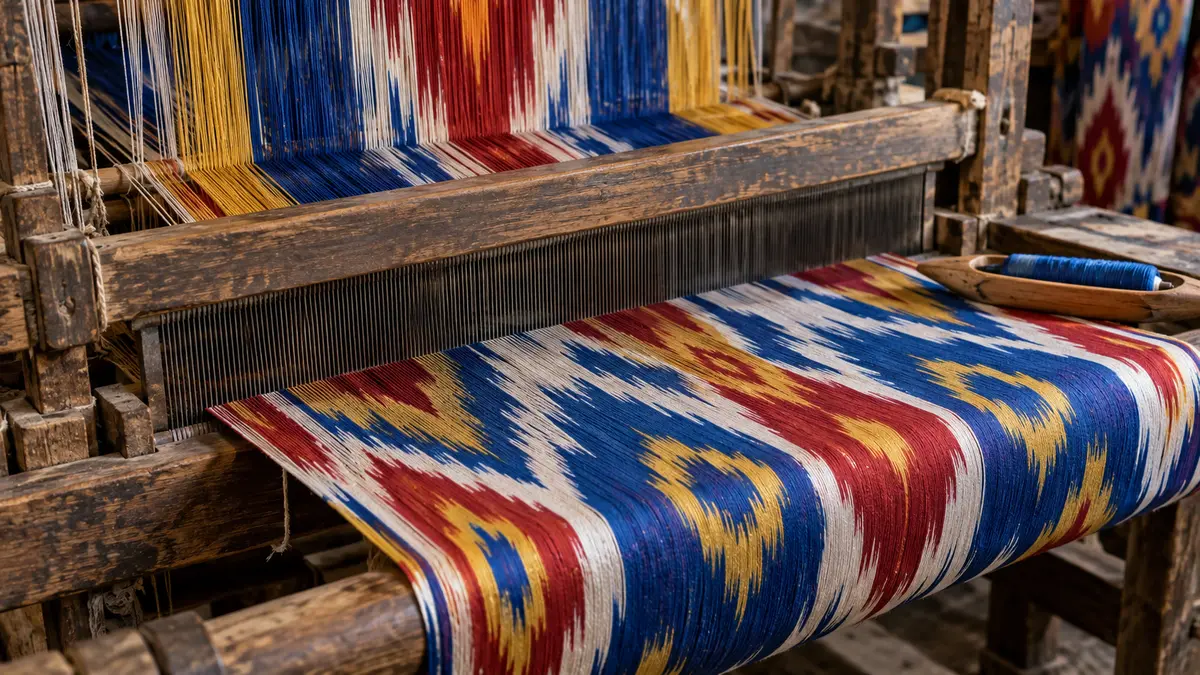
Margilan adds textiles to a Fergana Valley craft route. Its atlas and adras traditions are associated with the preparation of patterned cloth, including the sequence of tying, dyeing and weaving threads. The craft differs from pottery in its tools, materials and production stages. A cloth can be understood through the yarns and weave as well as through the pattern visible on its finished surface.
In an ikat process, selected portions of yarn are bound before dyeing so that the pattern is organized in the threads. Weaving then brings those threads into cloth. This is different from printing a finished fabric or applying embroidery to a woven surface. A workshop explanation can make those distinctions visible by showing yarn, prepared bundles, loom work and finished pieces separately.
Margilan Crafts Development Centre’s programme for traditional atlas and adras technologies entered UNESCO’s Register of Good Safeguarding Practices in 2017. Training, recovery of traditional methods and public presentation form part of the programme. The designation concerns this safeguarding work rather than the entire town’s built fabric. The centre provides a place for makers to teach and demonstrate textile skills within the Fergana Valley.
A journey combining Margilan and Rishtan therefore includes two separate kinds of production. The ceramics visit centres on an earth-based material changed by firing. The textile visit centres on fibres, colour and the ordering of threads. Describing both through the actual stages of making keeps the regional route specific and avoids reducing its craft towns to interchangeable souvenir stops.
Regional differences beyond a single blue bowl
Gijduvan, near Bukhara, has another ceramic tradition associated with the Narzullaev family. Green and yellow decoration, geometric and floral patterns, and family teaching appear in its craft practice. The town is in a different region from Rishtan. Each ceramic centre has its own makers and working methods, while individual bowls and vessels carry the shapes and decoration chosen during their production.
The comparison can begin with visible and functional details. A plate can be examined for the organization of its centre and rim. A jug can be studied through its neck, handle and body. Different makers may use similar vessel types with different proportions or ornament. Identifying a place of production is more informative than relying on colour alone to assign an object to a regional school.
Embroidery, woodwork and pottery also meet in the furnishings of a home or guesthouse. A ceramic bowl may be used alongside a woven cloth, while carved wood belongs to the room or courtyard. These are related through daily use, but they come from different craft processes. A regional craft itinerary can explore those relationships without claiming that one workshop produces every object encountered there.
A workshop can receive visitors for a demonstration, a practical lesson or the purchase of completed work. These activities involve different amounts of time and different use of materials. The maker identifies the process shown and the intended use of a finished object. Packing and transport become part of taking a ceramic piece away from the workshop or fair.
Margilan Crafts Development Centre was established in 2007 in the Said Ahmad Khoja Madrasah through collaboration between UNESCO’s Tashkent office and the Fergana provincial authorities. Theoretical and practical training began in 2009, before the safeguarding programme’s inclusion in the register in 2017. These dates mark the modern centre’s development. The atlas and adras techniques it teaches belong to an older textile practice.
The centre’s workshops include those of the Mirzaakhmedov family, Sherzod Gaziev and Alisher Ahmadaliev. Makers work with atlas and adras alongside Khorezm’s alocha technique and Surkhandarya’s alif and janda traditions. A workshop in Margilan can therefore contain methods associated with other Uzbek regions. The maker, technique and regional tradition identify different parts of a finished textile’s background.
This wider workshop programme gives a craft route several scales of study: an individual maker, a town associated with a practice, and a centre teaching methods from different regions. Rishtan's named tourist mahalla adds the neighbourhood scale to that sequence, with its own opening event and community.
Rishtan within a Fergana Valley journey
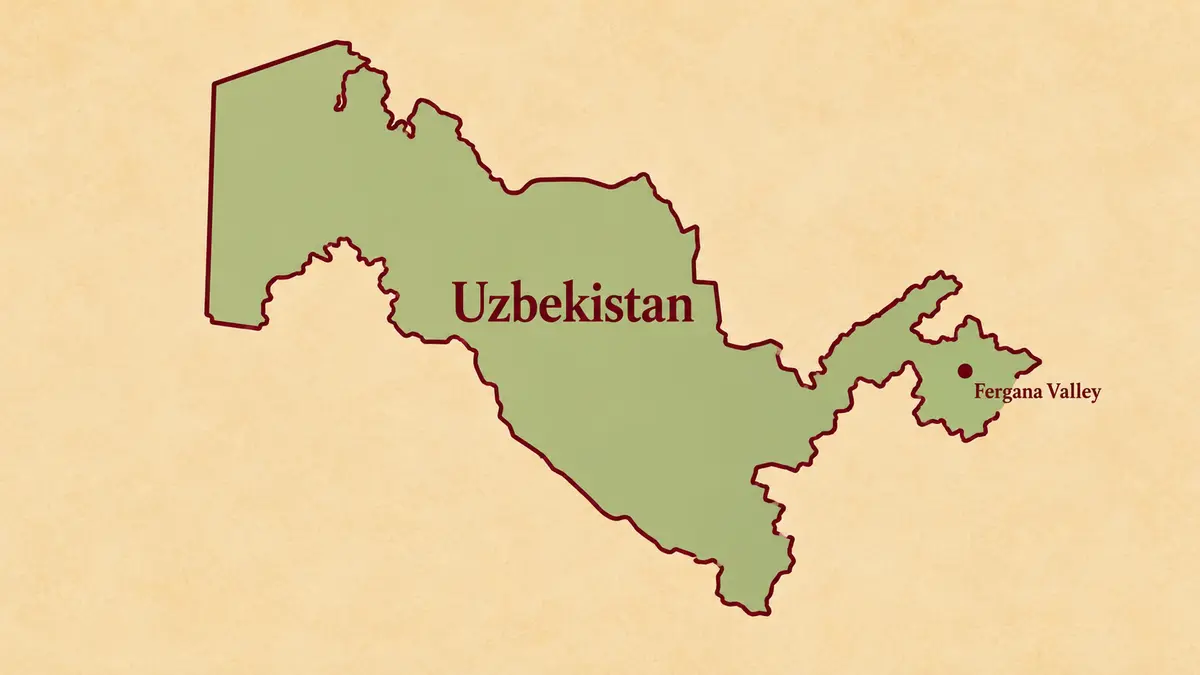
The Fergana Valley includes cities such as Kokand, Margilan, Fergana and Rishtan, each with a different place in a regional itinerary. Kokand's palaces and religious buildings provide architectural history; Margilan's textile workshops concentrate on fibre and weaving; Rishtan's ceramics concentrate on clay and firing. These subjects can be connected geographically without being combined into a single undifferentiated craft narrative.
Travel time between workshops also matters to what can actually be seen. An itinerary that names several towns in one day is not equivalent to spending that day with a maker. A short stop may allow a view of finished objects and one production stage. A longer arranged visit may include more detailed explanation or participation, depending on the workshop's programme and the maker's schedule.
Rishtan’s pottery workshops produce vessels through clay preparation, shaping, decoration and firing. The July 2025 tourist-mahalla designation added a named neighbourhood initiative to that established craft setting. A craft exhibition and domestic tourism fair accompanied the ceremony. ABA Travel’s Fergana Valley programme connects Rishtan with other regional places, including Margilan, where silk and cotton weaving introduces different materials and production methods.
Mamadali Topvoldiev mahalla gives the tourism initiative a local address within Rishtan district. Its craftspeople and visitor services form part of the neighbourhood setting, while the ceramic tradition includes the work of individual potters. A workshop visit can follow materials and tools through shaping, surface decoration and kiln firing. A finished bowl or vessel carries the result of those stages into use, display or sale.


















Your perspective
Share your thoughts on the story.