

A negotiation becomes an implementation problem
The useful question after a trade negotiation is what a manufacturer, importer or purchasing manager can actually do differently. Diplomatic announcements can reduce the perceived risk of further conflict, but a production schedule still needs quantities, product definitions, delivery dates and a dependable procedure. The understanding announced after talks between the European Union and China therefore deserves attention as an attempt to turn several overlapping commercial disputes into a manageable programme. Its value depends on the route from political agreement to operational certainty.
The Chinese commerce ministry's joint statement dates the second trade and investment consultation to 8–9 October 2026. Wang Wentao and EU trade commissioner Maroš Šefčovič led the talks. It schedules a ministerial video meeting in January and a third consultation in March 2027.
That timetable provides an opportunity for accountability. A later meeting can ask which procedures were implemented, which firms actually benefited and which disputes remain. It does not by itself ensure that any measure will work. Analysis should distinguish a mechanism for continuing discussion from evidence that the commercial relationship has already changed. This distinction is especially important when the announcement covers different instruments whose results will emerge through different channels.
Three instruments, three different tests
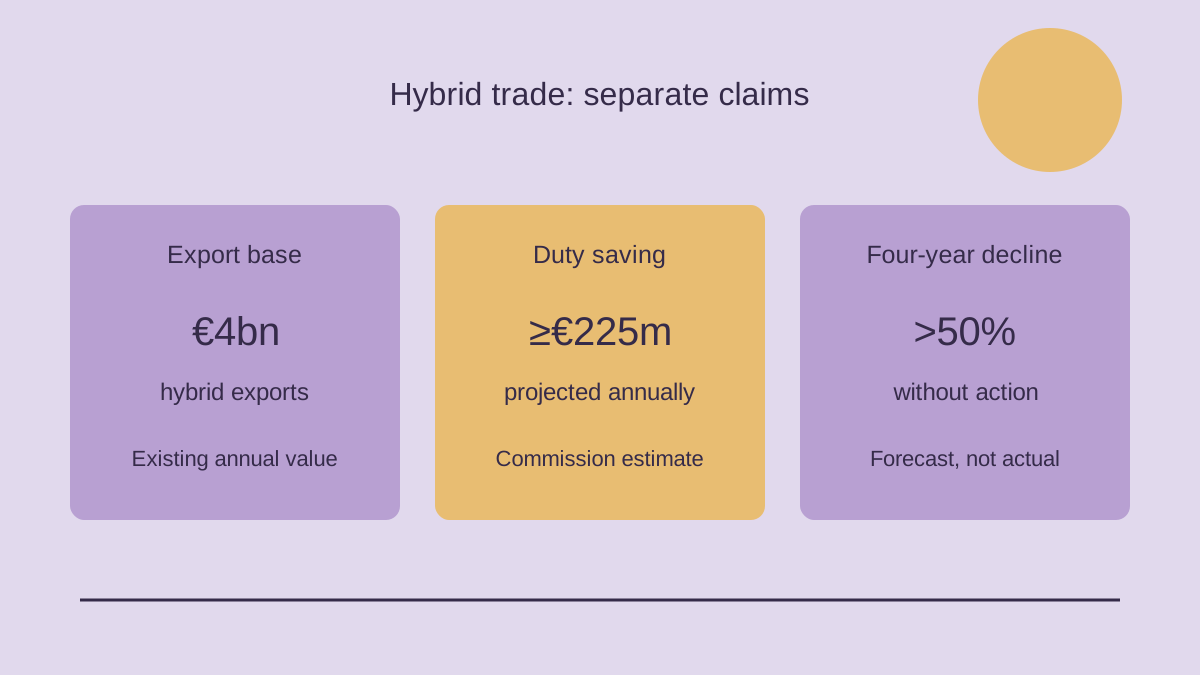
At his 9 October press conference, Šefčovič described understandings on hybrid and plug-in hybrid exports, lower Chinese tariffs for selected EU goods, and easier rare-earth and permanent-magnet export licensing. The tariff products represent almost €4 billion in existing exports; he projected at least €225 million in duty savings.
The measures address separate commercial problems. Moderating vehicle exports concerns the scale and composition of competitive pressure. Lower duties concern the cost of entering a market. Export licensing concerns whether an input can arrive predictably enough to support production. A favourable outcome in one category cannot automatically compensate for failure in another. A vehicle manufacturer could gain space in a domestic market while still facing unreliable supplies of a component. A food exporter could receive tariff relief without benefiting from any change in vehicle competition.
For that reason, an evaluation should use separate measures rather than a single headline score. Each instrument needs a defined baseline, a sequence of implementation steps and an observable commercial result. Combining them into a broad claim that the trade relationship has been repaired would obscure the very information businesses need to make decisions.
The baseline behind the hybrid percentage
In the question session, the commissioner explained the prospect of more than halving hybrid exports by reference to a four-year projection under an unchanged-policy scenario. He said procedural detail would follow consideration by European leaders. This is a projected reduction against a counterfactual, not a reported fall in current shipments.
A counterfactual asks what would otherwise happen. If an unchanged-policy forecast assumes rising exports, a substantial reduction against that forecast can still leave actual shipments above a previous year's level. Conversely, a reduction from a historical year describes a different economic outcome. Neither calculation is inherently wrong, but they answer different questions. A reader needs the denominator before treating a percentage as a measure of market relief.
The eventual implementation documents should therefore reveal the reference period and the treatment of forecast growth. Firms also need to know whether a commitment applies to the total market, particular exporters or specified categories. Without those details, a percentage cannot be translated into an order plan. An importer should not infer that half of its own available supply will disappear, and a competing producer should not assume that half of existing imports have been removed.
Product boundaries matter as much as totals
A hybrid category is commercially useful only when the vehicles covered by it are defined consistently. Powertrain descriptions used in marketing, customs classifications used at a border and the categories in an agreement need to align. Otherwise, businesses face uncertainty over which models count towards the intended outcome. That uncertainty can affect investment in distribution, after-sales service and inventory even before a shipment reaches a customs office.
Classification also changes the incentives created by a measure. If neighbouring product categories face different treatment, an exporter may have a reason to alter its product mix. That possibility is an analytical consideration, not evidence that any particular firm is attempting avoidance. A credible implementation framework should explain how changes in specification are assessed and how classifications can be challenged. The purpose is to make the rule understandable before commercial decisions depend on it.
For European manufacturers, the relevant question is not simply whether fewer imported vehicles enter a category. They need to examine which customer segments become more accessible, whether domestic products can meet demand and whether the distribution network can support additional sales. A negotiated change in imports creates an opportunity; converting it into viable production still requires competitive products and reliable operations.
Keep the battery-electric duty regime separate
The Commission's 29 October 2024 announcement concerned five-year countervailing duties on battery electric vehicles originating in China. It separately allowed discussions of WTO-compatible alternatives and individual price undertakings. That historical measure should not be confused with the new hybrid-export understanding.
The distinction prevents a misleading inference that a single negotiation has removed every vehicle-related trade instrument. A quantity-oriented understanding and a price undertaking have different commercial effects. One focuses on the scale of trade; the other addresses the terms under which an individual exporter may sell. The published instrument, applicable product definition and accepted procedure determine what a business must actually follow.
Procurement teams should therefore map the rules to the products they buy rather than rely on an announcement's broad language. A model described generally as an electric vehicle may not belong to the same legal category as a battery-only car. This article does not settle classifications or offer transaction-specific legal advice. It explains why an implementation assessment must preserve the distinction instead of treating the various instruments as interchangeable.
Duty savings are different from new exports
The existing export value and the projected saving perform different roles. The first indicates the commercial base covered by selected products. The second estimates a reduction in border costs. Neither number is a forecast of additional sales. Lower duties could improve margins, allow lower selling prices or support a mixture of both, depending on contracts and competition. The announcement alone does not specify who will ultimately capture the saving.
For an exporter, realised benefits depend on correct eligibility, documentation and pricing arrangements. If a customer contract fixes the delivered price, the allocation of a lower border charge may differ from an arrangement where the buyer pays that charge separately. Currency changes, transport costs and product demand can also affect the final result. Those influences explain why a duty estimate should not be treated as a guaranteed increase in profits.
Evidence of successful market opening would include use of the reduced tariff, fewer rejected applications and commercially viable repeat orders. A larger order book would be relevant, but it would still need analysis of whether growth came from the new measure or from unrelated demand. Monitoring should connect the administrative concession to the experience of affected firms.
Licensing relief operates through reliability
Facilitating export licensing for industrial inputs can matter even when a tariff does not change. A manufacturer may be able to afford an input and still struggle to schedule production if the time required to obtain permission is uncertain. A predictable procedure helps purchasing managers decide when to order, what buffer inventory to hold and how much delivery risk to include in a production plan.
The relevant measures therefore include application completeness, processing time, the frequency of requests for supplementary information and the reliability of approved shipments. A faster average processing time is helpful, but a small number of very long delays can still disrupt factories. Reporting should examine the spread of outcomes as well as an average. It should also clarify whether improvements apply consistently across eligible firms.
Licensing facilitation is not equivalent to unlimited availability or the removal of every restriction. Firms should assess the actual permitted products, customers and uses. A smoother process can lower uncertainty while leaving other conditions intact. Maintaining that distinction avoids encouraging purchasing decisions based on a freedom that the announcement has not promised.
The distribution of gains deserves attention
Trade measures distribute benefits and costs across participants. A producer facing strong import competition may welcome moderation of competing exports. An importer could face a more constrained supply choice. Consumers may value a wider range of affordable products, while employees in competing industries may value the prospects for domestic production. These interests can coexist even when they pull policy in different directions.
Evaluating the understanding therefore requires more than the reaction of a single industry. The policy question is how commercial relief, consumer choice and supply reliability interact. A temporary improvement in one firm's position is not the same as an increase in overall competitiveness. Firms need a reason to invest in capabilities that remain useful after the immediate negotiating pressure changes.
Policy design can support that transition by making procedures transparent and stable enough for planning. Sudden uncertainty encourages precautionary inventory or delayed investment. A clear implementation calendar allows a business to compare an expansion project with other uses of capital. The benefit of negotiated stability is partly the ability to make that comparison with fewer unknowns.
The trade balance is a separate outcome
A bilateral trade deficit summarises the difference between imports and exports; it does not identify a single cause or a single remedy. Individual product measures can improve conditions for affected companies without transforming the entire balance. Their commercial effect may be important within a sector even if it is small relative to the overall relationship. Scale should inform evaluation without making sector-specific progress invisible.
The connection between an instrument and the balance also depends on substitution. A buyer might replace one import with a domestically produced product, an import from elsewhere or a different category from the same supplier. A tariff reduction might support higher exports, but demand and production capacity still constrain the result. These are mechanisms to investigate, not outcomes established by the announcement.
An assessment should therefore report both direct implementation results and broader trade developments, with a clear explanation of what can reasonably be attributed to the measures. A change in the aggregate balance alone would be weak evidence of their effectiveness. It could reflect currency movements, economic conditions or unrelated product flows.
A practical monitoring agenda
The following questions would make later reviews more useful to businesses and to the public. They are an analytical checklist, not a list of already adopted provisions:
- What product definitions, reference forecasts and reporting periods govern the hybrid understanding?
- Which procedural decisions turn each political commitment into an applicable commercial measure?
- How much eligible trade actually uses the lower tariffs, and how are savings distributed?
- Do licensing improvements reduce both typical delays and unusually long processing times?
- What evidence separates the effect of these measures from unrelated changes in demand?
Answers should come from documents and operational data, with dates and responsible institutions identified. Businesses can then distinguish a completed step from an expectation. A public progress report should preserve unresolved questions rather than replace them with an overall declaration of success. This makes the next consultation a review of identifiable work instead of a repetition of the original announcement.
How companies can prepare without guessing
A sensible preparation programme begins with exposure mapping. A company can identify the products, suppliers, customers and contractual terms connected to the proposed changes. It can then separate decisions that depend on published implementation details from decisions justified by existing business needs. This preserves flexibility while avoiding premature assumptions about a rule whose full operation is not yet public.
Scenario planning can help, provided the scenarios are clearly labelled. A manufacturer might examine outcomes under unchanged trade conditions, partial implementation and full implementation. Each case should use explicit assumptions rather than quietly converting the political announcement into a forecast. Comparing cases reveals which business choices are robust and which depend heavily on an unresolved detail.
Companies can also prepare documentation and record existing lead times before a new procedure takes effect. That baseline will make later improvements easier to measure. The purpose is not to predict the negotiation's outcome with false confidence. It is to be ready to use a verified change while retaining evidence of whether it produces the expected commercial benefit.
Record decisions as well as indicators
A monitoring file should connect each indicator to the decision it can support. A shorter licensing time may justify a review of inventory, while a published product definition may justify revisiting a purchase contract. Recording that link helps distinguish useful evidence from impressive but irrelevant figures. The same file should identify the date of each assumption, the document supporting it and the point at which the business will reassess its plan. That creates a practical bridge between negotiations and commercial action.
What would constitute meaningful progress
The understanding is most useful when viewed as a set of commitments requiring different forms of proof. Vehicle moderation needs a transparent reference scenario and measurable application. Tariff relief needs actual use by eligible exporters. Licensing improvements need reliable results for businesses waiting for critical inputs. Continued consultations can connect these tests, but cannot substitute for them.
As of 9 October, the analytical case for cautious attention is stronger than the case for declaring the relationship repaired. The initiative creates a route towards practical changes while leaving implementation questions open. Its success should be assessed through the predictability it gives firms, the commercial results it enables and the clarity with which both sides report unfinished work. That is a more informative test than treating the announcement itself as the final economic outcome.
Evidence used: the joint consultation statement, the Commission's 9 October press conference, and its 2024 countervailing-duty announcement.




Your perspective
Share your thoughts on the story.