
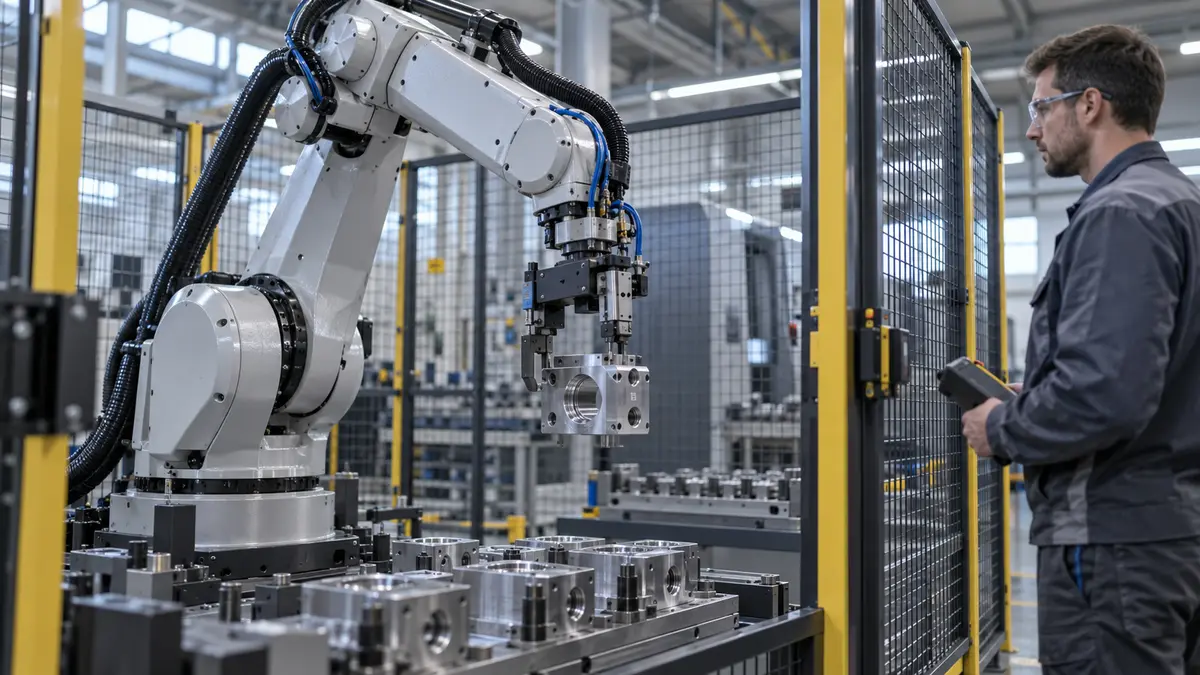
Five million industrial robots were operating in factories worldwide in 2025, according to the International Federation of Robotics. Manufacturing Dive reported the milestone on 28 September, drawing on the federation's latest industry figures. The scale is striking, but a count of installed machines leaves a different question open for each factory: how does a robot become part of a dependable production route? That question concerns the workpiece, the surrounding equipment, the people and the handling of exceptions, rather than the robot arm alone.
Automation decisions become clearer when the measure of success moves from a machine's demonstration to the operation it must support. A factory may need a consistent transfer between stations, a repeatable inspection or a way to reduce difficult manual handling. These are different tasks, with different requirements. The global milestone provides context for adoption; it cannot establish that any particular application is suitable, productive or ready to run. The analysis below examines the steps that turn a proposed application into a working system.
A stock is different from a year's installations
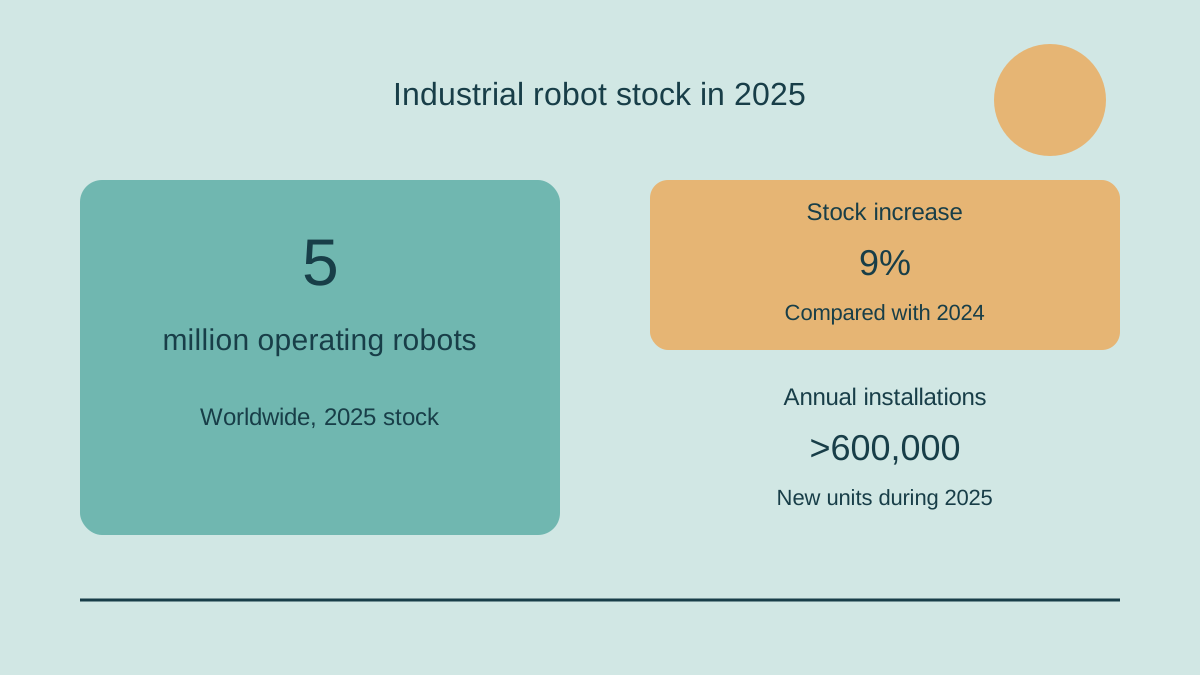
Manufacturing Dive's report separates the global operating stock from the machines installed during the year. The federation's World Robotics announcement places the 2025 stock at five million, up 9%. Annual installations increased by 11%, with more than 600,000 new units. The stock describes an operating population; the installation figure describes additions over a period. They are related without being interchangeable.
The federation also forecasts further installation growth. A forecast is neither an observed count nor a commitment by individual factories. Keeping those categories separate prevents a large operating-stock figure from being presented as a single year's purchases, or an expected future installation number from becoming a completed result. For a factory manager, none of the categories substitutes for an application review. They describe the market in which equipment decisions take place, while the decision itself requires evidence about a specific production task.
Start with the workpiece, rather than the arm
A robot application begins with the object being handled and the result required. The workpiece's shape, surface, weight and orientation influence how it can be presented and held. A task that appears straightforward when one sample is carefully positioned may become more demanding when incoming pieces vary. The application review should therefore describe the range of acceptable inputs, not simply the best sample available for a demonstration. That range helps define both the normal process and the conditions that require a different response.
The desired result also needs a clear description. Moving a part to a location is different from seating it in a fixture, joining it to another part or preparing it for inspection. Each outcome requires its own evidence. A successful pick does not prove a successful assembly, while a completed movement does not establish that the part was protected from damage. Starting with the workpiece and the outcome keeps equipment selection connected to an actual task rather than to a general wish to install more automation.
Presentation shapes repeatability
Before a robot acts, the workpiece must reach it in a condition the system can interpret. A tray, conveyor, fixture or other presentation arrangement helps determine position and orientation. If presentation varies beyond the system's tested range, the arm may need additional sensing or the upstream process may need improvement. A proposed cell should therefore include the method of feeding parts, rather than treating incoming material as a perfectly arranged input that someone else will always provide.
A review can follow the part from its previous operation to the point where the robot begins work. It can record how orientation is maintained, how an empty position is detected and how an unsuitable part is separated. These questions make an otherwise hidden dependency visible. They also help distinguish an application that is repeatable within a controlled range from one that is assumed to handle every variation. The latter claim needs much more evidence than a demonstration using a small, uniform set of parts.
The gripper is part of the process
The tool at the end of the arm translates movement into useful work. A gripping arrangement must hold the part securely while respecting its surface and shape. The force or contact suitable for one component may be unsuitable for another. A tool change can also introduce a new step into the cycle, with its own positioning, verification and maintenance needs. Treating the gripper as an incidental accessory can therefore conceal important limits of the proposed application.
The process description should state what confirms that a part is held correctly and what happens if that confirmation is missing. It should also describe release at the receiving station. A part that leaves the tool is not necessarily a part placed correctly. These distinctions create a more complete definition of a successful cycle. They do not imply that a named robot system has a defect. They show why the working capability of an application depends on the relationship between the arm, its tool and the specific production requirement.
Cycle time belongs to the whole route
A fast movement does not necessarily produce a fast manufacturing route. Feeding, checking, clamping, processing and release can each take time. Some steps may overlap, while others must occur in sequence. A robot's motion time should therefore be considered alongside the neighbouring operations, rather than used as a direct estimate of total output. The slowest necessary part of the route may lie outside the robotic movement that attracts the most attention in a demonstration.
A route diagram can record the start and completion conditions of each step. It can show when the robot waits for a station, when a station waits for a part and when finished work can leave. Such a diagram makes it possible to discuss a constraint without assigning every delay to the arm. An application may improve consistency or handling even if another process remains the output limit. The value of the installation should be assessed against the task it is meant to improve, with that limit stated plainly.
Buffers change where waiting appears
A buffer between operations can help one station continue while another experiences a brief interruption. It can also accumulate work that still needs processing, inspection or tracking. More buffered pieces are not the same as more completed customer orders. A proposed robotic route should therefore describe what a buffer is intended to absorb and how parts remain identifiable as they move through it. Otherwise, a local improvement can create a less visible queue elsewhere in the system.
The relevant questions include the conditions for releasing a part, the response when the buffer is full and the treatment of a part whose status is uncertain. Those conditions can be tested during a pilot. They are more informative than assuming that extra space will automatically resolve every mismatch in station timing. A buffer can support a defined operating arrangement, but it cannot replace a missing decision about the destination of work or the evidence needed to classify a piece as ready for its next operation.
Inspection needs a place in the sequence
A robotic operation may be highly repeatable while repeating a result that does not meet the product requirement. Inspection therefore remains a question about the outcome, not merely about whether the machine completed its instructions. The process review can identify which characteristic must be checked, when the check occurs and which record connects the result to the workpiece. Without that connection, a successful machine cycle can be mistaken for evidence that the product is acceptable.
The route also needs to describe the response to a failed or unavailable inspection. A part may need to wait, move to a separate area or return for a defined correction. The appropriate choice depends on the actual process. What matters for the review is that the response is deliberate and traceable. Inspection should not appear as an informal activity added after the rest of the application has been designed. Its requirements can influence fixtures, part presentation and the information that must travel with the work.
Exceptions define the application's real boundary
Normal operation is only one part of a production system. An absent part, an uncertain sensor result or a receiving station that is not ready can interrupt the route. The application needs a defined way to recognise those conditions and communicate the state of the work. A trial that never encounters an exception offers limited evidence about how a cell will behave during a longer production period. It may show a normal sequence without testing the decisions needed when that sequence cannot continue.
A useful pilot therefore includes a documented review of expected exceptions within the application's scope. The aim is to clarify responsibility and the evidence needed to resume work, not to claim that every possible event can be predicted. An exception record can show whether the part's status is known, whether the route stopped in a defined condition and who may authorise the next action. This helps evaluate operational readiness without equating the absence of a visible problem during a demonstration with proof of complete reliability.
Changeovers test flexibility
An application that handles one product can require additional work before it handles another. Changes may involve fixtures, tools, programs, input presentation or inspection. The phrase flexible automation becomes meaningful only when the intended range of changes is described. A system suitable for a defined family of components is not automatically suitable for every product a factory might want to make. Defining the family helps keep the claim within the evidence available from the application.
A changeover review can identify the items that remain the same, those that must be replaced and those that require renewed verification. It can also consider how the team confirms that the correct setup is active before production resumes. This makes the preparation part of the operating route, rather than an invisible interval outside the cycle-time claim. Flexibility can be valuable, but it still has a scope and a cost in attention, tooling and confirmation. Those limits belong beside the benefit in an application assessment.
People and maintenance support availability
A robotic cell still depends on people who can interpret its state, maintain the surrounding equipment and manage production priorities. Skills may be distributed across operators, maintenance staff, process specialists and inspection teams. A plan that names only the person responsible for programming overlooks those other roles. The application review should describe who supports each part of the route and how information about a problem reaches the person able to address it.
Maintenance also concerns the tool, fixtures, sensors and part-feeding arrangement. A well-maintained arm cannot compensate for every problem elsewhere in the cell. Records can distinguish recurring symptoms from isolated events and relate interruptions to the work being performed. These observations do not provide a predicted availability figure for a particular installation. They explain why availability needs a system view. The number of robots present at a factory is useful inventory information, but it is not a measure of how reliably the complete production route performs.
Evaluate the pilot against a defined question
A pilot is most informative when it answers a question specified before the demonstration. Can the proposed arrangement handle the defined input range? Can inspection remain connected to the part? Can the team recognise an exception and preserve the work's status? Each question suggests evidence that can be collected and a boundary for interpreting the result. A general intention to show that automation works is less useful because it leaves the meaning of success open to change afterwards.
- Define the workpiece, required outcome and tested input range.
- Include presentation, tooling, inspection and neighbouring stations in the route.
- Record waiting, changeovers and exceptions alongside successful cycles.
- Match any expansion decision to the capability actually demonstrated.
The five-million milestone describes the reach of industrial robotics. The work of deployment takes place at a more specific level: a part, a route and an organisation able to support it. A defensible application review connects those elements without converting a market statistic into a guarantee of local results. That is how a robot moves from being an installed machine to being a useful part of production, with its capabilities and limits visible to the people who depend on it.



Your perspective
Share your thoughts on the story.