
Writing in Kommersant on 8 October 2026, Marieta Manukyan described an OECD study of customs procedures across its 38 members. Fewer than 40 percent of reviewed measures clearly addressed particular border implementation issues, including documents, procedures and data exchange. The estimate of approximately 18 percent more global exports from a 10 percent improvement in procedures was a long-term calculation. It described potential gains rather than growth already achieved.
What border procedure indicators measure
The preceding OECD trade facilitation indicators report, published in March 2025, described changes between 2022 and 2024. Average improvements reached 4.4 percent in Asia-Pacific, 3.1 percent in Europe and Central Asia, 4.4 percent in the Americas, 4.7 percent in the Middle East and North Africa, and 6.5 percent in sub-Saharan Africa. These measured procedural development rather than each shipment's processing time. The organization separately estimated that more efficient border processes had reduced trade costs by up to 5 percent over a decade.
A different approach comes from the five United Nations regional commissions' global survey on digital and sustainable trade facilitation. Conducted every two years since 2015, its 2025 edition covered more than 180 economies and 62 measures, including new questions about electronic commerce and green trade facilitation. UNECE's regional analysis covered 48 member states. The survey compares implementation of legal, administrative and digital tools. Its observation concerns an implemented measure; the results do not automatically become statistics about individual consignments moving through a particular border crossing.
The international agreement provides a procedural foundation
The WTO Trade Facilitation Agreement entered into force on 22 February 2017. Article 7.4 provides for risk management, concentrating controls on high-risk consignments and expediting low-risk goods. Criteria include product descriptions, origin, value and traders' compliance records. Article 10.4 describes a single window through which documentation and data reach participating agencies at one entry point. Information already received should not be requested again except in urgent circumstances and other limited, published exceptions. These provisions connect information handling with the selection and organization of border controls.
The WTO's digital technology overview shows that the agreement's technological component begins with relatively ordinary tools. These include publishing information and forms online, paying duties and fees electronically, and submitting documents through a single window. Even email can support communication between agencies and enquiry points. More advanced technologies support origin verification, data analysis and customs audits. The WTO also recognizes their costs and organizational challenges: implementation requires assessment of border agencies' needs and a technology plan developed with business participation, linking equipment choices to the relevant procedures.
A publication by WTO Deputy Director-General Angela Ellard on 26 February 2025 examined single-window organizational challenges separately. A shared platform requires integrating several agencies and coordinating information flows. Differences in mandates, resources and regulatory frameworks complicate cooperation even where a digital system exists. Risk management needs data analysis and compliance verification capabilities. The publication associated technical assistance and capacity building with practical implementation of the agreement. An obligation itself does not provide equipment, trained personnel or coordinated working processes; those capabilities form part of the implementation work.
At the WTO committee meeting on 1–3 December 2025, members prepared the agreement's second review in 2026. Following ratification by the Democratic Republic of the Congo, ratifications had reached 161. The year 2025 contained deadlines for 159 Category C measures, provisions for which developing and least-developed members identified technical assistance and a transition period. The committee reviewed fourteen extension notifications covering 37 measures. Single windows, agency cooperation and risk management were among the challenging areas, so discussion of deadlines also concerned the capacity to implement those commitments.
A common format starts with data definitions
The World Customs Organization Data Model supplies harmonized definitions and electronic messages for customs and other border regulatory agencies. Its elements are designed for reuse across systems. The model maps to the United Nations Trade Data Elements Directory and uses international standards. Version 4 supports modern message formats, including JSON, and application interfaces. A free web application lets users examine and compare elements and consult information packages. Here, standardization concerns the content and structure of a message that its sender and recipient need to interpret consistently.
The Data Model's technical guidance on information packages explains how subsets of information are organized around border procedural objectives. A package selects data needed for a particular application within the wider model. Its structure uses classes, attributes and relationships in the UML modelling language. Alongside customs requirements, the model includes other government agencies' needs within a single window. The common format therefore covers relationships between message components and agency tasks. It describes how particular pieces of information relate, extending beyond assigning the same name to an individual field.
UNECE's updated Recommendation 33, published in September 2020, describes a single window as a way to bring participating government administrations together around one submission of trade information. The initial problem involves importers, exporters and transit operators sending extensive documentation to agencies with separate systems and forms. Through a shared submission point, authorities can access required information and coordinate its processing. The recommendation connects this approach with more effective resource use and official controls while retaining the participation of different agencies in carrying out their respective functions.
UNECE Recommendation 34 concerns simplification and standardization of international trade data. Its publication page is dated January 2014. It answers requests from single-window developers seeking to harmonize government information requirements. The document proposes a four-stage process for creating a minimum, simplified and standardized national dataset. Work on that dataset belongs within the wider implementation programme. UNECE recommends developing strategy, policy, technology, data harmonization and legal foundations in parallel. The information model is considered alongside the conditions under which government and business will apply it.
UNECE Recommendation 35 addresses the legal foundation for an international trade single window. Its description, published in January 2014, places it within the common implementation toolkit. The document provides a checklist of typical legal issues encountered when introducing such a system. UNECE does not prescribe a mandatory sequence for applying the recommendations: legal foundations, strategy, technical solutions and information harmonization should develop in parallel. The legal document is therefore a distinct component in designing the shared service. A platform's technical launch does not replace work on its operating conditions.
UNECE Recommendation 36, published in December 2017, extends interoperability beyond a national system. It addresses interaction between two or more electronic single windows in different countries or economies. A national window simplifies submission within one administrative environment; cross-border interaction requires harmonizing data and processes between participating parties. The document builds on earlier recommendations concerning window establishment, information harmonization and legal foundations. Its purpose is to identify conditions for exchanges between systems, preserving the distinction between a national service's internal organization and its connections with participants abroad.
European systems connect customs with sector controls
A legal foundation for the European Union customs single-window environment entered EU law in December 2022. Its central certificate exchange mechanism, EU CSW-CERTEX, had operated as a pilot since 2017. It links national customs systems with Union systems responsible for non-customs formalities, including sanitary requirements, organic products, environmental authorizations and cultural goods. Customs can receive original digital certificates and verify them automatically. Exchanges on released quantities also let competent sector authorities monitor how authorized import or export volumes are used, connecting certificates with goods clearance.
The CATCH system for fishery imports provides a practical example of sector documentation. Since 10 January 2026, EU importers must use it to send required documents to member states' competent authorities. If a catch certificate arrives on paper and is not yet in the system, the importer or representative transfers its information into digital form. Instructions require accurate copying of product codes, fish species, vessels and trips. Processing documents retain links to the relevant catch certificates. Product entries use six-digit Harmonized System codes, connecting sector information with the common product classification.
Europe's advance cargo information system, ICS2, serves a different purpose. A European Commission notice dated 29 August 2025 described completion of its third-release transition and coverage of all transport modes, including road and rail, from 1 September. Entry Summary Declaration data arrive before goods and support risk assessment. The notice also identified requests from certain states and the United Kingdom concerning Northern Ireland for temporary transitional exceptions. This was a historical implementation account: general system availability and individual participants' adaptation periods were addressed separately alongside changes in transit information systems.
Emissions information follows a separate verification process
The European Carbon Border Adjustment Mechanism, CBAM, has applied under its definitive regime since 1 January 2026. It connects selected imports with emissions generated during production and complements Europe's emissions trading system. Covered sectors include cement, iron and steel, aluminium, fertilizers, electricity and hydrogen. The official page describes authorized declarants, national competent authorities and the registry. Production information in this model supports the carbon component of imports. It belongs to a specific mechanism for particular sectors, rather than an identical examination of every product crossing a border.
In a separate announcement on 24 August 2026, the European Commission presented guidance for CBAM verifiers and accreditation bodies. A verifier first obtains accreditation, then applies for registry access; the national competent authority checks its eligibility. Access became possible from 1 September 2026, with registration required within two months of accreditation. From January 2027, verifiers are to issue reports through the registry, enabling importers to use verified actual emissions in declarations. That final date concerns the programme's next stage, rather than reports already issued when the October article appeared.
Plant certificates demonstrate international information exchange
The OECD's February 2025 report on sanitary and phytosanitary electronic certificates distinguishes sector certification from trade documents. An exporting country's competent authority issues a certificate confirming a consignment's compliance with the importer's requirements. For plants, the International Plant Protection Convention provides an international foundation; other categories have their corresponding organizations. The report examines challenges in designing, implementing and using electronic exchanges, including free-text requirements, differing formats and countries' digital capabilities. Standardized transmission needs to preserve the information's sector-specific meaning and the receiving authority's ability to verify it.
The ePhyto Hub supports voluntary, multilateral exchange of electronic phytosanitary certificates between national plant protection organizations. Its rules establish a shared message structure, codes and terms. A country connects its national system or uses the generic system. Participation requires the ability to create, store, send and receive electronic certificates, validate message structures and display their contents. Connections are authenticated and transmission uses secure transport. The international hub therefore links national services through an agreed protocol while certificate creation and handling remain within the corresponding national information systems.
The programme's September 2026 update reported approximately 250,000 unique electronic certificates exchanged monthly during the preceding quarter. Somalia's generic-system production environment was ready to issue and receive certificates, while Ethiopia began live exchanges in July. Regional workshop feedback covered 56 represented countries and territories. Participants most frequently identified budget constraints, followed by national-system integration, cooperation with customs, connectivity and legal issues. The update distinguished technical readiness from live exchange: countries occupied different stages of connection and organizational preparation, even while using the same international solution.
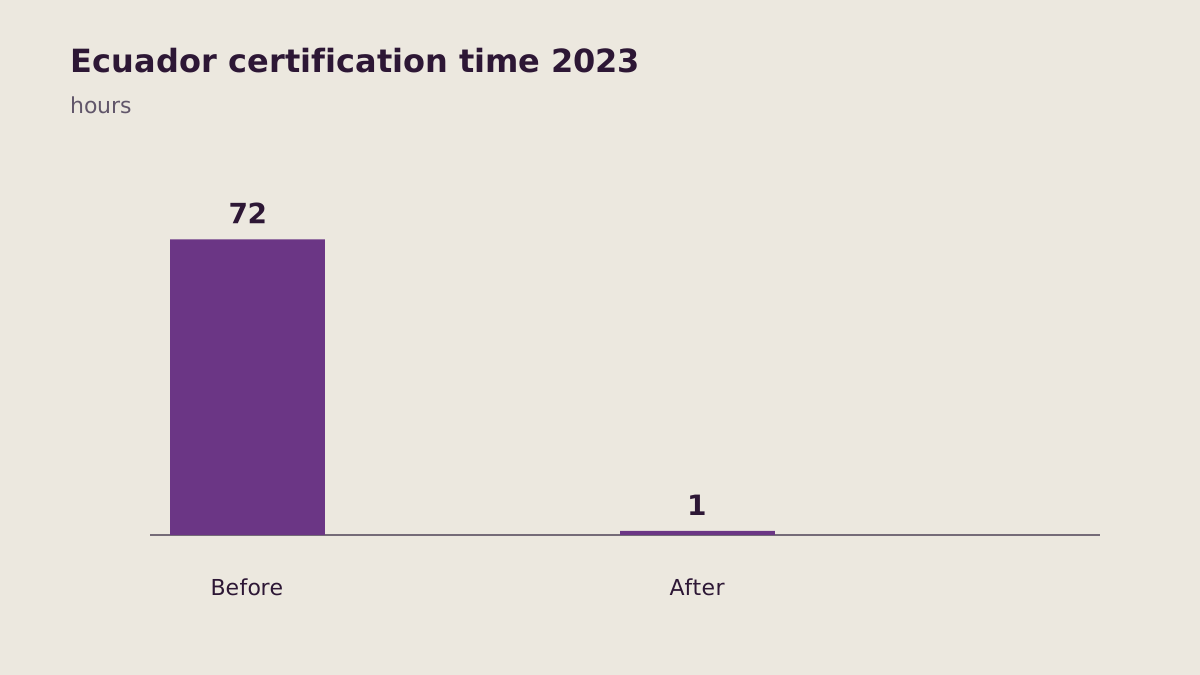
In a publication dated 28 September 2026, Ecuadorian official Larry Mauricio Rivera described his country's transition since 2023. He reported certificate generation taking about one hour instead of 72, with approximately 110,000 electronic export certificates issued through the international hub during the preceding twelve months. He estimated annual savings for banana and cut-flower exporters at a minimum of $5 million. Those results concern the national process he described.
Port systems cover vessel and cargo movements
The International Maritime Organization associates maritime single windows with information submitted about a vessel's arrival, stay and departure. Since 1 January 2024, their use for electronic exchange has been required under amendments to the Convention on Facilitation of International Maritime Traffic. The shared submission point brings together information needed by public authorities when a vessel calls. The organization's dataset and reference model support harmonized maritime messages. This describes an international requirement and exchange instrument; it does not itself confirm an identical degree of platform implementation in every port worldwide.
The World Customs Organization's guidance on customs and port authority cooperation considers practices across advanced, developing and emerging economies, with particular attention to small island developing states. It describes using existing international tools in regulating port and customs digital systems, and aligning port and customs legislation with data harmonization requirements. Its description emphasizes understanding business processes and existing systems when pursuing interoperability. Information exchange in that cooperation relates to specific port and customs functions: architecture is considered together with the organization of operations and the participating authorities' responsibilities.
Time measurement connects reform with operations
The World Customs Organization released Version 4 of its Time Release Study Guide in 2025. The method measures the interval between goods' arrival and physical release and is treated as a whole-of-border instrument. The update covers planning, process maps, sampling, questionnaires and tests of technical, procedural and logistical readiness. Analysis separates data by groups and time intervals, addresses unusual observations, and supports presenting results with follow-up monitoring. Participation by other border agencies lets the study examine the sequence of operations through which goods pass while retaining a shared measured outcome.
The World Customs Organization's SAFE Framework, updated in 2025, combines three areas: customs-to-customs arrangements, customs-business partnerships and cooperation with other government agencies. New provisions expand collaboration with environmental authorities and inclusion of micro, small and medium-sized enterprises in authorized economic operator programmes. They also address ethical codes and insider threats to supply-chain security. The framework supplies international standards and cooperation approaches. Its description shows how trust in traders and inter-agency work form part of the wider organization of controls and facilitation for legitimate international commerce.
Supply-chain traceability complements border information
GS1's EPCIS 2.0 standard, introduced in June 2022, supports exchanging supply-chain events. Messages describe an object, time, location, business context and means of observation. An accompanying vocabulary establishes common values. The format supports sensor readings, certification details and relationships between products and packaging, including items grouped into cases and pallets. JSON and application interfaces enable events to be sent and queried between applications. These records concern objects' movement and condition within the chain and can retain the context of manufacturing and logistics operations.
The same organization's Global Traceability Standard, ratified in August 2017, provides a foundation independent of sector and technology. It covers identification, data capture and sharing. The standard provides for unique identifiers for products, locations and participants, labelling at packaging levels, and defined responsibilities along the value chain. Partner records connect a product with its supplier, recipient and relevant locations. This approach covers information between businesses alongside government declarations. Sector-specific and technological solutions can vary while retaining a common foundation for identifying objects and communicating their associated information.
In the United States, a separate example of publishing control results comes from the 28 January 2026 update to the Uyghur Forced Labor Prevention Act enforcement dashboard. Customs and Border Protection began counting shipments as individual import transactions. Filters cover fiscal year, industry, origin country and four-digit commodity headings. The dashboard separates released, denied and pending transactions. Information is aggregated for protection, and other forced-labor enforcement programmes are excluded. The published statistics therefore have a defined accounting unit and limited scope that remain relevant when the data are used.
Three levels of information exchange
- A national single window combines document submission to participating government agencies.
- International interoperability links different countries' systems through harmonized data and processes.
- Business traceability retains object identifiers and movement records along the supply chain.





Your perspective
Share your thoughts on the story.