

Combining several small wool deliveries into a larger offer looks, at first, like a problem of addition. Put the quantities together, give the offer a name and invite a buyer. Yet the larger lot immediately creates questions that none of its individual deliveries had to answer alone. Which components does the offer include? Can one contributor replace its material after the description has circulated? If part of the offer disappears, is the remainder still the same proposition?
On 16 May 2025, Interfax reported that Ksenia Bobyleva of the Industry and Trade Ministry had described plans for wool auctions and eventual exchange trading in Russia. She also discussed a directory of processors and an expected directory of producers. These were plans and official statements, not evidence of completed trading.
The proposed direction raises a useful commercial question independent of any particular exchange design: how can smaller suppliers participate in a larger, coherent offer? The discussion below considers one hypothetical pooled lot. It does not describe existing exchange rules, recommend a legal structure, prescribe fibre grading or claim that named producers use this arrangement. Its focus is the relationship between the larger offer and the smaller deliveries that give that offer its substance.
A joint offer and a mixed batch are not the same thing
Start with a distinction that the word pooling can conceal. Several deliveries can be marketed together while remaining physically separate. Alternatively, their material could be combined into a physical batch. Those arrangements create different possibilities for identifying, changing and withdrawing a component. A single listing does not tell the reader which arrangement exists.
For this analysis, imagine that the deliveries remain separately identifiable while a coordinator presents them as one offer. That assumption matters. It allows the example to follow each contributor's material without pretending that an already mixed batch can simply be separated back into its original deliveries. Nothing here is an instruction to blend wool or a claim about the technical suitability of doing so.
A buyer facing the joint offer therefore needs a description of both levels. At the offer level, the buyer sees what is being sold together. At the component level, the buyer can understand what supplies that promise. Giving the bundle one identifier can simplify communication, but it does not make the underlying differences vanish.
The commercial advantage, if one exists, must come from a better coordinated proposition, not from hiding its construction. A larger number attached to an offer is not automatically a more useful supply opportunity. The buyer may care about the coherence of what will arrive, the timing of its availability and the ability to resolve a change without reconstructing the entire conversation.
Define the boundary before asking for a decision
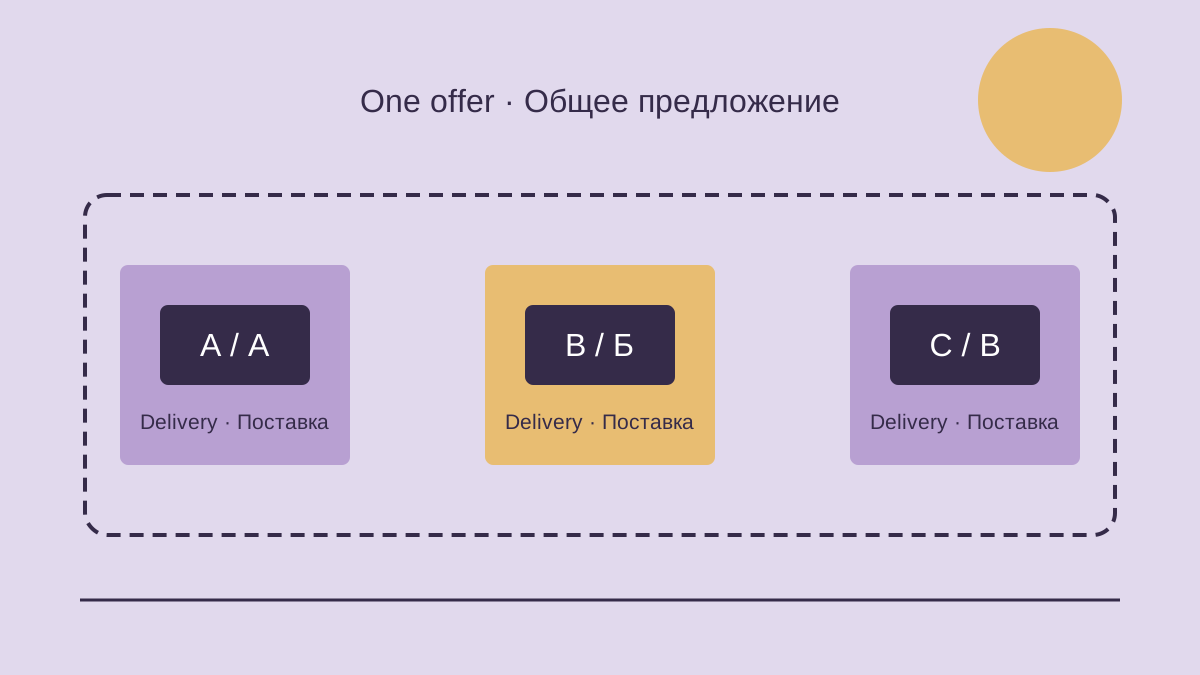
Imagine three suppliers, A, B and C, each contributing a separately identified delivery. The coordinator describes all three together as Lot L. No actual quantities, quality grades or prices are assigned in this example. The question is simply whether everyone uses Lot L to mean the same set of components at the same time.
At the outset, it could be tempting to treat the lot as whatever material those suppliers eventually bring. That leaves its boundary open. The buyer would then be evaluating a moving collection rather than a described offer. The coordinator might believe it has communicated a complete proposition while the suppliers believe they have communicated only a provisional intention.
A more explicit description distinguishes material already included from material merely expected. This does not require pretending that every uncertainty has been eliminated. It requires making the uncertainty visible at the correct level. An expected delivery is not silently counted as an available component, and a possible replacement is not treated as though it were part of the description already reviewed.
The same discipline applies to the offer's timing. A joint offer may refer to components becoming available together, or to several deliveries arriving over an agreed interval. These are different propositions. Their suitability depends on the buyer's needs; neither is inherently superior. What matters for the example is that changing from one to the other changes the offer rather than merely its administrative label.
Keep the component record connected to the offer
A supplier directory answers a different question from a lot record. A directory can help participants identify someone to contact. It does not, merely by listing a business, establish that a particular delivery exists, belongs within the offer or matches its description. Treating contact information as a certification of the material would ask the directory to prove something it does not demonstrate.
In the hypothetical arrangement, a component record connects a delivery identifier to the version of the joint offer that includes it. The useful relationship is not simply supplier A equals part of Lot L. A supplier might have several deliveries, while only one is included. The connection must be specific enough to distinguish the material promised here from material discussed elsewhere.
That record also needs to distinguish the source of a statement from its status. A contributor's description, a later clarification and a buyer's agreement are not interchangeable entries. Recording all three under a single word such as confirmed would obscure who confirmed what. The aim is to retain the sequence of decisions without implying that a record alone proves the physical characteristics of wool.
This is a coordination principle, not a prescribed testing method. Whether a particular description is adequately supported requires its own evidence and the relevant parties' agreement. A tidy spreadsheet cannot turn an unsupported assertion into a demonstrated property. It can, however, prevent that assertion from losing its author, date or connection to the delivery being discussed.
One changed delivery tests the whole arrangement
Return to suppliers A, B and C. The buyer has reviewed a description of Lot L containing their three deliveries. Before a sale is completed, B says its originally described delivery is no longer available and proposes a different one. Even if the replacement has the same stated weight, the original component set has changed.
The coordinator now faces a choice about communication. It could keep the original lot name and silently update an internal record, or it could explain that the proposition has changed and present the revised description. Only the second approach allows the buyer to distinguish its earlier assessment from a decision about the new combination. The identifier can remain useful, but its continuity should not conceal a substantive revision.
Replacement is not merely correction
A correction to a spelling error and substitution of a delivery are different kinds of change. The former may leave the material proposition intact. The latter changes what the buyer is being asked to consider. Treating both as routine administrative edits would flatten a distinction that matters commercially, even though this article makes no claim about the legal consequences of either action.
A practical change record would describe what changed, which component was affected and which offer version the buyer is now evaluating. It need not reproduce every earlier email. Its purpose is to preserve a reliable link between the decision and the material set. A new conversation can then start from the changed point instead of forcing everyone to guess which description remains current.
The buyer might accept the replacement, request more information or decline the revised offer. The example does not assume an outcome. Nor does it assume that the other contributors should automatically absorb the consequences. A pooling arrangement becomes more intelligible when these separate decisions remain visible rather than being collapsed into the statement that the lot is still available.
A smaller remainder is not necessarily the original offer
Consider a different branch of the same example. B withdraws, and there is no replacement. A and C still have their described deliveries available. It is arithmetically possible to remove B's contribution from a total, but that subtraction does not settle the commercial question. The remaining offer could differ from the combination the buyer originally wanted.
Perhaps the buyer was considering the combined availability of all three deliveries. Perhaps the removal changes the timing or the organisation of collection. These are hypothetical possibilities, not claims about normal industry practice. Their point is that a reduction in quantity can also change the structure of the proposition, so an unchanged lot name cannot substitute for a fresh description of what remains.
The coordinator should also distinguish a withdrawal from a partial sale. In one case, a component is no longer being offered through the arrangement. In the other, a component has been allocated to a completed or agreed transaction. Combining the two under a single reduction figure would make it harder to understand what happened and what remains available.
For the same reason, the count of registered suppliers is not the count of contributors to the current offer. Three businesses may remain in a directory even when only two contribute to a specific lot. Maintaining those separate counts prevents a directory, an offer and a transaction from appearing to describe the same population when they do not.
Allocation needs a separate conversation
A joint offer also requires its participants to understand how an eventual transaction relates to their contributions. This article does not prescribe contractual terms or a method of distributing proceeds. It does identify a logical problem: the coordinator cannot assume that a single buyer-facing total automatically explains each contributor's position.
If the buyer takes the full described lot, the arrangement still needs records connecting that result to the components. If the buyer proposes taking only part of the offer, the participants must distinguish that proposal from acceptance of the original whole. The existence of a divisible physical quantity does not by itself show that the commercial offer was intended to be divisible in the same way.
Suppose the coordinator presents the remaining A and C deliveries after B's withdrawal. A wants to proceed, while C prefers to wait. That difference cannot be resolved merely by repeating the total size of the remaining lot. It is a difference in the participants' decisions. A clear account keeps the available material, the authority to include it and the proposed transaction separate.
There may be several workable ways to organise those relationships. The example does not select one as universally correct. It shows why the arrangement needs an explicit understanding rather than a convenient assumption that all contributors have made the same decision at every stage. Pooling coordinates individual positions; it does not erase them.
A short record can preserve the important distinctions
The objective is not to burden a small supplier with a miniature version of a large institution's reporting system. More fields do not automatically mean better coordination. A concise record is useful when it preserves distinctions that would otherwise become ambiguous. In the hypothetical lot, a limited set of questions would do most of the explanatory work:
- Which separately identified deliveries belong to the current version of the offer?
- Which contributions are available and which remain conditional or expected?
- Does the description refer to separate deliveries marketed together, or to a physically combined batch?
- What changed after the buyer last reviewed the offer, and who supplied that information?
- Has a component been withdrawn, replaced, allocated to a transaction or left uncommitted?
- Which version of the material set corresponds to the decision currently being discussed?
These questions are not an exchange compliance checklist. They are a way to make the example's own commercial logic inspectable. Any actual arrangement would need its own appropriate documents, expertise and agreed procedures. The narrower lesson is that a record should explain the relationship between the parts and the whole instead of merely preserving a grand total.
It should also avoid turning uncertainty into a false binary. A delivery can be identified but not yet available. An offer can be described but not yet accepted. A buyer can request information without committing to take the material. Retaining these distinctions is more informative than marking every participant and component either active or inactive.
Aggregation is a coordination service, not a price guarantee
A pooled offer may make smaller contributions easier for a buyer to consider together. Whether it actually does so depends on the proposition and the participants. A larger lot does not automatically produce a higher price, reduce every cost or attract a buyer. Those outcomes require evidence beyond the fact that quantities have been assembled under one name.
The coordinator's useful contribution is therefore not just addition. It is maintaining a coherent description while individual deliveries, availability and decisions evolve. That work is especially visible when something changes: a replacement, a withdrawal or a request to take only part of the offer. The arrangement succeeds conceptually when those changes can be explained without losing track of the underlying material.
For wool trading, the distinction offers a clear way to evaluate a proposed pooled lot without forecasting its market success. Ask whether the larger offer retains a reliable connection to its smaller deliveries. If it does, participants can discuss the same proposition and recognise when it changes. If it does not, the apparent simplicity of one lot may merely move unresolved questions out of sight.
Your perspective
Share your thoughts on the story.