
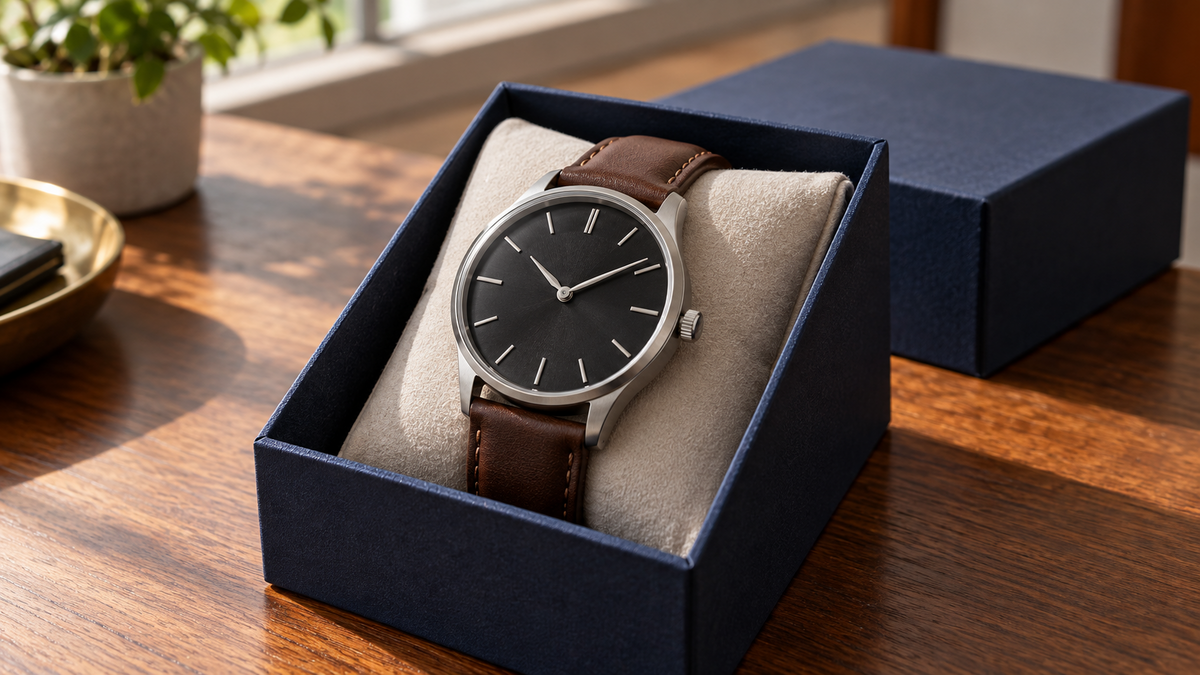
A person buying a watch for someone else is making two decisions at once. The product must suit the person who will wear it, but the purchase must also feel like the right way to mark an occasion. Those decisions overlap without being identical. A retailer that treats the conversation as a straightforward search for a price and a model can miss the uncertainty that makes gift buying distinctive.
In Mint’s report of 25 September 2025, Titan watch-division chief executive Kuruvilla Markose linked analog-watch momentum in India with gifting and a premium focus. His account supplies a historical starting point, not proof of every shopper’s motives. The following analysis considers the retail decisions around gift buying; it does not describe undisclosed Titan procedures or recommend particular watches.
The buyer is not necessarily the wearer
When someone shops for themselves, they can directly judge whether a watch suits their taste. A gift buyer often works from incomplete knowledge: a remembered preference, a familiar style of clothing or an impression of what the recipient already owns. The sales conversation therefore concerns not only the product but also the confidence with which one person can choose for another.
The retailer cannot remove that uncertainty by simply presenting a more expensive option. Price may help the buyer define a comfortable spending range, but it does not reveal the recipient’s preferences. A costly watch can still be the wrong expression of the occasion. Equally, a restrained choice can be appropriate without representing a failure to sell a premium product.
A useful opening separates what the buyer knows from what they are guessing. The salesperson might establish the occasion, the intended recipient’s known preferences and the date by which the gift is needed. This is a commercial framework, not a script attributed to any company. Its purpose is to keep an assumption about the wearer from becoming an unsupported promise at the counter.
Comparison can matter more than the number of models
A large display offers variety, but variety alone does not make the choice easier. If the buyer cannot understand the differences between adjacent models, each additional option can restart the same conversation. The retailer’s task is not merely to show what is in stock. It is to help the customer compare a manageable set of choices on grounds that are actually relevant to the gift.
Visible design differences can provide one starting point: a restrained or more conspicuous appearance, a particular dial colour, or a strap style the recipient is known to prefer. These observations should remain separate from technical claims. Appearance cannot establish durability, suitability for an activity or future service requirements. Such claims need the actual product information, not inference from how an item looks.
The benefit of comparison is that it exposes the buyer’s priorities. A customer may initially ask for something impressive, then favour a quieter design when shown contrasting options. That is not necessarily a retreat from the purchase. It may be progress towards a choice the buyer can explain. The salesperson learns more from that comparison than from repeatedly moving up a price ladder.
Assortment needs distinct roles
For the retailer, a gift-oriented assortment is not simply an expanded collection of expensive watches. Each item occupies display space, ties up stock and requires staff familiarity. The question is whether it adds a meaningful choice or merely another close variation whose commercial role is difficult to identify.
Two models can have a similar price but serve different preferences. Conversely, models at different prices may appear interchangeable to a buyer unless the distinction is explained. The store therefore needs an account of why the assortment is organised as it is. That account can connect price ranges with visibly different choices without pretending that every customer follows the same sequence.
Removing a poorly understood option is not automatically the right answer, however. It might serve a small but identifiable group that the headline sales total conceals. A useful review combines what sells with what customers compare, ask about and decline. The aim is to distinguish a genuinely useful alternative from stock whose presence creates complexity without answering a recognisable customer need.
An occasion creates a deadline
A gift often has a date attached to it. A product that is suitable in principle may not solve the buyer’s problem if it cannot be handed over in time. This gives availability a different meaning from a broad statement that the retailer carries a model. The relevant question is whether the particular item can be made ready under the terms actually offered.
The conversation should distinguish an item available now from one that might be obtained later. The buyer also needs clarity about any optional presentation or other service that forms part of the transaction. No universal promise follows from the category of watch or the store’s positioning. The retailer has to work within its actual stock, processes and agreed arrangements.
This distinction matters when interpreting a lost sale. A buyer who leaves because the item cannot be ready for the occasion has not necessarily rejected its design or price. If every unsuccessful conversation is labelled price resistance, the store may discount stock while leaving the real obstacle untouched. Recording the known reason is more useful than supplying a convenient explanation afterwards.
Own-brand and multibrand displays answer different questions
A retailer selling its own range can organise the conversation around differences within that range. A multibrand setting introduces another comparison: why consider one label rather than another? Neither format guarantees a better experience. They require different explanations, and the customer may arrive with a preference that determines which comparison is relevant.
In an own-brand setting, a coherent presentation can make a range easier to understand. In a multibrand setting, the retailer may help someone explore alternatives they had not previously considered. These are possible advantages, not findings about a named network. Both depend on whether staff can explain what is offered without making unsupported claims about competing products.
The practical issue is the role of the store in the buyer’s decision. Some customers seek a particular watch and mainly need a reliable transaction. Others need help choosing the type of gift. Treating both groups identically can waste attention: extensive exploration may frustrate the first, while a rapid move to checkout may leave the second unsure of their choice.
A higher receipt does not settle the demand question
If a store sells a greater share of higher-priced watches, its average selling price can rise without an increase in the number of watches sold. That distinction is elementary but important when a business describes a premium shift. The sales mix, the price of comparable items and the total number of purchases are separate parts of the result.
Gift purchases add another possible difference: the occasion may change the spending range even for the same customer. A person might spend differently on a major celebration than on another purchase. A retailer cannot infer a permanent change in that customer’s willingness to spend from a single transaction. The context of the purchase matters alongside the amount recorded.
Nor does a larger receipt automatically mean a stronger contribution to the business. The item, any included services and the time needed to complete the sale all have commercial consequences. A review that sees only the final amount may overlook those differences. The aim is not to discourage premium sales, but to understand what the apparent improvement actually contains.
Three participants, two kinds of confidence
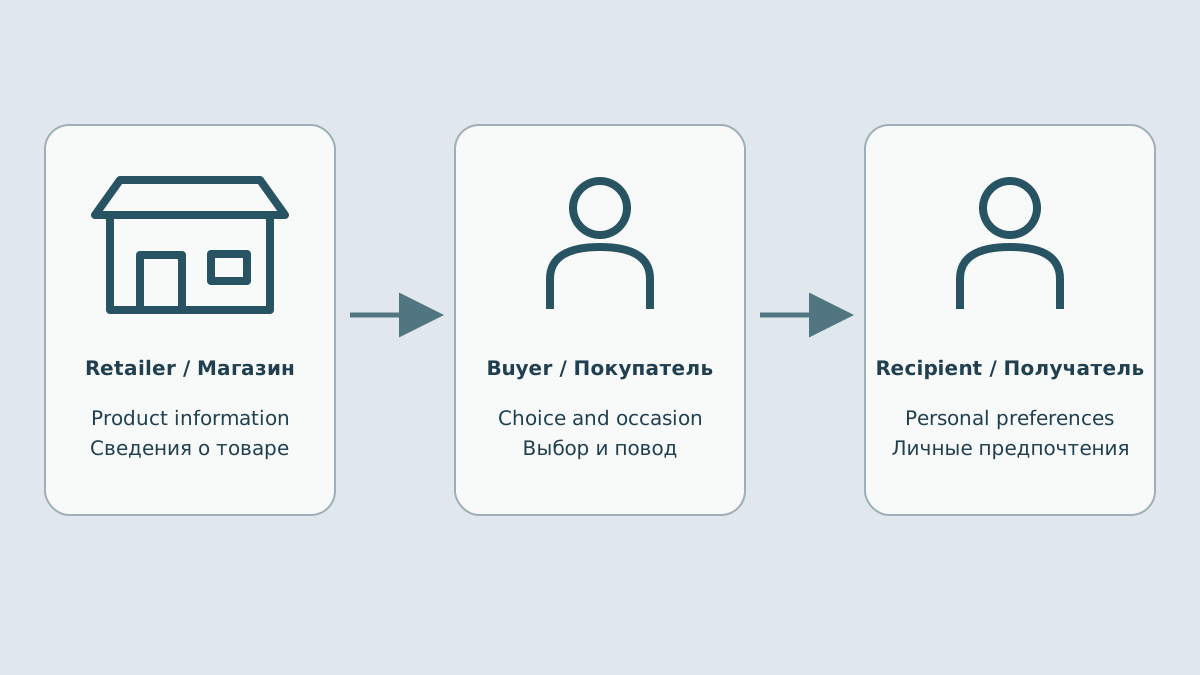
A simple way to visualise the transaction is to separate the retailer, the buyer and the intended wearer. The retailer can provide product information and clarify the purchase arrangement. The buyer supplies knowledge of the occasion and of the recipient. The recipient’s preferences remain partly outside the conversation when they are not present.
This is a qualitative decision model, not a map of a company’s customer data or a measured pattern of behaviour. It distinguishes confidence in the transaction from confidence in the choice. The first concerns what the retailer has agreed to supply. The second concerns whether the recipient will appreciate it. Good service can help with both, but cannot guarantee the second merely by making the first reliable.
The handover is part of the purchase
For a gift buyer, the transaction does not end conceptually at the payment terminal. The item will be presented to another person. Packaging, accompanying information and the practical arrangement for handing it over can therefore be relevant to the purchase. Their significance depends on the occasion and on the services the retailer actually offers.
The business should avoid treating attractive presentation as a substitute for clarity. A buyer needs to know what is included and what remains optional. Any applicable arrangements for later assistance should be explained accurately rather than improvised to reassure an uncertain customer. This is not a statement of legal entitlements or a claim about any particular retailer’s policies.
A clear handover can also reduce ambiguity for the recipient. The buyer should not have to reconstruct the salesperson’s explanation from memory if information accompanies the item. At the same time, the retailer should not invent a promise that the gift will suit every preference. Presentation makes the purchase coherent; it does not remove the distinction between the buyer’s intention and the wearer’s eventual response.
Staff attention is a resource, not an unlimited extra
Gift selection can involve discussion, comparison and a return to an earlier option. A store can accommodate that process while recognising that staff attention is limited. The relevant management question is not how to shorten every conversation, but how to avoid repeating explanations that could have been made clear at the beginning.
A consistent description of the assortment can help different employees continue a conversation without starting again. Clear availability information can prevent time being spent on an option that cannot meet the occasion’s deadline. These improvements concern the organisation of the sale, not pressure on the buyer to make a faster decision or an assumption that longer discussions are unproductive.
The store can also distinguish browsing from a request for a specific service. Someone comparing styles may need space to look, while another customer needs a precise answer about an item already chosen. Allocating attention according to the actual question is more useful than assuming that every person near the display is at the same stage of purchase.
What to examine after a busy season
A seasonal peak can make a retail strategy look persuasive because many transactions occur close together. The period afterwards is useful for understanding what drove them. The store can examine the mix of purchases, the role of availability and the kinds of questions that repeatedly arose, instead of treating the peak as proof that every part of the offer worked equally well.
A compact review might separate the following observations. They are possible management questions rather than universal targets or reported practices at Titan:
- Which models were bought, and which were frequently compared but not selected?
- When was the occasion’s deadline a stated reason for choosing or declining an item?
- Did the average receipt change because of mix, comparable prices or the number of items?
- Which explanations repeatedly required clarification before purchase?
- Which promised handover arrangements were completed as agreed?
- What later questions revealed information that should have been clearer at the sale?
The value of the review lies in connecting an observation to a decision. Frequent uncertainty about visible differences may suggest a presentation problem. Repeated inability to meet a deadline may point to stock or process limitations. A change in sales mix may call for a closer look at assortment. None of these findings automatically justifies the same response, such as expanding the premium range.
Interest, purchase and recommendation remain separate
A watch that attracts attention is not necessarily the one purchased. The purchased watch is not necessarily the one a recipient would have chosen alone. And a completed gift transaction does not automatically lead to a recommendation. These distinctions need not make the retailer pessimistic. They simply prevent one visible signal from standing in for the entire customer relationship.
The store can improve the parts it controls: accurate information, meaningful comparison, clear availability and a dependable handover. It can also learn from questions that recur after the sale. What it should not do is convert a story about renewed interest in analog watches into a guarantee that every new model or higher price point will find a buyer.
Selling a watch as a gift is therefore a task of connecting people as well as products. The buyer needs a choice they can make with confidence, the wearer remains the person whose preferences matter, and the retailer must be clear about its own contribution. A stronger retail conversation respects all three roles without confusing an impressive receipt with a complete explanation of demand.
Historical reporting: Mint, Suneera Tandon, 25 September 2025.
Your perspective
Share your thoughts on the story.