

A paper mill does not sell its customers an empty pallet, but it cannot treat the pallet as an afterthought. Packaging sits at the junction between a finished product and a successful delivery. Bringing its manufacture inside the factory changes that junction: a supplier relationship becomes a production responsibility. The economic question is whether the new responsibility improves the entire dispatch process, not simply whether a workshop can make an object previously bought from somebody else.
On 24 March 2025, Vedomosti reported that Svetogorsk Pulp and Paper Mill in Russia had invested RUB55 million in wooden-pallet production with annual capacity above 500,000 units. The company announcement places the operation within existing infrastructure in Svetogorsk, Leningrad region, and describes plans to meet internal needs and sell surplus output. It dates the decision to 2024 and the launch to March 2025.
Those disclosures establish a useful starting point, not a verdict on financial performance. They do not supply realised utilisation, unit costs or payback. The following analysis therefore examines the choices an in-house packaging operation creates, rather than presenting an undisclosed business case as a proven success.
Start with the unit that reaches dispatch
The easiest comparison is also the least informative: a supplier's price against the cost of wood and labour. A purchased pallet arrives with part of the production process already paid for. An internally manufactured pallet has to absorb that process somewhere in the organisation. Maintenance, supervision, inspection and rejected material do not disappear because the finished item crosses an internal doorway instead of arriving on a lorry.
A better unit of comparison is a pallet accepted for its intended use and available when dispatch needs it. This definition connects physical quality with timing. An inexpensive unit that cannot carry the required load is not an equivalent substitute. Nor is an otherwise acceptable batch arriving after a scheduled shipment. Purchasing and production should be compared against the same specification, delivery point and service expectation, or the apparent saving may merely represent a change in what is being measured.
The comparison also needs a consistent boundary. If supplier delivery is included in an invoice, internal transport should be counted on the manufacturing side. If inspection is required under either arrangement, only its incremental difference belongs in the decision. This avoids two opposite mistakes: loading every shared expense onto the workshop, or allowing the workshop to look cheap because other departments quietly perform its work.
Existing infrastructure has a cost of its own
Using an established industrial site can remove the need to recreate support functions. Yet an existing building is not economically free simply because the enterprise already owns it. Space may have another use; maintenance teams have limited hours; internal roads and loading areas can become congested. The practical question is which resources would genuinely remain idle without the new activity, and which resources the activity takes away from another task.
This distinction matters when judging expansion after the initial launch. Spare floor space might accommodate the first line without a major building project, while a second line could require a different level of expenditure. Applying the first project's average cost to every future unit would then produce a misleading forecast. An operation can be attractive at one scale and considerably less attractive at the next.
Shared infrastructure also creates a management problem. If a paper-production breakdown and a pallet-line fault need the same technician, somebody must choose the repair sequence. The packaging workshop's apparent independence is therefore conditional on the availability of shared services. A credible internal arrangement specifies response priorities and contingency options before simultaneous demands expose an unwritten hierarchy.
A captive customer is not a utilisation guarantee
Supplying one's own mill provides a customer whose plans are accessible. That can make coordination easier than trying to forecast unrelated external orders. It does not mean every hour of installed capacity will be needed. Packaging requirements depend on dispatch schedules, product formats and the way goods are grouped for shipment. A single annual capacity figure does not reveal those patterns.
Managers therefore need a demand calendar, not just an annual total. A line might have spare capacity across a year while struggling during a concentrated dispatch period. Producing ahead can bridge the gap, but it moves the problem into finished-pallet storage and working capital. Alternatively, retaining an outside supplier can cover peaks, although that supplier needs a commercially workable relationship rather than an expectation of immediate help whenever internal production is inconvenient.
Capacity should also be separated from saleable output. Changeovers, planned maintenance, training and rejects affect what the workshop can actually deliver. These are operational questions to measure, not assumptions to erase. Without such information, dividing investment by announced annual capacity gives neither a production cost nor a payback period. Capital spending and a flow of potential output are different quantities.
Internal quality needs a customer with authority
When a supplier delivers a defective batch, a buyer can point to a purchase specification and seek a remedy. Inside one enterprise, the same disagreement may become less visible. The dispatch department can feel pressure to use what the workshop has produced, while workshop staff can regard rejections as an obstacle to meeting their output target. Organisational proximity does not automatically align incentives.
A useful arrangement gives the receiving operation an explicit acceptance role. The specification should be understandable to both production and dispatch, with a clear process for recording rejected units and deciding whether they can be repaired. Counting the line's output before acceptance encourages one kind of behaviour; measuring reliable supply of usable units encourages another. Neither requires treating colleagues as adversaries.
Responsibility should continue after acceptance. If a packaging problem is discovered during loading, the company needs to trace the batch, understand the failure and decide whether remaining units require inspection. A workshop located nearby can make feedback faster. That advantage exists only if observations reach the people able to change production, rather than ending as an informal complaint between shifts.
The supplier relationship moves upstream
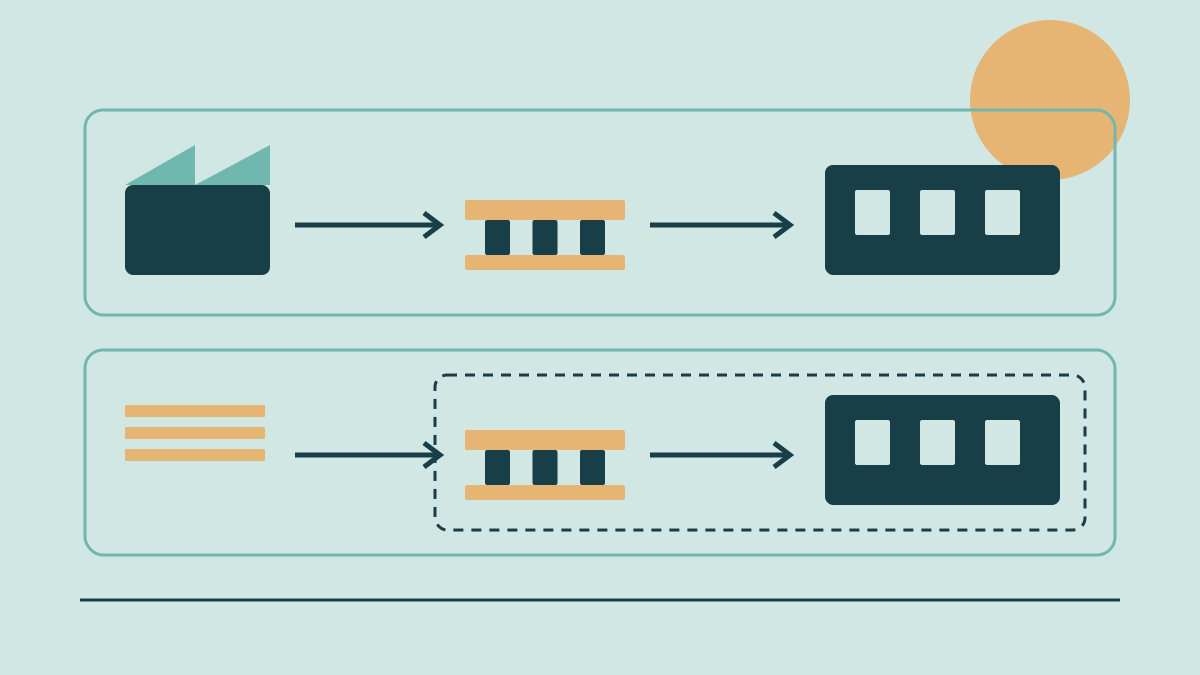
The upper route shows a supplier delivering finished pallets to the mill. In the lower route, raw material enters a production step within the mill's dashed boundary. The diagram compares responsibilities, not costs, shipment volumes or distances.
Insourcing finished packaging does not eliminate purchasing. It changes the purchases. The enterprise now needs suitable raw material, consumables, replacement components and whatever external services the workshop cannot provide. A reliable finished-pallet supplier previously combined several of those obligations. Bringing production inside means taking responsibility for coordinating them directly.
For that reason, procurement should compare supply systems rather than count suppliers. Having fewer finished-goods invoices may simplify one administrative task while creating several new material-management tasks. The relevant question is whether the organisation can manage the new combination more effectively. A supplier count by itself says little about continuity, quality or the time spent resolving exceptions.
Raw-material variation can also turn into production variation. Incoming inspection and consistent specifications help distinguish a material problem from a machine or handling problem. Otherwise the workshop may respond to erratic output by changing its process without identifying the cause. The additional information available from internal production is valuable only if the company uses it to diagnose problems rather than merely accumulating records.
Surplus output is a separate commercial proposition
Selling output beyond internal requirements sounds like a natural way to use spare capacity. The word surplus, however, should describe availability after a realistic service commitment to the mill. A batch that looks spare in a quiet week may be needed when dispatch catches up. External customers require promises about quantity and timing, not a standing explanation that the internal customer always comes first.
External sales also introduce costs not present in an internal transfer. Customer acquisition, credit decisions, order handling, delivery arrangements and dispute resolution all need an owner. A selling price above immediate manufacturing cost can make an order look attractive while leaving these obligations unrecognised. Conversely, refusing all outside business may leave a worthwhile use of genuinely spare capacity unexplored.
The workable approach is to evaluate external orders separately and make the priority rules explicit. Which capacity is committed internally? How much room exists for firm outside orders? What happens when either customer changes its schedule? Answers to these questions matter more than treating every possible external sale as evidence that the workshop has become a profitable standalone business.
Backup purchasing can preserve flexibility
An in-house operation need not turn an occasional external purchase into an admission of failure. Some activities are worth internalising for their regular demand while retaining purchased supply for unusual formats, temporary peaks or interruptions. The appropriate boundary can be selective. It may follow product specifications or service requirements rather than a simple rule that everything must be made or everything must be bought.
There is nevertheless a cost to keeping options available. An outside supplier may be unwilling to reserve production time without predictable business. A mill that removes all normal orders and later requests urgent deliveries should not assume its former priority remains unchanged. Maintaining a backup relationship involves understanding the supplier's incentives as well as the buyer's needs.
This makes resilience a question of workable arrangements rather than the number of names in a contact list. A second source is useful when it can supply an acceptable item within the necessary window. Testing that capability on ordinary orders can reveal practical differences before an interruption makes them urgent. The decision to retain backup supply should be reviewed alongside workshop performance, not only after a breakdown.
Measure the change without rewarding the wrong result
A production boundary should be reviewed through several measures because no single indicator captures its effect. Lower purchasing expenditure can reflect successful internal substitution, but it can also coincide with higher material stocks or unrecorded support costs. A high workshop output can represent efficient production, or it can create inventory that dispatch does not yet need. The interpretation depends on the surrounding evidence.
- Track accepted units against the mill's actual requirements, separating scheduled demand from emergency requests.
- Record material use, rejects, repair work and attributable support costs on a consistent basis.
- Compare promised and actual availability at dispatch, including any purchases needed to fill gaps.
- Distinguish internal supply from external sales and record the additional obligations of outside orders.
- Review stocks and payment timing so that a saving in one account is not mistaken for a reduction in total cash tied up.
These measures do not require an elaborate reporting system at the outset. They require definitions that remain stable long enough to reveal a pattern. Changing the acceptance standard or reallocating overhead midway through a comparison can make a trend appear better without changing operations. When definitions must change, the reason should be documented so that the result remains interpretable.
Separate a launch review from an investment review
The first review asks whether the workshop can deliver safely and consistently. The later investment review asks whether the whole arrangement produces the expected economic benefit. Combining the two too early risks treating normal commissioning difficulties as a permanent verdict, or treating a successful start as proof of long-term profitability. Each review needs evidence appropriate to its question.
The investment review should also recognise alternatives that remain available. Supplier terms may change, internal requirements may shift, and the workshop may discover a more efficient operating pattern. The purpose is not to defend the original decision indefinitely. It is to determine whether the present boundary still serves the enterprise better than the feasible alternatives, including a mixed arrangement.
The workshop is only part of the decision
The Svetogorsk announcement describes a concrete move into an adjacent activity. Its broader significance lies in the responsibilities that move with production. Purchasing, inspection, maintenance, dispatch and commercial sales become connected in a different way. A relatively modest supporting product can therefore expose a substantial coordination problem: the enterprise must decide who promises what to whom, and how performance will be judged.
That does not establish that insourcing is generally better than buying. A specialised supplier can have advantages in scale, customer diversity and operating experience. An internal workshop can have advantages in proximity, information and alignment with a particular mill's needs. Which combination matters most depends on actual operations. The useful lesson is to evaluate the entire delivery system, not to assume that ownership itself creates a saving.
For this project, the publicly announced investment and capacity are a starting record against which later disclosures could be assessed. Until operating results are available, the disciplined conclusion is narrower: the mill has changed where packaging is made and which responsibilities it carries. Whether that change improves cost, reliability and flexibility together is a question for observed performance, not for a calculation built from capacity alone.
Your perspective
Share your thoughts on the story.