

A pellet plant measures activity through the work passing through production. A customer measures it through the fuel needed at a particular time. Those perspectives meet in a sale, but they do not necessarily move together from week to week. A factory can be busy before buyers are ready to receive more product, while a period of strong deliveries can draw on work completed much earlier.
On 14 August 2025, Interfax reported Segezha Group’s account of higher pellet output at its Siberian plants in Russia and its expectation of stronger domestic sales with the heating season. The expectation was forward-looking. This article uses that historical statement as a starting point for independent analysis of production, inventory and the timing of orders, not as evidence of subsequent results.
Factory activity and customer readiness are different signals
An increase in output tells the commercial team that more product has been made. It does not tell them when a buyer will accept delivery, whether the product matches an outstanding order or whether the available stock is located where it is needed. These questions require different records from the production total.
The distinction is particularly useful when management describes a seasonal opportunity. A broad expectation that demand will strengthen can justify preparing a plan, but it cannot supply the missing details of that plan. The producer still needs to distinguish enquiries, agreed purchases and the dates attached to them. Otherwise, the same anticipated demand can be counted repeatedly in different departments.
This is not an argument for waiting until every order is certain before producing anything. It is an argument for identifying the uncertainty that advance production creates. Preparing stock may be a deliberate commercial choice. Calling it preparation rather than completed sales keeps the decision visible and gives management a basis for revising it when customer information changes.
Not all stock is available to the next buyer
A physical inventory count describes what is present within a defined boundary. It does not automatically describe what can be promised to a new customer. Some product may already be committed, awaiting a particular release decision or assigned to an order with a later collection date. The business needs to know which part of the stock remains commercially available.
A simple separation between free and committed stock can help, provided the definitions are consistent. An informal reservation should not silently acquire the same status as an accepted order. Equally, a confirmed commitment should not disappear from the available-stock calculation merely because its delivery date lies beyond the current reporting period. The status belongs with the product, not just with the calendar view.
Location introduces another distinction. Stock recorded across a group is not necessarily interchangeable at short notice. A sales team should not assume that a combined quantity can satisfy a particular delivery arrangement without checking the relevant operational constraints. This is a commercial coordination issue; it does not establish any specific transport route, handling method or technical requirement for the product.
The heating season is not an order book
A season describes a broad period in which a use for the product may become more important. An order book records particular commitments. The gap between the two includes purchasing decisions, timing and the quantity that customers choose to receive. Treating the season itself as a confirmed order book removes precisely the information needed to plan responsibly.
The producer can instead separate levels of evidence. A general market expectation is one level. An enquiry from a potential customer is another. A purchase agreed under defined terms carries different information again. These categories need not be given invented probabilities to be useful. Keeping them separate already prevents a speculative conversation from being presented as an assured shipment.
When several customers mention a similar future period, the commercial team also needs to ask whether their timing is firm. A cluster of enquiries can indicate interest without proving that all buyers will be ready together. The useful task is to clarify what is known, record what remains open and avoid presenting a rough seasonal assumption as a precise delivery schedule.
Domestic and export calendars need their own evidence
A producer serving more than one market may encounter different ordering rhythms. The important word is may: the distinction should be established from the business’s actual customers rather than assumed from a label such as domestic or export. Buyers within the same market can also differ in how they place orders and arrange receipts.
A commercial plan can preserve those differences instead of forcing every order into one seasonal profile. The relevant questions concern when a customer decides, when the quantity becomes firm and when the product is to be handed over. Answering them does not require a claim that one market is inherently more predictable or more valuable than another.
Nor should a new destination be treated as an immediate solution to unsold inventory. An intention to develop a market is different from an accepted order there. The company needs evidence that the proposed buyer and transaction fit the product and arrangement being offered. This analysis does not provide trade-law guidance or claim that any particular destination was available on specific terms.
Make the inventory bridge explicit
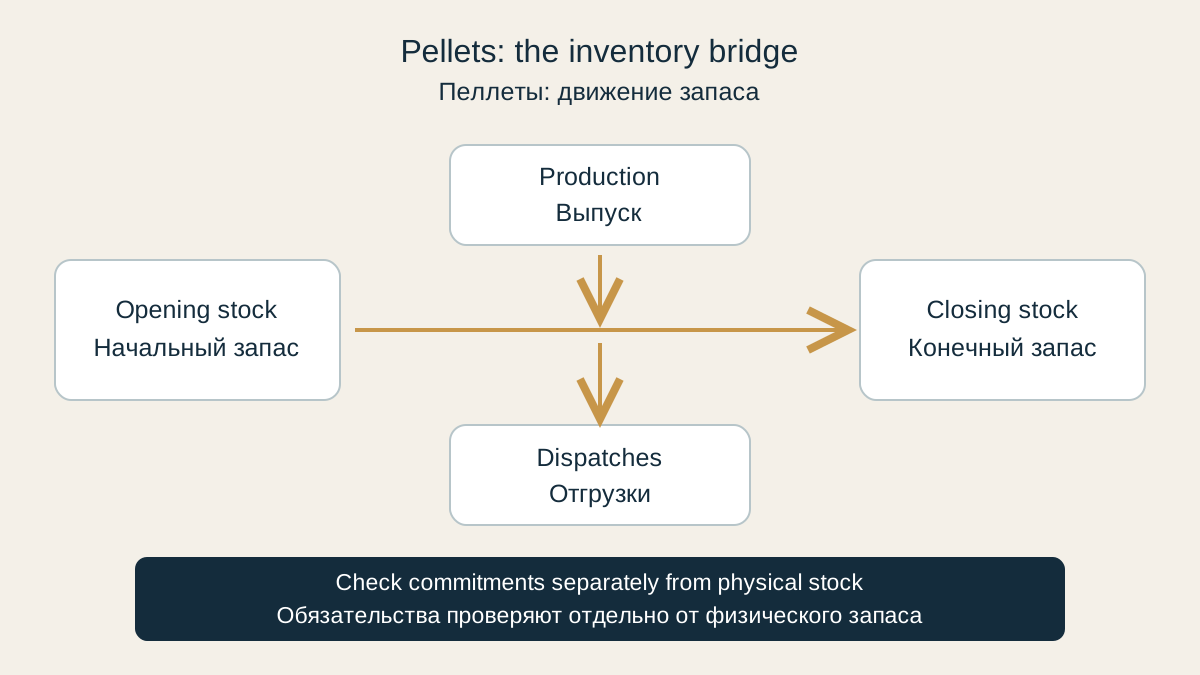
A useful way to connect the factory and the sales office is to show the movement between opening and closing stock. For a clearly defined product and reporting boundary, the bridge begins with the opening quantity, adds recorded inflows and subtracts recorded outflows. Other movements must be identified rather than hidden inside a residual labelled demand.
The categories must describe what actually moved. Production is one possible inflow; a transfer from another location is a different one. Dispatch is a physical outflow, while a sales figure may follow a different recognition point or scope. If those concepts are mixed, the bridge can appear to explain stock while really combining incompatible records.
This is why a published sales total exceeding a published production total does not, by itself, prove that inventory fell by the difference. The figures may cover different assets, products or moments in the transaction. Without a matched boundary and the other movements, the subtraction creates an answer that the underlying information has not established.
A qualitative stock-flow example
Imagine a planning sheet with opening stock on the left, production entering from above, dispatches leaving below and closing stock on the right. No quantities are assigned. The sheet simply makes it possible to ask where each recorded movement belongs. A separate note identifies commitments against the closing stock, because a physical balance and a freely sellable balance are different views.
This is an illustrative relationship, not a reconstruction of Segezha’s accounts or a measured forecast. It deliberately avoids assigning company figures to an incomplete bridge. Its value is to show the questions that would have to be answered before drawing a conclusion about accumulation, release or the amount available for a new order.
Customer concentration and timing concentration are different exposures
A supplier can depend heavily on one customer even when that customer takes product regularly throughout the year. Another supplier can serve many customers whose orders all fall into a short period. Both patterns deserve attention, but they describe different forms of concentration. A customer count alone cannot reveal the second.
The first raises questions about the importance of a particular commercial relationship. The second concerns the calendar of commitments and the resources needed when several transactions coincide. Adding customers does not necessarily spread work more evenly if they all want the same delivery window. Likewise, spreading deliveries does not remove dependence on the buyer who accounts for them.
A planning review can therefore look at customers and time separately. This is a way to identify the shape of the order book, not a claim that a particular level of concentration is acceptable or unacceptable. The appropriate response depends on what the business has actually agreed to supply and what alternatives it can realistically develop.
A restart needs a commercial release decision
When a production line resumes work, the operational change is visible. The commercial change may be less immediate. Additional output still needs a destination in the plan: committed orders, deliberate seasonal stock or another clearly stated purpose. Without that link, a restart can improve the production chart while leaving the sales office with a growing task that has not been assigned.
The question is not whether restarting is inherently good or bad. It is what evidence supports the planned use of the additional product. Management can distinguish what is already committed from what is being produced in anticipation. That distinction allows the decision to be reviewed without rewriting its original purpose after the outcome becomes clearer.
It also helps prevent a future capacity statement from becoming a claim about realised sales. The ability or intention to make more product is one part of the commercial chain. The customer’s acceptance of an order and the eventual completion of the transaction are other parts. A coherent report preserves the sequence rather than treating them as interchangeable achievements.
Revisions need an owner
A seasonal plan will be less useful if every department keeps a different version of it. Sales may learn that a customer’s timing has changed while production continues to use the earlier schedule. The problem is not necessarily poor forecasting. It may be that new information has no clear route into the decision that still governs work.
A practical revision process identifies who records a change, who assesses its consequences and who approves an altered plan. The process need not be elaborate. It does need to make clear whether a conversation has changed a firm commitment or merely updated an expectation. Otherwise, a tentative remark can trigger an operational change that the customer never requested.
The same discipline applies when information improves. A previously uncertain enquiry may become an accepted order. That development should change its status and the relevant availability calculation, rather than remain buried in a salesperson’s notes. Planning gains value when both stronger and weaker evidence enter the shared view through a consistent process.
Compare alternatives without inventing certainty
A producer can examine more than one possible timing pattern without pretending to know which will occur. One view might place customer receipts earlier, another later, while keeping the assumptions explicit. The purpose is to identify which decisions would change, not to disguise a preferred forecast as a set of supposedly precise predictions.
For example, a later receipt pattern can raise questions about the amount of product remaining uncommitted and the timing of future production decisions. An earlier pattern can expose whether the promised quantity is actually available. These are commercial questions. They do not provide technical instructions for storage, transport or the operation of a pellet facility.
A short comparison can be organised around the following points. The list is a proposed management framework, not a description of the company’s internal system:
- Which orders are firm, and which remain enquiries?
- What stock is free, committed or awaiting clarification?
- Which inflows and outflows belong to the same reporting boundary?
- Where do several customer dates overlap?
- What new evidence would change the next production decision?
- Who records and approves a revision to the shared plan?
Judge seasonal preparation after the calendar moves on
Producing ahead of a buying period can be described as preparation while the outcome remains open. Later, the business should examine what happened to that stock. Did it serve the intended orders, remain available or become attached to a different plan? The answer matters more than preserving the original label of seasonal preparation indefinitely.
A single closing balance is not enough to explain the result. The company needs the movements and commitments around it. A lower balance might reflect deliveries, but without the bridge it should not be automatically interpreted as stronger underlying demand. A higher balance might be deliberate, but that explanation needs a current purpose rather than a repeated reference to an earlier expectation.
The strongest link between the plant and the heating season is therefore not a confident prediction. It is a consistent account of what has been made, what has been promised, what has moved and what remains to be decided. Keeping those categories distinct allows the producer to prepare for seasonal customers while still recognising the commercial uncertainty that lies between output and completed sales.
Historical reporting: Interfax, 14 August 2025.
Your perspective
Share your thoughts on the story.