

Two renovation offers can use the same unit of measurement and still describe different purchases. A price per square metre looks easy to compare because it reduces a complicated job to one number. But the number does not explain which work is included, who supplies the materials or what happens when the customer changes a selection. Before ranking quotations, a buyer needs to know whether they cover the same basket of work.
On 4 May 2024, Kommersant reported increased interest in apartment renovation in Russia, citing Avito Services and discussing homes sold without finishing. That historical report supplies the context for this analysis. The question here is narrower than the direction of market prices: how can a customer compare offers without confusing a different scope with a cheaper version of the same job?
The distinction matters to contractors as well. A business that includes more work in its quotation may appear expensive beside an offer that leaves several items for later. Simply lowering its headline figure would not explain the difference. A clearer comparison makes the contents visible before either side argues about the total. It also creates a reference for discussing later changes without treating every increase as evidence that the original price was misleading.
Start with the purchase, then choose the unit
A unit price is a compact expression of a defined quantity and a defined scope. Both parts need attention. If two offers refer to different areas or different interpretations of the work, using the same currency per square metre does not make them equivalent. The unit is useful only after the underlying description has become sufficiently clear. Otherwise, its apparent simplicity conceals the questions that the comparison is meant to answer.
This does not mean that a customer must prepare an exhaustive technical specification before speaking to a contractor. An early conversation can begin with an outline. But an outline price should remain recognisable as an outline price. It should not be compared as though it were a fully specified offer from another business. The first task is to identify the level of definition each quotation has reached, rather than assuming that every written total carries the same certainty.
A shared request can describe the spaces involved, the intended work and the decisions that remain open. It can also identify items that the customer expects to arrange separately. The purpose is not to prescribe construction methods or substitute for appropriate specialist assessment. It is to give competing providers the same commercial question. Their answers may still differ, but the differences become easier to explain when the starting request is common.
Read across the inclusions
Consider a qualitative example with two renovation proposals. Offer A includes specified labour, selected materials and delivery of those materials. Offer B includes the specified labour but leaves material purchasing and delivery to the customer. There are no market prices or actual companies in this example. Its purpose is to show why a lower quoted total for B would not, by itself, establish a lower total cost for the same completed purchase.
The missing components in B should not be silently assigned a value of zero. Nor should the buyer insert an arbitrary allowance and call the result a firm comparison. A better next step is to obtain the relevant information or ask each provider to quote a common scope. If that cannot yet be done, the comparison should keep the unresolved component visible. An honest blank can be more useful than a precise-looking total assembled from unsupported assumptions.
The same logic applies in the other direction. An included item is not automatically valuable merely because another offer excludes it. The customer may already have an arrangement for that component or may prefer to manage it independently. In that case, the appropriate comparison could remove it from the broader offer rather than add it to the narrower one. Normalising scope means aligning the purchase with the customer's intended arrangement, not always selecting the largest package.
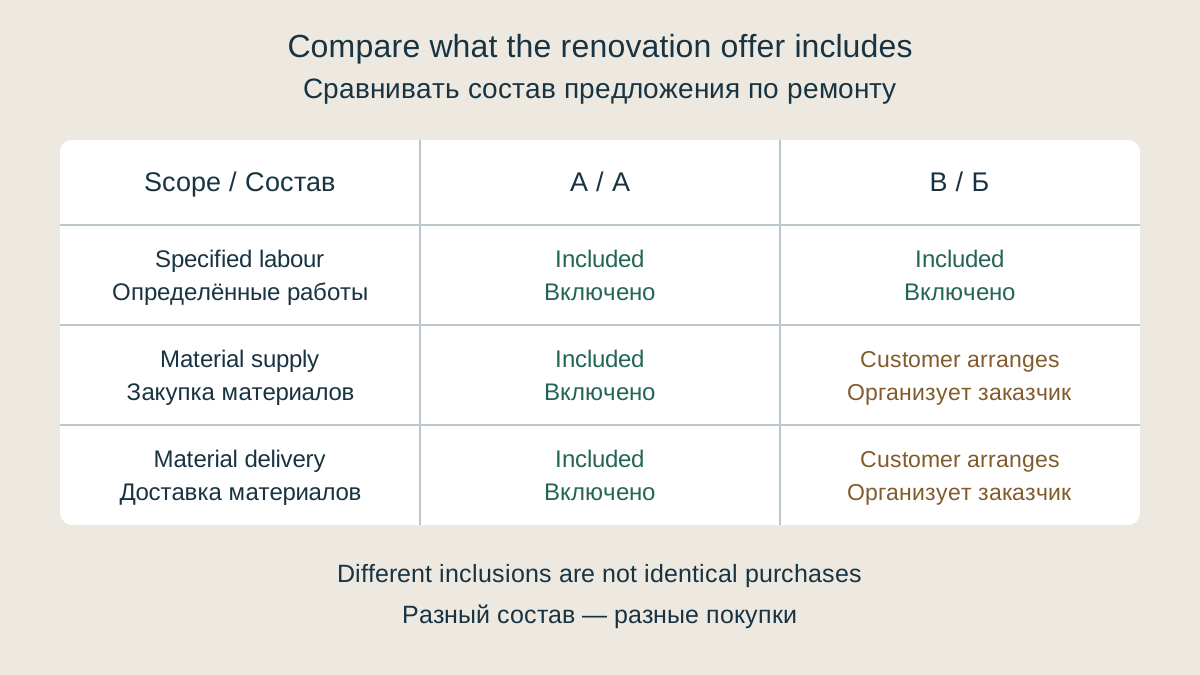
A short comparison table can carry a long conversation
The useful rows are the decisions that change who does what. Labour, material supply and delivery are examples, not a universal checklist for every project. A row should distinguish included, excluded and unresolved. The unresolved category matters because silence is not a reliable description of either inclusion or exclusion. If a contractor has not addressed a component, the customer needs clarification before treating it as part of the agreement being compared.
- Use the same description of the requested work for each offer.
- Separate supplied materials from work performed with customer-supplied materials.
- Identify delivery or other supporting arrangements that affect the purchase.
- Keep exclusions and unresolved items visible beside the quoted total.
- Record which choices must be settled before a more definite quotation is possible.
The table is a conversation aid, not a substitute for the provider's detailed offer. Its role is to reveal mismatches early enough to ask useful questions. If a row becomes so broad that different services can hide inside it, the buyer can divide that row. If a row has no effect on the decision, it may not deserve more detail. The comparison should become clearer, not simply longer.
Materials need a description, not just a budget label
A materials allowance can represent an unresolved selection rather than a confirmed bundle of products. A customer who reads it as a fixed description may later be surprised when a different choice changes the total. The useful distinction is between a product already specified and an amount reserved while the selection remains open. Both can have a place in an early offer, provided their different meanings are clear.
For example, the buyer might not yet have chosen a finish for a particular room. A contractor can explain the basis used in the quotation without claiming that every possible choice is covered. The comparison can then ask whether another provider has used an equivalent basis. It is not necessary to invent a universal price range for finishes. The immediate issue is whether the competing offers assume the same decision or leave different decisions unresolved.
Customer-supplied materials introduce another boundary. An offer for work performed with materials supplied by the buyer differs from an offer in which the contractor also arranges the purchase. That difference should remain visible even if the products are ultimately identical. The parties need to understand the division of tasks rather than assuming that the presence of a material in the project means its procurement is included in every quotation.
Keep unknown conditions apart from changed preferences
Not every revision has the same cause. One may follow a customer choosing a different finish. Another may follow clarification of a condition that was not established when the preliminary offer was prepared. A third may simply correct a misunderstanding about what the original request included. Putting all three under an undifferentiated heading such as additional work makes it harder to understand whether the purchase changed or the initial description was incomplete.
This analysis does not decide which party should bear a particular expense. That question depends on the actual arrangement and circumstances. The practical point is that the explanation should identify what changed. A revised selection, a newly established requirement and a correction to the quotation are different events. Clear descriptions allow the parties to discuss the relevant event instead of arguing about a total whose components have become invisible.
A comparison should therefore preserve the original assumptions. If an early quotation was based on a stated condition that later proves different, the record can show that distinction. If the condition was never addressed, it should not retrospectively appear as though it had been agreed. Keeping the earlier version is useful because it prevents a revised document from becoming the only available account of what the parties originally understood.
Explain the revision as a change to the basket
A revised total is easier to understand when it is connected to a named change. The explanation can identify the affected work or selection, state whether the previous item is removed or retained, and show what now replaces it. Without that connection, a buyer may see only a larger number. The contractor may know the reason, but knowledge held inside the business does not make the customer's comparison clearer.
Replacement deserves particular attention. If a customer selects an alternative item, the revision should distinguish a substitution from an addition. Otherwise, the discussion may appear to charge for both the old and new choices even when that was not intended. Conversely, if both items remain part of the requested work, describing the change merely as an upgrade can conceal the expanded scope. Ordinary language about removal, replacement and addition is often more informative than a broad label.
Several small revisions can also alter the meaning of the overall job. Reviewing only the latest change may leave the customer without a current picture of the purchase. A consolidated description can show the original scope together with accepted revisions, while retaining the history separately. This is not an argument for repeatedly rewriting everything. It is a way to keep a current decision view without losing the evidence needed to explain how it developed.
The endpoint belongs in the comparison
Offers can differ in how they describe completion. One may name a set of finished tasks, while another uses a broad phrase that leaves the endpoint unclear. Comparing only the initial work description can miss that difference. The customer should be able to explain what the provider regards as the completed purchase in the quotation under discussion. This is a commercial clarification, not a statement of legal acceptance rules or a technical standard for inspecting construction.
The endpoint also helps reveal tasks assigned to someone else. If a provider's scope ends before a separate activity arranged by the customer, the distinction belongs in the comparison. It does not necessarily make the offer worse. It means that the offer is one part of a larger arrangement. Treating that part as a complete package would misrepresent both the contractor's proposal and the customer's remaining responsibilities.
A useful question is whether the same intended result is being compared across offers. If the answer is no, the buyer can either align the requests or acknowledge that the options represent different purchases. There is nothing inherently wrong with choosing between different purchases. The error is presenting the choice as a straightforward price ranking when the contents and endpoints have not been made equivalent.
Do not make the comparison more certain than the information
Once the main inclusions are aligned, a lower price becomes more informative, but it still does not answer every question about the choice. The comparison may contain unresolved selections or assumptions that need further discussion. Those limitations should remain visible. A neatly formatted table can otherwise create the impression that all uncertainty has been removed, even though the table merely organises what is currently known.
The buyer can separate decisions that can be made now from those that require clarification. For instance, it may already be clear which offer includes material purchasing, while the exact selection remains undecided. That partial clarity is useful. It should not be discarded because the entire project is not yet specified, nor overstated as a complete cost comparison. Progress comes from resolving the important differences in sequence rather than forcing a premature single-number answer.
Contractors can help by responding directly to the shared request and identifying where their proposal uses a different assumption. A deviation can be a legitimate alternative, but it should be recognisable as an alternative. If the customer asks for one scope and receives another without explanation, the resulting price comparison is weak regardless of how attractive the total appears. Clarity about a difference is more useful than hiding it inside a general package description.
A comparable offer is easier to choose and explain
The comparison also needs to identify which version of each offer it uses. If a provider clarifies an inclusion in a later message, the comparison should connect that clarification to the relevant proposal. Otherwise, a customer can accidentally compare the old total from one document with the expanded description from another. Version control here means a simple, traceable relationship between the description being considered and the amount attached to it, not elaborate administration.
Timing is another assumption worth making visible. An offer prepared for one intended start may need confirmation if the customer's plan changes. This does not establish that its price must change, or give either side a particular entitlement. It simply identifies a question that has become relevant. The comparison remains more reliable when it distinguishes a currently confirmed proposal from an earlier indication whose assumptions have not been revisited.
The main discipline is simple: define the purchase before using the price to rank it. A shared scope, visible exclusions and a record of revisions do not guarantee that a project will proceed without disagreement. They do make it easier to identify what the disagreement concerns. The parties can discuss a specific component or changed assumption instead of treating every question as a dispute about the headline figure.
The historical discussion of renovation demand is a reason to pay attention to that discipline, not a source of current price guidance. Buyers considering their own project need quotations that describe their own intended work. Contractors explaining their proposals need a way to show why superficially similar totals may cover different responsibilities. In both cases, the useful comparison starts with the contents of the offer and only then returns to the number attached to it.
Source: Alexandra Mertsalova, Kommersant, 4 May 2024. The offer examples and comparison framework are independent analysis; they do not reproduce a contractor's quotation or prescribe construction methods.
Your perspective
Share your thoughts on the story.