

On 9 July 2025, Kommersant reported a ministry proposal concerning public purchases of foreign upright pianos in Russia. The article described music schools as important customers and reported manufacturers’ concerns about component supplies. The proposal was a potential change in purchasing conditions, not evidence of a subsequent legal decision or a completed increase in production.
For a manufacturer, the commercial question extends beyond the size of the market that might become accessible. Orders have dates, specifications and conditions. A factory needs to know which commitments it can place on a production calendar. The discussion below develops that distinction as independent business analysis; it does not describe the internal planning practices of any company mentioned in the historical report.
An annual market does not arrive evenly
An annual demand estimate compresses time. It brings purchases made in different months into one total and can therefore conceal the difference between a steady stream of work and a short period of intense ordering. Two markets with the same annual volume can create very different scheduling problems. A factory cannot recover a missed delivery window simply by pointing to unused time earlier in the year.
The relevant comparison is consequently between dated demand and the work that can be completed before each commitment falls due. This is not a reason to dismiss market estimates. They remain useful for understanding scale. Their limitation is that they cannot, on their own, establish the sequence in which a particular factory should accept orders, commit material or promise completion.
The same distinction applies to a statement about production capacity. A headline annual capacity figure does not explain which configurations it covers, what resources it assumes or how much of the schedule is already committed. Treating it as a freely available pool of identical delivery slots would add assumptions that the number itself does not contain.
A conversation is not yet a dated order
A school asking for information is a potential customer, but its inquiry is not equivalent to an accepted order. A requested quotation, an expression of interest and a confirmed commercial commitment carry different information. Planning becomes less reliable when those stages are combined into a single list labelled demand. The apparent strength of the list may then depend on counting the same opportunity several times.
A useful record distinguishes what the customer has said from what the manufacturer has accepted. It can show the requested quantity and date without implying that either is confirmed. It can also preserve the date on which the information was obtained. A request discussed some time ago should not silently remain current simply because nobody has formally removed it.
This distinction does not require a prediction of which school will eventually buy. Where evidence is insufficient, the uncertainty can remain visible. Commercial staff can explain which decisions are pending, while production staff can see which work is genuinely committed. Assigning a precise probability to every inquiry would not automatically improve the plan if those probabilities had no defensible basis.
Keep the customer's requested date separate
The date a customer would prefer and the date a supplier has agreed are different fields. Combining them makes it difficult to tell whether the factory is late against a promise or still discussing what can be offered. A clear record preserves both, along with the latest agreed change. This supports honest communication without pretending that every request can be met.
Several buyers may want the same window
Institutional customers can have reasons to seek delivery in a particular period. A manufacturer should establish those reasons with each customer rather than assume that every school follows the same calendar. The planning issue arises whenever separate customers ask for overlapping windows. Their orders may be independent commercially while competing for the same production and delivery resources.
A sales total does not reveal that overlap. A calendar does. Placing confirmed commitments against the relevant periods allows a team to see whether a proposed order fits alongside existing promises. It also shows whether moving one job would merely transfer the conflict to another customer. A revised date is not a solution if it creates an unacknowledged missed commitment elsewhere.
The manufacturer can therefore distinguish available annual capacity from available capacity before a particular deadline. That distinction is useful even without publishing an elaborate forecast. It requires the company to state what its promise depends on and to revisit the promise when those assumptions change. It does not imply a universal lead time for building or delivering an instrument.
Product mix gives the calendar its shape
Counting instruments is a convenient starting point, but it may not be a complete description of the work. Different orders can specify different versions, finishes or accompanying services. The planner needs the differences that actually affect the company's process, not every detail that appears in a sales brochure. A practical schedule connects a commercial specification with the resources needed to fulfil it.
This does not mean assuming that one model always takes longer than another. Such a claim would require evidence from the relevant production process. The general point is that equal unit counts need not mean equal workloads. If a company treats every instrument as an interchangeable scheduling unit, it should understand the conditions under which that simplification remains useful.
Shared stages introduce another distinction. Work may use the same people or facilities at one stage but different resources elsewhere. An apparently open period in one department does not establish that the whole order can be completed. The schedule must remain connected across the stages the manufacturer actually uses, without importing an imagined standard process from a general market article.
Starting early changes who carries uncertainty
Producing ahead of a confirmed sale can create inventory that is available sooner. It can also commit resources before the buyer and final specification are known. Neither outcome makes early production universally right or wrong. The commercial question is what has been committed, what remains adaptable and who bears the consequences if the expected order does not arrive.
A finished instrument held for sale is different from material that could support several future configurations. The difference concerns the remaining choices, not an assertion that one form of stock is always more valuable. A planning review can identify where a decision narrows those choices. Once a commitment has been made, a later cancellation may leave more than a blank space on the calendar.
The distinction also matters when teams discuss readiness. Material on hand, work in progress and finished stock are not interchangeable descriptions. Each represents a different position in the company's process. Summing them without explanation can make supply look more immediately available than it is, particularly if the customer's requested configuration has not yet been matched to the stock.
- Separate confirmed customer commitments from opportunities still under discussion.
- Keep requested and agreed delivery periods distinguishable.
- Identify stock committed to a particular order rather than treating it as generally available.
- Record which choices remain open before work is started early.
- Show how a schedule change affects commitments already made.
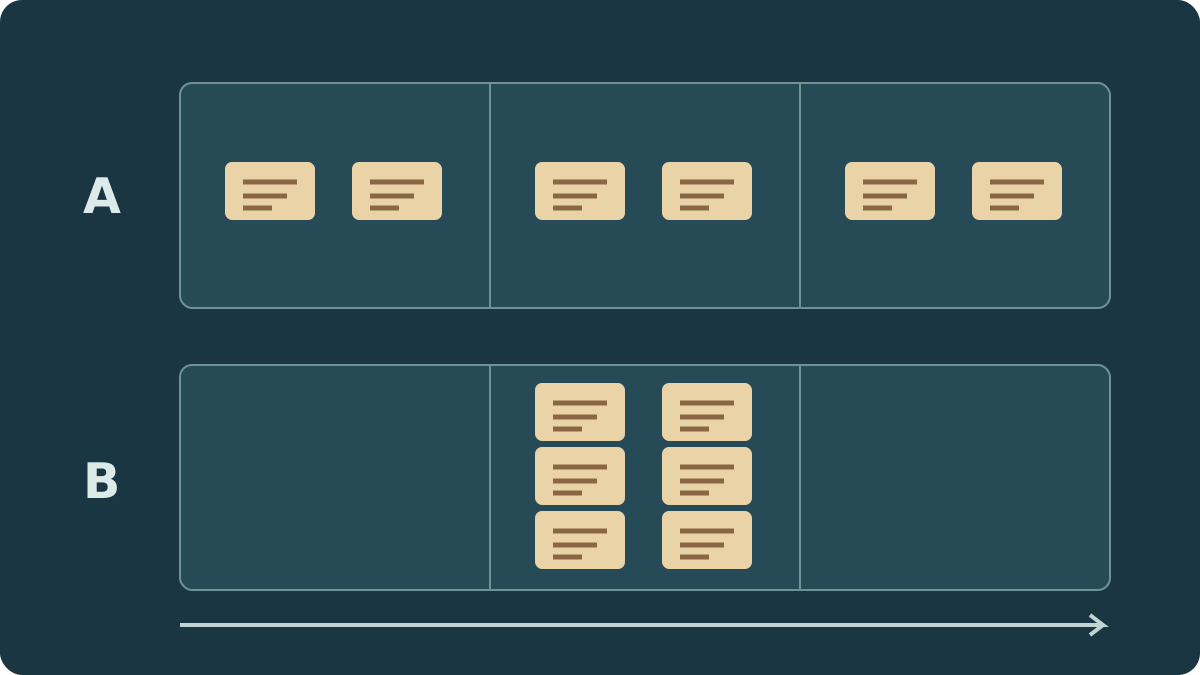
Two calendars can describe the same annual demand
Consider an illustrative manufacturer receiving interest from several schools. In one scenario, their requested deliveries are spread across the year. In another, they are concentrated in the same short window. Assume the annual number of instruments is unchanged. This is a qualitative example, not a reconstruction of any factory's orders, and it assigns no production rates or financial returns.
In the first scenario, confirmed orders might be sequenced with less overlap. That possibility still depends on the actual resources and product mix. In the second, the factory would need to examine whether work could be completed earlier, whether customers would accept different dates or whether some requests could not be promised. The annual market total does not decide between those responses.
Suppose the factory starts work early to address the concentrated window. The scheduling conflict may become smaller, but the organisation now needs to account for work committed before final customer decisions. It has exchanged one kind of uncertainty for another. Presenting only the improvement in the delivery calendar would omit the inventory and commitment questions created by that choice.
The example's conclusion is not that demand concentration necessarily causes failure. It is that demand timing changes the decision even when annual volume is held constant. A commercial review becomes more informative when it can discuss both the number of potential orders and their maturity, timing and specificity. No invented utilisation target is needed to establish that distinction.
Changes need a visible owner
An order can change after it has entered the schedule. A requested alteration may concern timing, configuration or the scope of associated services. Recording the request is not the same as accepting it. Someone needs to determine what the change would affect before a revised promise is communicated. Otherwise, different teams may operate with different understandings of the same order.
The record should preserve the earlier commitment as well as the accepted revision. This is useful for explaining why the calendar changed and for identifying work that was already completed under the earlier arrangement. It is not a recommendation about a particular contractual remedy. Legal rights and procurement requirements depend on the applicable documents and should not be inferred from this general planning discussion.
There is also a distinction between changing one order and changing the plan around it. Moving an individual delivery can affect other work even if its own specification remains unchanged. A responsible review makes those consequences visible. The aim is not to prevent all changes but to avoid describing a local adjustment as costless when it transfers disruption to another commitment.
Measure what has actually been promised
A concise management review can distinguish confirmed workload, unresolved inquiries and work started without a final allocation. These categories answer different questions. A large inquiry list may indicate commercial interest without proving a full schedule. Conversely, a modest number of confirmed orders may contain demanding deadlines. Neither can be interpreted reliably without its timing and scope.
Measures should retain their definitions when they are compared over time. If an organisation begins counting tentative requests as orders, apparent growth may partly reflect the changed definition. If it records a rescheduled delivery as a new order, the total may also become misleading. Consistent records allow changes in the business to be separated from changes in the way it is described.
Such measures are tools for asking questions, not guarantees of performance. A company would still need evidence about its own process before setting targets or drawing conclusions about improvement. The historical announcement provides no basis for inventing a preferred backlog, stock level or service response time. Precision should follow evidence rather than compensate for its absence.
The relationship continues beyond delivery
For an institutional buyer, a purchase may sit within a longer relationship with the supplier. The commercial scope should make clear which services are included, which are separate and where questions should be directed. That clarity concerns responsibilities; it is not a technical guide to instrument maintenance. Specialist work should remain with appropriately qualified people under the relevant arrangements.
From the manufacturer's perspective, future service commitments should not disappear merely because the instrument has left the factory. If the company has promised further work, that promise belongs in its planning records. Counting the initial delivery as the end of every obligation can leave later responsibilities without resources or ownership. The appropriate treatment depends on what was actually agreed.
A market opportunity still needs an operating plan
The July 2025 report offers a historical starting point, not proof that purchasing rules later changed or that manufacturers received more orders. Establishing either outcome would require subsequent dated evidence. It would also be necessary to distinguish a change in market access from a change in confirmed demand, completed deliveries or company results.
The durable business question is how an organisation translates possible demand into commitments it can explain and fulfil. For a piano factory, that translation involves customers, dates, specifications and remaining choices. A larger accessible market may create opportunities, but it does not supply the order calendar. Building that calendar is a separate commercial and operational task.
Historical source: Kommersant, Yulia Yurasova, 9 July 2025.
Your perspective
Share your thoughts on the story.