

A personalised fragrance appointment can end with a bottle, but the bottle does not describe everything the customer bought. A 9 December 2025 feature by Darya Bogomolova in Kommersant Style explored individual fragrance services in Russia, including the role of participation in the creation process. That provides a starting point for a business distinction: a guided experience and a subsequent product order can belong to the same customer relationship without being the same service.
The distinction matters when a studio decides what it promises, how it records work and what it calls a successful return visit. Someone buying an unusual afternoon may value explanation, attention and involvement. Someone requesting another bottle of an agreed fragrance may instead value continuity and straightforward fulfilment. Neither purpose is inherently superior. Confusing them, however, can make a profitable-looking appointment difficult to interpret and a satisfied one-time visitor look like a disappointed customer simply because they have not placed another order.
Identify the deliverables before counting the bottles
A workshop can combine several deliverables: access to a session, guided choices, an introduction to a creative process and a physical item to take away. A studio does not have to price each element separately for customers, but it should understand which elements it is undertaking to provide. Otherwise, the bottle becomes a misleading unit of output. Two appointments may each produce one bottle while requiring very different amounts of explanation, preparation and individual attention. Their apparent equality in the sales record conceals a difference in the service performed.
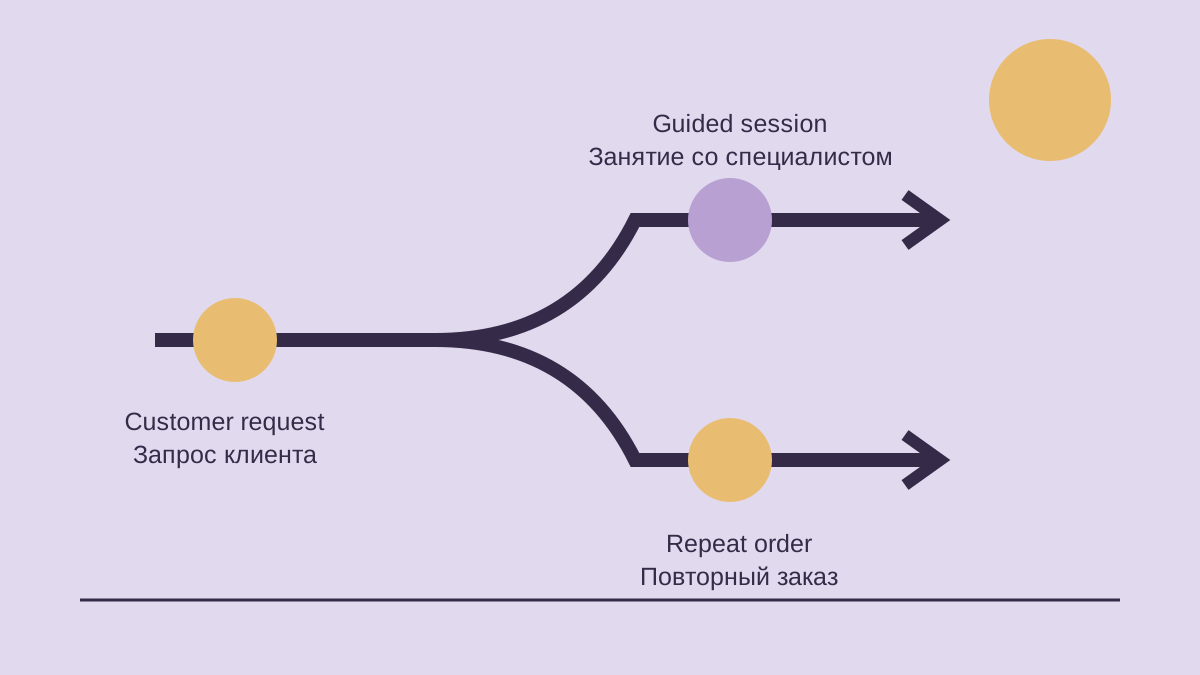
A repeat order has a different starting point if the customer wants the previously agreed result rather than a new creative session. Some earlier work may not need to be repeated, but the studio still has a new request to interpret and fulfil. The appropriate comparison is therefore not “a bottle versus the same bottle”. It is a first service bundle versus a later service bundle. Separating them makes it possible to ask what work remains, what information must be available and which expectations need to be confirmed before the later order is accepted.
This is a management distinction, not a claim that every perfume business must offer the same packages. One studio might concentrate on occasional experiences; another might organise its customer relationships around continued product supply. A third might offer both. Each can be coherent if its promises and working records match its chosen service. Problems arise when the customer is sold an experience but management evaluates the appointment entirely as a product-acquisition channel, or when a reorder is described as simple fulfilment while the team actually performs another full consultation.
Guided attention is part of the work
When a customer pays to participate, explanation is not necessarily an interruption to production. It may be part of what the studio has sold. A narrow measure that counts only the finished item can make this attention look like avoidable delay. The business then risks removing the very element that distinguishes the appointment from buying a ready-made product. A useful internal record should make guided time visible without treating every minute of conversation as waste or assuming that more time always produces a better experience.
The same applies to preparation and follow-through. Setting up an appropriate session, understanding the booked format and keeping an intelligible record can be relevant work even when customers do not see all of it. These activities should not disappear from the business model because they happen before arrival or after departure. Conversely, a studio should not attribute every general operating expense to a single participant simply because that participant asked the most questions. The purpose of attribution is to understand the service, not to manufacture a convenient explanation for a result already preferred.
For planning, the team can distinguish work linked to the appointment as a whole from work that changes with the participant’s request. That distinction need not begin with a complicated financial model. A clear description of what the team actually does is a better starting point than a precise-looking calculation built on unobserved assumptions. Once the activities are understood, the studio can decide which differences are important enough to record consistently and which would create more administrative effort than useful information.
A one-time visit can still fulfil the customer’s purpose
A person who books an experience for a celebration may not intend to establish a continuing supply relationship. If the appointment delivers what was promised, the absence of a later bottle order does not by itself establish failure. Another participant may arrive specifically hoping to find something they will request again. Those two customers should not automatically be judged against the same repeat-purchase expectation. Their original purposes differ, and a meaningful review of the service needs to preserve that difference rather than imposing one business ambition on every visitor.
This does not make repeat business irrelevant. It means that the studio should ask what kind of return it is observing. A customer may order the same product, book a new session with different preferences, bring another participant or simply recommend the experience. These actions are not interchangeable. They can each be useful to understand, but combining them into one broad label such as loyalty makes the record less informative. The studio loses sight of whether people value continuity, further exploration or the social format of the appointment.
Customer feedback also needs to match the promise. Someone evaluating the guidance may comment on whether the choices were explained clearly. Someone evaluating a later order may focus on whether the requested version was understood and the agreed process followed. Asking only whether they liked the bottle can miss either issue. A short, relevant question is often more useful than a long satisfaction form whose answers do not tell the team which part of the service should change.
Distinguish a repeat order from a new creative brief
The phrase “the same again” needs a shared reference. It should connect the customer’s request to the relevant prior record, rather than to someone’s memory of a pleasant appointment. That does not require the studio to reveal proprietary technical information or make claims about ownership rights. It requires an operational way to identify what the customer is requesting. The commercial question is whether the team can recognise the earlier agreed product and explain what the next order includes, not whether an informal note settles a legal issue.
A request for a change can shift the nature of the work. A customer might want a new direction while describing the order as a repeat because it follows the first visit. If the studio silently treats that request as routine fulfilment, it may understate the consultation and review involved. If it insists on repeating every part of the original appointment regardless of the request, it may create unnecessary work. The useful step is to identify the change and agree which service is now being requested before making a promise about completion.
Keep the customer-facing choice simple
The internal distinction does not need to become a dense menu of technical categories. The customer mainly needs to understand whether they are requesting the earlier agreed product or exploring a different one, and what follows from that choice. A studio can explain this in ordinary language. It should avoid using the word personalised as an unlimited promise that every future revision is included. Clear boundaries protect the customer’s understanding as much as the business’s ability to allocate work.
Those boundaries should also avoid promises that the studio has not substantiated. Participation in a creative session is not, on its own, evidence of a health benefit, a guaranteed emotional effect or universal suitability. Claims of exclusivity also need their own basis, rather than the word personalised alone. A business can describe the experience and its own service without making those additional claims. Keeping the offer focused makes it easier for customers to judge the actual proposal instead of an attractive but ambiguous collection of possible benefits.
Two customers illustrate the difference
Consider two hypothetical customers, without assigning invented prices or industry averages. The first books a guided appointment as an occasional leisure activity and leaves with the included bottle. The second books an appointment with the intention of returning for further supplies of the agreed product. At the first visit, their physical outputs may look similar. Their future expectations are not. A business that assumes both relationships should develop in the same way may spend time on follow-up that is relevant to one customer but not to the other.
For the first customer, a later invitation to another experience could be more relevant than repeated prompts to reorder the same product. For the second, a clear explanation of how to identify and request the earlier version may be more useful than another introduction to the workshop. These are possibilities to test through the customer’s stated preference, not predictions about either person. The point is to connect follow-up to the reason for the visit rather than deciding in advance that every participant should enter an identical sequence of offers.
Now suppose the second customer later wants a different direction. That request should not automatically count as a failure of the original service, nor should it automatically be recorded as uncomplicated repeat fulfilment. It may represent a new creative purpose. Recognising the change allows the studio to offer an appropriate next step and record the work honestly. The relationship continues, but its continuation does not mean that the product or service remains unchanged.
Repeat fulfilment is not free of work
It is tempting to think that all meaningful effort occurs at the first appointment and every later order is a simple extension of it. That assumption can hide the activities associated with receiving, identifying, preparing and handing over another order. Even where the creative discussion is not repeated, the studio still needs a process that fits the service it has agreed to provide. A useful comparison records the work that genuinely differs rather than assuming either complete repetition or no additional work at all.
Shared preparation creates a further attribution question. Some work may support several appointments or orders, while other tasks belong to one request. Counting the shared task afresh for every bottle exaggerates total effort; ignoring it makes the operation appear easier than it is. The studio can choose a practical, consistent allocation approach for internal review without pretending that it reveals a universal cost of personalisation. The important point is comparability: changes in the record should reflect changes in activity, not an unnoticed change in how the same work is assigned.
Such records can inform decisions about the offer. If customers regularly request changes that require substantial discussion, the studio may need a clearer follow-on consultation format. If many visitors seek only an experience, the first appointment should be evaluated as a service in its own right. Neither conclusion requires a claim about an industry-wide optimum. They arise from comparing the business’s own promises with the work required to honour them, then deciding whether the existing format still describes what customers are asking for.
Choose a denominator before announcing a repeat rate
A statement that customers return is incomplete unless the business explains who was eligible to return and what action counts. A recent participant has had less opportunity to place a later order than someone who attended much earlier. A new session and a repeat bottle order are different actions. Mixing these observations can produce an impressive number that does not answer the intended question. The remedy is not a more elaborate headline percentage; it is a stable definition attached to a clearly described group.
- Separate first appointments from later product orders and new creative sessions.
- Compare customer groups with a similar opportunity to return.
- Define whether a return means an order placed, an order completed or another appointment attended.
- Keep a changed request visible rather than automatically classifying it as unchanged fulfilment.
- Read feedback about the experience separately from feedback about later supply.
- Avoid treating a one-time leisure visit as a failed subscription.
The resulting record can remain modest. It need not predict the lifetime behaviour of every participant. It should show enough to distinguish a genuine pattern from an artefact of classification. If the definition changes, the earlier and later figures should not be presented as directly comparable without explanation. This discipline is useful precisely because a small studio may have a limited number of observations: a few differently classified visits can otherwise appear to represent a substantial change in customer behaviour.
Make the continuing relationship explicit
A studio can offer both an enjoyable appointment and a route to further product orders. The practical requirement is to make each promise intelligible and to preserve the distinction in its records. The first service should not rely on an assumed later purchase to explain its purpose, and the later order should not acquire an unlimited creative brief by accident. Customers can then choose the relationship they want, while the team understands what it has committed to deliver.
The bottle remains important, but it is not a sufficient description of the business. Guided participation, agreed product supply and renewed creative work represent different activities, even when they occur around the same object and the same customer. Treating them separately makes the offer easier to explain and the work easier to evaluate. The aim is not to force every visitor into repeat purchasing. It is to know what a customer asked for, what the studio provided and what a possible next transaction would actually require.
Your perspective
Share your thoughts on the story.