
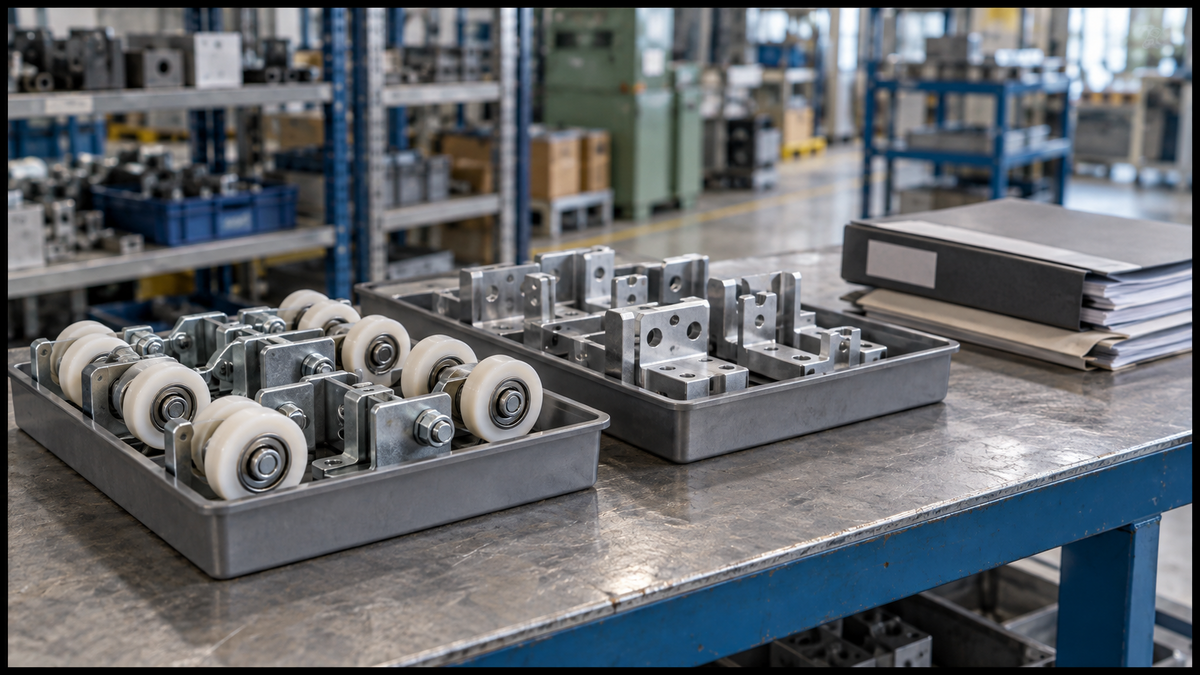
On 12 August 2024, RBC Krasnodar reported that Kahman planned to complete a factory modernisation by the end of the year, with stated capacity reaching up to 2,000 lifts annually. The report concerned a manufacturer in Krasnodar Krai, Russia, and attributed the plan to regional authorities. It was an announcement of intended expansion, not evidence that the capacity had subsequently been achieved.
The announcement raises a broader manufacturing question: when a factory expands and changes its component supply, how can it keep the identity of each product clear? The discussion below examines that organisational problem. It does not describe Kahman’s internal procedures or provide technical instructions for designing, certifying or maintaining lift equipment.
A larger workshop does not resolve a version question
Floor space and product identity answer different questions. A new workshop may provide room for more equipment or a different arrangement of work. It does not, by itself, establish which component belongs in a particular order. A factory can have space available while a production team still lacks an authoritative answer about a proposed replacement part.
The distinction becomes important when expansion coincides with changes in sourcing. Managers may be dealing with new suppliers, revised drawings, different packaging and altered delivery arrangements at the same time. Those changes need not be problematic individually. The organisational risk arises when information about them travels on different schedules and teams act on different versions of the same decision.
A purchase order might reflect the latest commercial discussion while a work instruction still refers to an earlier configuration. Alternatively, a revised production record may exist before the necessary parts have arrived. Neither situation can be resolved merely by asking everyone to work faster. The first task is to identify which record governs the decision and whether the other records have caught up.
Start with the order, not the most recent document
It is tempting to assume that the newest drawing or component list should govern every unfinished order. That assumption can create confusion. A change may apply only to future orders, a particular configuration or a defined group of units. The question is therefore not simply which document is newest, but which approved configuration applies to the item being built.
This is a matter of record management rather than a recommendation about any particular engineering change. The responsible technical specialists determine suitability and the applicable approval requirements. Other teams need a clear way to see the resulting decision without making that technical judgment themselves. A warehouse employee should not have to infer compatibility from a similar appearance or a familiar supplier name.
Separate identity from description
A descriptive name helps people recognise an item, but it may not distinguish revisions. Two components can share a broad label while differing in a way that matters to the product record. Conversely, a supplier may change a commercial description without changing the item. A reliable handover needs identifiers and applicable revision information, not just an informal name copied into an email.
The same principle applies to a finished unit. Its record should make it possible for authorised staff to determine what was actually supplied, rather than merely what a general catalogue currently describes. A catalogue represents an offer at a point in time. An individual production record concerns a specific item and its documented configuration.
A document should also distinguish its issue date from the date on which a change applies. An instruction published today may concern future orders rather than work already under way. Keeping both dates visible helps a later reader reconstruct the sequence without assuming that publication and application were simultaneous.
A purchasing alternative is not yet a production decision
Procurement may find an alternative when a supplier cannot meet a delivery date. That can be useful work without constituting permission to substitute the item. Commercial availability, technical acceptance and authorisation for a particular order are separate decisions. Combining them in the phrase “replacement approved” leaves too much room for different interpretations.
For example, approval to request a quotation does not establish approval to purchase. Approval to purchase samples does not establish permission for unrestricted production use. A team can avoid ambiguity by recording what a decision permits, what remains unresolved and who is responsible for the next action. This does not require every internal message to become a lengthy report; it requires the scope of the decision to be visible.
The commercial case also needs to preserve uncertainty. A lower quoted price can be compared with the existing price, but that comparison should not silently include unverified assumptions about rework, delivery reliability or inventory disposal. Where those effects are unknown, leaving them identified as unknown is more informative than presenting a precise saving that depends on them.
Old stock does not disappear when a change is approved
A revision creates an inventory question as well as a documentation question. Parts already purchased may remain suitable for some orders, may require a separate decision or may no longer have an authorised use. The physical quantity in the warehouse does not answer which of these situations applies. A stock report that treats all items with similar descriptions as interchangeable can obscure the issue.
Keeping the categories distinct allows a production planner to see available stock separately from stock awaiting a decision. Otherwise, an apparent surplus may coexist with a shortage for a particular order. The factory has material, but not necessarily material that can be assigned to that job. This is a mismatch of eligibility and demand, not simply a failure to buy enough.
- Distinguish stock assigned to an existing configuration from stock intended for a later one.
- Identify material whose disposition remains unresolved rather than counting it as freely available.
- Record the decision that changes an item’s status and the orders affected by it.
- Keep physical movements and their corresponding records consistent.
These are general organisational considerations. They do not establish whether a component can be reused, modified or installed. Such decisions belong to qualified personnel under the requirements applicable to the product. The administrative aim is to prevent an unresolved technical question from being hidden by an apparently complete inventory total.
The handover is where an assumption becomes an instruction
Many misunderstandings become visible only when work crosses a team boundary. A buyer may believe an alternative is ready because the supplier has confirmed delivery. A planner may believe it is ready because the item appears in the system. An assembler may receive a kit and reasonably assume that all prior decisions have been completed. Each person sees a different piece of the process.
A useful handover makes the status explicit at the point where another team will rely on it. What exactly is being handed over: a proposal, a sample, an approved purchasing item or material assigned to a specific production configuration? If the answer is not clear, a label such as “urgent” does not make the transfer complete. It merely adds pressure to an ambiguous task.
Responsibility also needs to follow exceptions. If a discrepancy is found, someone must own the decision about what happens next. Without that ownership, the same question can circulate among purchasing, planning and production while each team waits for another to respond. Tracking an exception as a decision with an owner is different from repeatedly forwarding the original message.
A qualitative example of a mixed transition
Consider an illustrative factory with an older order already in assembly and a later order still in planning. A supplier proposes a revised component for future deliveries. The example does not represent Kahman or any documented company case, and it assumes no particular technical compatibility between the versions.
In one approach, the revised item replaces the older entry everywhere as soon as its commercial record is created. The planning system then appears simpler, but the team assembling the earlier order may lose visibility of the configuration it was supposed to follow. A later reader could mistake the current entry for a record of what had originally been specified.
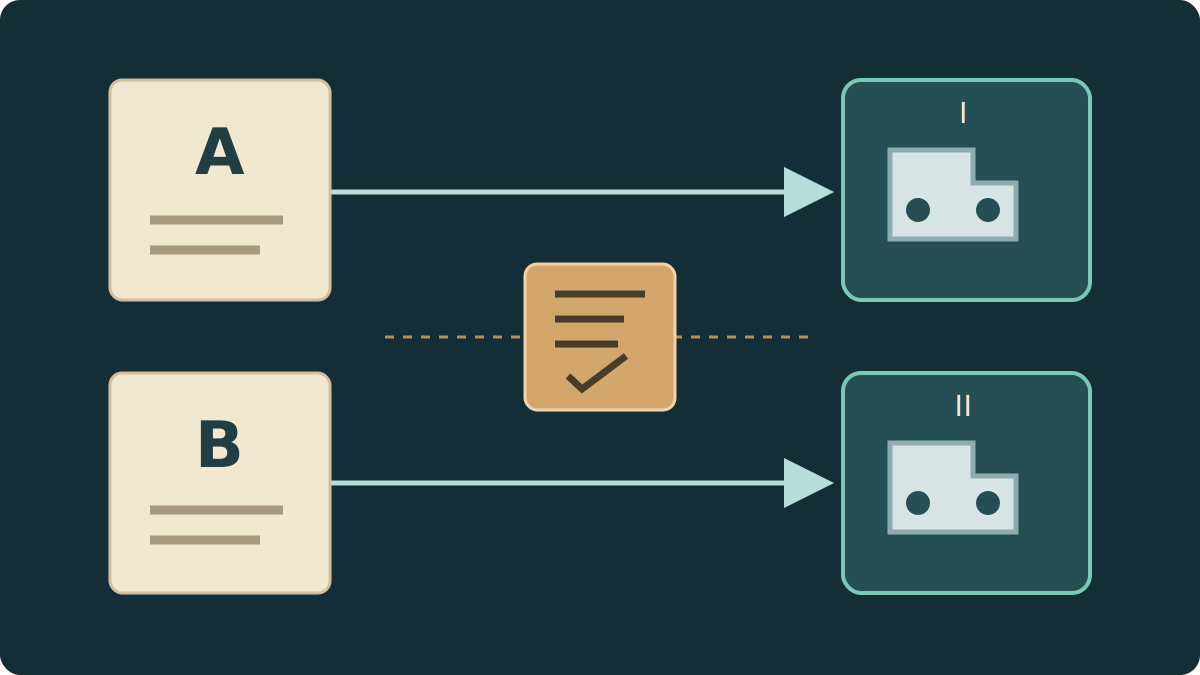
In another approach, the organisation retains the earlier order’s configuration and separately records the proposed change for later work. The authorised decision establishes the change’s scope before material is allocated. The records are less superficially tidy, because both versions remain visible, but they preserve the distinction between an existing commitment and a proposed future arrangement.
The second approach is not evidence that the alternative component is suitable. It simply preserves the information needed for the responsible people to make and apply that decision. This is the central point of the example: traceable records cannot replace technical judgment, but poor records can prevent a sound judgment from reaching the people who need to act on it.
Measure the transition without inventing a success rate
A management review can ask whether unresolved changes are accumulating, whether orders are waiting for disposition decisions and whether records agree with physical stock. These questions are more specific than asking whether the factory is “ready” in general. They can reveal which part of a transition needs attention without treating every delay as the same kind of failure.
The choice of measure matters. Counting completed approvals does not reveal whether the approvals cover the orders currently waiting. Counting available components does not reveal whether they belong to the required configuration. Counting closed exceptions may be misleading if closure means that a question was transferred rather than answered. A measure needs a definition that matches the decision it is intended to support.
No universal threshold is supplied here. A useful review would consider the nature of the product, the organisation’s responsibilities and the applicable requirements. Inventing a target from a general expansion announcement would imply evidence that the announcement does not contain. The immediate benefit of clear definitions is interpretability, not a guaranteed improvement in a headline metric.
Distinguish a pause from a reversal
A proposed change may be paused while evidence is collected without being rejected. Conversely, a decision to stop using a proposed alternative does not automatically explain what happens to samples, purchase commitments or partially prepared orders. Those consequences need their own recorded disposition. Treating every inactive proposal as a closed case can leave material and commitments behind without an owner.
A review can therefore distinguish the decision’s status from the status of its consequences. The proposal may be closed while a supplier credit remains unresolved, or the commercial arrangement may be settled while records still need correction. This distinction helps management ask a concrete follow-up question instead of assuming that one completed task settles the whole transition. It also keeps the record honest about work that remains without implying that a paused proposal has failed technically.
Service information is part of the record’s future use
A production record may be consulted long after the expansion project has left management’s agenda. Authorised service staff may need to identify the configuration of an individual unit, while commercial staff may need to explain what was delivered under an earlier order. If every record has been overwritten by the latest version, those questions become harder to answer.
Retaining the relationship between an order, its approved configuration and its documented supply does not mean keeping every informal draft forever. It means deciding which records provide authoritative evidence and how revisions remain distinguishable. Access should also reflect responsibilities: the ability to consult historical information is not the same as permission to alter it.
This longer perspective changes how a factory evaluates administrative shortcuts. A local convenience during a busy transition can create ambiguity for someone who was not present when the decision was made. An explanation that depends entirely on one employee remembering a conversation may be difficult to reconstruct after responsibilities change. The record should carry the decision’s meaning beyond that conversation.
What the expansion announcement can and cannot establish
The historical announcement provides a starting point for discussing growth. It does not establish the manufacturer’s actual production-control arrangements, the suitability of specific components or the later completion of the project. The organisational questions examined here remain separate from those factual claims. They should not be read as allegations of deficiencies at the named company.
Evidence about the project’s eventual outcome would require subsequent dated reporting. Evidence about a particular product configuration would require the relevant authorised records. Neither can be supplied by stretching an annual capacity figure into a description of operational readiness. A clear account keeps those levels of evidence separate, even when a simple narrative of expansion would be easier to tell.
The practical conclusion is narrower and more durable: when production arrangements change, the identity of the work needs to remain intelligible. New space, new suppliers and new component records only become a coherent operating arrangement when people can determine which decisions apply to which orders. That is an information and accountability problem as well as a matter of physical manufacturing capacity.
Historical source: RBC Krasnodar, Anastasia Nazarova, 12 August 2024.
Your perspective
Share your thoughts on the story.