

A recycling plant can produce exceptionally pure metal without recovering every gram that entered its gates. It can also process more material while producing less of the metal that matters commercially. Neither possibility is a contradiction. They follow from measuring different things: the composition of a finished product, the share of available metal recovered, and the weight of material put through a process. Confusing these measures turns an industrial announcement into a much stronger claim than the numbers support.
On 7 August 2024, Mining Weekly reported that the Royal Mint in the United Kingdom had announced a South Wales facility able to process up to 4,000 tonnes of circuit boards annually. In its own announcement, the company described the recovered gold as having 999.9 purity. These were company statements, not a report of a completed year's operating performance.
The announcement provides a useful starting point for a broader question. What would a reader need to know to understand a metal-recovery operation? The answer is not another impressive percentage. It is a set of quantities with compatible boundaries. The following analysis develops that distinction using invented arithmetic examples, not estimates of the Royal Mint's inputs, recovery efficiency, revenue or environmental impact.
Start with the material being measured
Consider three containers in an imaginary accounting exercise. The first holds incoming circuit boards. The second represents the gold contained within those boards, whether or not it can ultimately be recovered. The third represents the gold successfully recovered into a specified output stream. These are three different quantities, even when someone informally describes all of them as the plant's gold business.
The weight of incoming boards is not the weight of the gold inside them. Nor does a statement about the purity of an output describe the fraction of the original gold that reached that output. A percentage needs both a numerator and a denominator. Remove the denominator, and a technically correct number can become commercially misleading without changing a single digit.
For this analysis, output purity means the gold content of the recovered product divided by that product's total mass. Recovery fraction means the mass of gold recovered into the chosen output divided by the mass of gold present in the corresponding input. Feedstock throughput means the mass of material processed during a stated period. These definitions are deliberately separate. A reporting system may use additional measures, but it should not quietly substitute one of these for another.
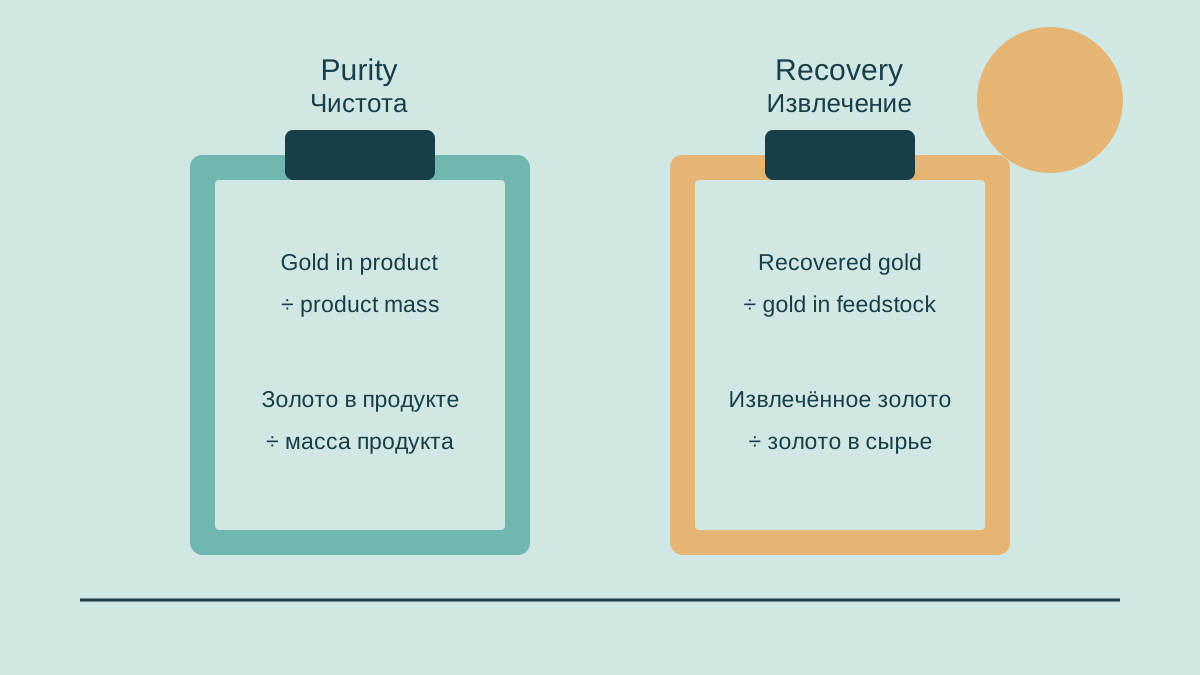
A small example separates purity from recovery
Imagine a batch containing exactly one kilogram of gold within a much larger quantity of other material. Suppose an imagined process delivers 0.8 kilograms of that gold into its final product. In this simplified example, the recovery fraction is 80 per cent. That calculation says nothing yet about the total weight or purity of the final product.
Now suppose that recovered product weighs 0.801 kilograms in total. Its gold content is still 0.8 kilograms. Dividing gold content by product mass gives a purity of approximately 99.88 per cent. The same batch therefore has a recovery fraction of 80 per cent and a product purity of about 99.88 per cent. A very pure product and incomplete recovery coexist in the arithmetic.
Reverse the emphasis. Another imaginary process could recover 0.9 kilograms of the original gold into a product weighing one kilogram. Its recovery fraction would be 90 per cent, while its product purity would be 90 per cent. It would recover more gold but deliver a less pure output at the boundary used in this example. Whether that output could be sold, or would need further processing, is a separate question that these numbers do not answer.
Keep the example inside its boundaries
These figures are selected only to make the denominators visible. They are not representative industrial yields, product specifications, prices or technical instructions. No conclusion about a particular technology follows from them. Their purpose is narrower: improving one percentage does not automatically improve the other, because the two percentages compare different masses.
Even the word recovered requires a boundary. Gold captured in an intermediate material is not necessarily the same measure as gold delivered in a final product. When two reports use different endpoints, a direct comparison can be invalid even if both reports are accurate. A reader needs to know where the measurement stops before deciding which operation appears to perform better.
More feedstock need not mean more recovered gold
Throughput adds another denominator. Suppose a hypothetical plant processes ten tonnes of material containing one kilogram of gold and recovers 80 per cent of that contained gold. The recovered quantity is 0.8 kilograms. Now imagine a second period with twenty tonnes of material, but with only half a kilogram of gold across the entire input. At the same recovery fraction, the output is 0.4 kilograms of gold.
In that example, feedstock throughput doubles while recovered gold halves. There is no mathematical inconsistency and no need to assume that the recovery process became less effective. The composition of the incoming material changed. Those deliberately invented quantities are not an estimate of the metal content of actual circuit boards; they demonstrate why a tonnes-per-year figure cannot independently determine a gold-output figure.
The opposite is also possible. A smaller input containing more gold could produce a larger recovered quantity. A comparison of two periods would therefore need information about their inputs, not just the weight processed. Otherwise a change caused by material composition could be mistaken for an improvement or deterioration in operating performance.
An announced maximum capacity introduces another distinction. It describes an ability under a stated or implied set of operating conditions, not the quantity necessarily processed over a completed period. Even if actual throughput later matches that capacity, calculating recovered metal would still require the relevant contained-metal quantity and the recovery fraction. Capacity alone does not fill those missing cells.
A calendar boundary can divide one physical batch
Annual totals seem easy to compare because they share the same dates. But matching calendar periods does not guarantee that the input and output refer to the same material. Imagine a batch arriving near the end of December, entering processing before year-end and reaching the chosen final-output stage in January. Its incoming weight and recovered metal could appear in different annual totals.
Dividing January's output by January's new input could then produce a number that describes a mixture of current activity and earlier work. The problem is not solved by adding more decimal places. It requires recognising material carried across the boundary. For a simple batch comparison, the denominator should correspond to the batch that produced the numerator.
A period-based account can instead explain opening material, additions, outputs and closing material within a defined process boundary. That is a conceptual reconciliation, not a claim that every published report must disclose a complete plant ledger. The important point is that metal still inside the boundary is different from metal already delivered outside it, and neither should disappear merely because the reporting year changes.
Where records do not reconcile, the difference needs investigation. It should not automatically be labelled an extraction loss, a theft, a measurement error or an inventory gain. Those are different explanations with different evidence requirements. A public announcement usually cannot settle them, and a commentator should not manufacture an operational diagnosis from an unexplained difference.
The denominator also has uncertainty
The arithmetic examples assume the quantity of gold entering each imaginary batch is known exactly. That assumption is useful for teaching the relationship but should remain visible. In an actual account, any uncertainty about the input quantity affects the calculated recovery fraction. An exact-looking output number cannot make an uncertain input estimate exact.
This does not require a discussion of laboratory methods to understand. If the denominator is revised while the numerator stays unchanged, the reported ratio changes. A reader comparing two periods should therefore ask whether the underlying definitions and estimation basis remained consistent. Otherwise an apparent change in process performance might partly reflect a change in the way the ratio was assembled.
The same caution applies when combining batches. A simple average of their individual recovery percentages does not necessarily equal the recovery fraction for all their contained gold. A batch holding a small amount of gold and a batch holding a much larger amount should not automatically receive equal weight. The combined fraction comes from compatible total recovered and total contained quantities, rather than an unqualified average of percentages.
For example, recovering half of one unit and all of nine units gives 9.5 recovered units out of ten, or 95 per cent overall. Averaging the two batch percentages, 50 and 100, would instead produce 75 per cent. This second invented example illustrates weighting, not any particular plant's reporting practice. It also shows why the level of aggregation matters as much as the headline percentage.
Physical output is not automatically a commercial result
A physical account and a commercial account answer different questions. The first can identify how much material crossed a defined boundary. The second asks what transaction occurred, under what agreed conditions, and what amount was actually received or owed. Knowing a quantity of recovered gold does not by itself reveal all the terms needed to calculate the commercial outcome.
For a hypothetical business, material might have been produced but not yet delivered to a customer. Another hypothetical business might process material owned by someone else rather than sell recovered metal for its own account. These are possible arrangements, not descriptions of the Royal Mint. Their relevance is that the same physical output figure can sit within different business relationships.
Multiplying a recovered quantity by a quoted market price would therefore be only a narrowly defined illustration. It would not establish realised revenue, margin or cash generation. It would leave unanswered questions about ownership, timing, contractual settlement and the costs within the chosen business boundary. This article does not calculate a projected return because the announcement is not a complete commercial model.
Nor does a purity figure establish an environmental benefit. Such a claim would require its own comparison, scope and supporting evidence. Keeping that question separate is not an argument against recycling. It is a way to avoid asking one measurement to prove several unrelated outcomes. Product composition, physical recovery and environmental performance are different subjects.
What a useful operating explanation would distinguish
A concise disclosure can be informative without pretending to contain every operational detail. Its value comes from making the measures interpretable and consistent. For a reader seeking to understand a metal-recovery operation, the following distinctions would be more useful than an isolated percentage:
- The material included in the throughput figure, and whether the number is designed capacity or actual processing during a specified period.
- The input and output boundaries used for any recovery calculation, including whether the output is intermediate or final.
- The denominator behind a purity statement, kept separate from the denominator behind a recovery fraction.
- The treatment of material that enters in one reporting period and remains within the process at its end.
- The basis for aggregating batches with different contained-metal quantities, alongside any material estimation limitations.
- The distinction between physical output and whatever commercial or environmental conclusion is being discussed.
This is an analytical framework, not a description of undisclosed procedures at a named facility. An operator may have information that is not public, and a short announcement may have a different purpose from a detailed performance report. Absence from an announcement does not demonstrate absence from the company's internal records.
That distinction matters for criticism as well as praise. It would be unjustified to call a plant inefficient because its press release does not provide a recovery fraction. It would be equally unjustified to infer near-total recovery from a statement about very pure gold. Both judgments would cross the same evidential gap in opposite directions.
Read the announced achievement at its actual scale
The strongest interpretation of an industrial announcement is often the most carefully bounded one. A statement about a new processing capability can be significant without becoming evidence of every later operating result. A statement about product purity can be useful without telling us how much contained metal was left elsewhere. Precision means retaining those limits, not treating them as an inconvenience.
For a business reader, the practical lesson is to follow the material through the calculation. Ask what enters, what is contained within it, what leaves at the selected endpoint and what remains across the reporting boundary. Then ask which of those quantities the headline actually measures. Only after that is it sensible to compare periods, batches or businesses.
Pure gold is a property of an output. Recovery is a relationship between compatible inputs and outputs. Throughput is a quantity of material processed over time. Keeping those three ideas distinct makes the business discussion more useful: it explains what an announcement establishes, what remains unknown and what further evidence would be needed before drawing a larger conclusion.
Your perspective
Share your thoughts on the story.