

A customer who leaves a coat in the wardrobe for another month has made no visible announcement to the neighbourhood dry cleaner. There is no cancellation form and often no conversation. The counter simply receives one less order. For the business, that silence creates a difficult question: has the customer left, reduced the number of garments needing professional care, or merely moved a familiar purchase further into the future?
On 4 May 2026, Kommersant described pressure on dry-cleaning demand in Russia. Its interview with Aquarelle proprietor Tatyana Nekhorosheva highlighted weaker demand and efforts to preserve customer relationships. That was an operator’s account, not a measurement of every local market. It provides the starting point for the independent business analysis below.
Three counts that should not become one
A shop can begin with three different records: visits, garments and money. They are connected, but they answer different questions. Visits describe how often someone comes through the door to place an order. Garments describe the work accepted. Revenue describes what the business charges for that work. Treating any one of these as a complete measure of demand hides changes that matter at the counter.
Suppose a regular customer brings several items together rather than making separate trips. The visit count falls, but the number of garments need not. The average order becomes larger without any improvement in the price paid for an individual service. Conversely, a familiar customer might still visit at the usual time but leave fewer items. The relationship remains visible while the workload attached to it shrinks.
These are possible patterns, not claims about what happened at the business interviewed by Kommersant. Their practical value is diagnostic. A shop responding to fewer visits with a blanket discount may reduce income from garments that would have arrived anyway. A shop seeing a larger average receipt may assume customers are spending more freely when they are actually combining trips to save time.
A longer interval is not a cancelled subscription
Dry cleaning does not necessarily follow a fixed renewal date. A garment may be worn occasionally, stored between seasons or brought in before a particular event. Without an agreed schedule, the absence of a repeat order cannot be read like the cancellation of a monthly contract. The operator needs a reference point that reflects how that customer previously used the service.
One approach is to compare customers first seen in similar periods and ask how many have returned after comparable amounts of time. The important qualification is comparable. A recently acquired customer has had less opportunity to return than someone acquired much earlier. Mixing both groups can make retention appear to worsen even when their behaviour is unchanged.
The same caution applies when a new service attracts people with different needs. A customer bringing a special-occasion garment need not repeat as frequently as one using the shop for routine workwear. Neither should automatically be labelled better or worse. They represent different purchasing rhythms, and the shop’s offer, opening hours and staffing need to be understood against that mix.
The wardrobe changes the average receipt
A higher average receipt can result from a different collection of garments rather than a price increase. A lower one can reflect fewer items per order rather than customers switching to a cheaper service. The distinction matters because a response aimed at price will not necessarily address a change in what is being brought to the shop.
A useful comparison holds the service category reasonably steady. The operator can look separately at recurring garment groups and at additional services actually accepted, rather than placing every receipt into one average. The categories should remain simple enough for staff to apply consistently. An elaborate classification that changes according to who is on duty creates apparent trends out of recording differences.
This is not an invitation to infer how an individual garment should be treated. Technical suitability belongs to the qualified assessment of the item. The commercial question comes afterwards: which work was accepted, what was charged, and how much staff time and other resources did that order require? A more expensive order is not automatically a more attractive one if it demands substantially more attention.
An estimate and an accepted order are different stages
Some demand becomes visible before a garment is handed over. A customer asks about the price, describes an item or visits the counter to discuss a deadline. Recording every such conversation as an order exaggerates the workload. Ignoring all of them loses evidence about where people stop before making a purchase.
A modest record of enquiries can distinguish a price question from a timing problem or a service the shop does not offer. The purpose is not to collect a detailed personal history. It is to identify recurring obstacles in the transaction. A customer who needs an earlier collection date presents a different problem from one who is satisfied with the timing but declines the quoted charge.
Staff should also avoid assigning a reason that the customer never gave. An unanswered estimate is simply unresolved unless there is further evidence. Calling every unresolved enquiry a price rejection can lead management to discount a service whose real obstacle is something else, such as uncertainty about the collection process or whether the item can be accepted at all.
The calendar has more than one date
An order passes through several moments: enquiry, acceptance, completion and collection. Those dates need not coincide. A busy collection counter may be handing back work accepted earlier, while the number of new orders is weakening. Equally, a strong intake day can create little immediate collection activity. The visible queue alone is an incomplete account of the business.
Separating those stages helps the operator understand what staff are actually doing. Taking in garments, answering questions and locating finished orders all use attention, but they are not interchangeable tasks. A single total of people served may hide a shift towards conversations and collections that produces less new work than an equally busy day in the past.
Payment timing introduces another distinction. Where payment is taken at acceptance, the cash movement occurs before the item is returned; where it is taken later, the timing differs. A shop should analyse its own arrangement consistently rather than compare a cash total with another business’s order total. This is an operational distinction, not a proposal to change contractual terms.
What a change in timing can look like
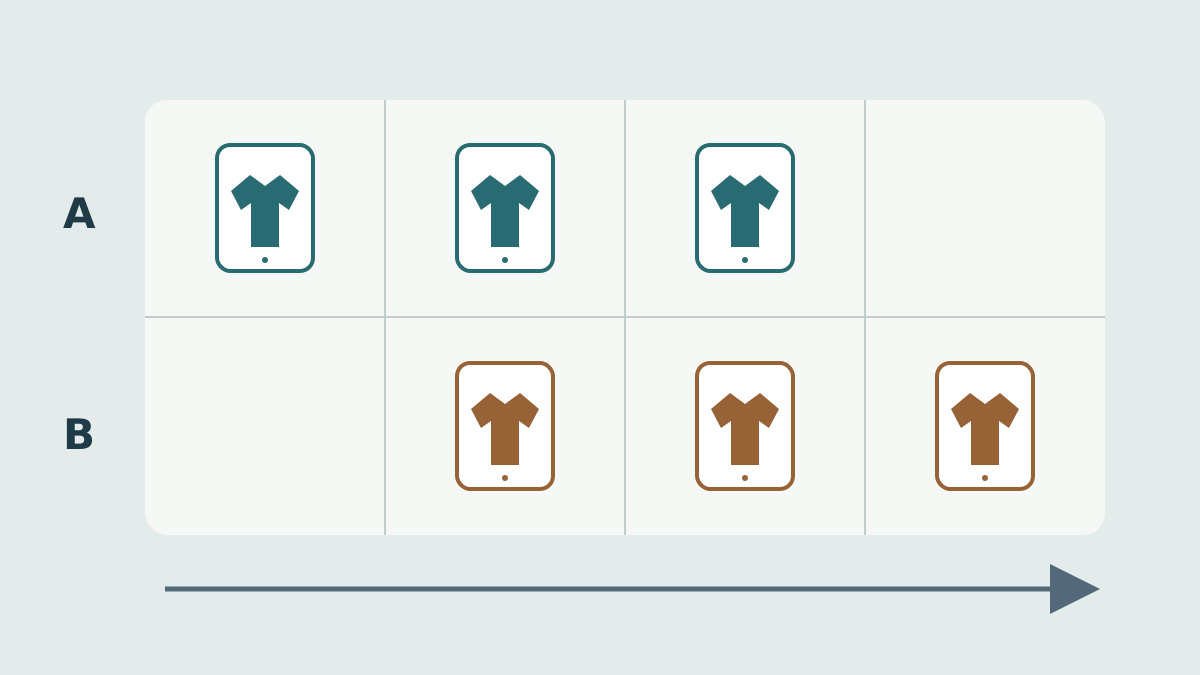
Consider two illustrative calendars containing the same customers and the same set of orders. In the first, the orders are distributed across several periods. In the second, customers postpone their visits and the orders appear later. An observer looking only at an early period would see a sharp difference, even though the complete example contains no difference in total orders.
This deliberately simplified comparison is not a forecast or a finding about actual customers. In reality, some postponed orders might never arrive. Its purpose is to show why the observation window matters. Management needs both a near-term view of the workload and a longer view that can reveal whether an apparent loss was a delay, a lasting reduction or a combination.
Being remembered is different from being needed today
A customer may continue to value a shop while having no immediate reason to use it. That creates a limit to promotion: reminding someone of a service does not create a garment that requires it. A business can make the next transaction easier, but it should not assume that every quiet customer needs persuading to purchase immediately.
The useful relationship may be built around clarity. Customers can understand what information to bring when asking about an item, how an estimate becomes an accepted order and how they will know that collection is possible. These are specific parts of the service experience. They offer a clearer management task than a broad instruction to staff to be more attentive.
There is also a boundary to unpaid attention. An extended consultation consumes staff time even if it does not lead to an order. A shop can be helpful without promising unlimited assessment, instant answers or a result before the item has been examined. Clear boundaries protect both the customer’s expectations and the time available for work already accepted.
A discount changes the order, not just the headline price
A general price reduction is easy to communicate but difficult to interpret afterwards. Some customers may have ordered at the original price. Others may bring forward work they would have placed later. A larger intake during the offer therefore does not, by itself, establish that the shop gained lasting demand or improved its economics.
A more informative test starts with a specific problem. If customers repeatedly decline because a collection arrangement is inconvenient, the business can examine that arrangement rather than immediately reducing every price. If a clearly identified service has spare capacity, an offer limited to that service may be easier to evaluate than a discount spread across unrelated categories.
Even a narrow test needs a boundary. The operator can define the eligible work, the observation period and the resources it expects to use. Afterwards, it can separate additional accepted orders from orders merely moved between dates. No comparison will remove every uncertainty, but a defined question makes the result more useful than a temporary increase in receipts alone.
Collection can become a separate bottleneck
Finished garments still require space and a reliable way to locate the correct order. If collections concentrate at particular times, a shop may experience pressure at the counter even when processing capacity is available. Treating that pressure as evidence that the entire business needs more production equipment would confuse two different parts of the operation.
The first question is where the delay occurs. Is a customer waiting for an item to be finished, or is a finished item taking time to retrieve? Is the collection information clear, or do customers arrive expecting work that is not ready? These distinctions can be investigated without claiming that all shops suffer from the same problem.
Changes should then match the observed problem. Better organisation of finished orders addresses retrieval; clearer communication addresses uncertainty about readiness. Neither automatically solves a shortage of processing time. The value of separating stages is that it prevents a single busy moment from becoming a justification for an unrelated investment or a promise the shop cannot reliably keep.
A small dashboard is more useful than a confident label
The operator does not need a large reporting system to begin asking better questions. A consistent set of definitions is more important than a crowded spreadsheet. The following measures form a possible starting point, provided they can be collected without disrupting service or gathering unnecessary personal information:
- Accepted orders and garments, counted separately.
- Receipts within stable service categories, rather than one blended average alone.
- Repeat visits observed over comparable intervals.
- Enquiries that become orders, with reasons for declining recorded only when known.
- Outstanding work and finished orders awaiting collection as separate groups.
- Staff attention required by intake, assessment and collection.
These measures are prompts for investigation, not universal targets. A neighbourhood shop and a collection point serving a different customer base can have different patterns without either being inefficient. Comparisons become useful when they account for the offer, the customers and the stages of work, rather than assuming that one number describes every business.
The dashboard also needs a decision attached to it. If repeat visits weaken while enquiries remain steady, the next investigation differs from one in which enquiries disappear. If garment counts remain stable but revenue falls, the mix and charges deserve attention. If accepted work grows but collection becomes difficult, the bottleneck may sit after the main service has been completed.
Leave room for the diagnosis to change
The most useful explanation is one that can be revised by evidence. A shop may initially suspect that customers are postponing work. If enough time passes and the expected return does not occur, that explanation becomes less convincing. If visits resume but contain fewer items, the relationship may have survived while the level of demand has changed.
Likewise, a successful short promotion should not become proof that price explains everything. Its effect may depend on timing, the garments included or customers already planning a visit. Looking at what happens after the offer helps distinguish a temporary rearrangement of orders from a more durable change in purchasing behaviour.
A quieter counter therefore calls for a sequence of questions rather than a single dramatic conclusion. What has changed: customers, visits, garments, accepted work or collection timing? Which part is visible in the records, and which remains an assumption? A business that can make those distinctions has a better basis for its next service decision, even when it cannot predict when every familiar customer will return.
Historical reporting: Kommersant, Nikita Putyatin, 4 May 2026.
Your perspective
Share your thoughts on the story.