

A point on a map can be perfectly clear while the last part of a delivery remains uncertain. A driver may know which building contains the destination and still need to choose between a public entrance, a service gate and a courtyard reached from another street. That distinction matters when a business adds more precise location information to its order process. Better positioning can remove one question without answering the next one.
ETGovernment reported on 28 May 2025 that the Department of Posts in India had launched the Know Your DIGIPIN and Know Your PIN Code portals. DIGIPIN provides a grid-based digital location reference. The launch offers a useful starting point for a separate operational question: after a destination has been located, what information makes the final approach usable?
This is not a test of the system's encoding method, nor a claim that its introduction has already changed delivery performance. It is a way to examine the relationship between a location reference and a delivery instruction. A retailer or carrier considering such references needs to preserve that distinction. Otherwise, the apparent certainty of a precise point can conceal unresolved choices about arrival, access and the person or place that will accept the parcel.
The destination contains more than one decision
For planning purposes, it is helpful to separate four objects. The destination point identifies a position. The entrance identifies a way into the relevant premises. The approach describes how a delivery reaches that entrance. The handover point identifies where the agreed transfer takes place. These objects can coincide in a simple delivery, but a process designed around that coincidence may struggle when they do not.
A small shop with a street-facing counter might require little explanation beyond its ordinary address. A business occupying space inside a larger compound may need more. Its office could sit close to one boundary, while the entrance available for deliveries is on another side. Drawing a shorter line to the office does not establish that the boundary can be crossed. Nor does a point inside the compound identify which doorway a recipient expects the carrier to use.
The distinction is commercial as well as geographical. A promise to deliver to a reception desk differs from a promise to carry an item to an internal department. Both can refer to the same destination on a map. If the order process never identifies the agreed handover, a carrier and a customer can each believe the destination was understood while holding different expectations about the service. A more detailed location reference cannot resolve an agreement that was never made.
The useful question is therefore not whether one form of address is more modern than another. It is whether each piece of information has a clear job. A business can use a location reference to reduce ambiguity about position while retaining ordinary address text and a separate entrance instruction. The additional fields should clarify a decision that someone actually has to make; collecting more description without a defined use merely transfers clutter into the delivery task.
A courtyard makes the difference visible
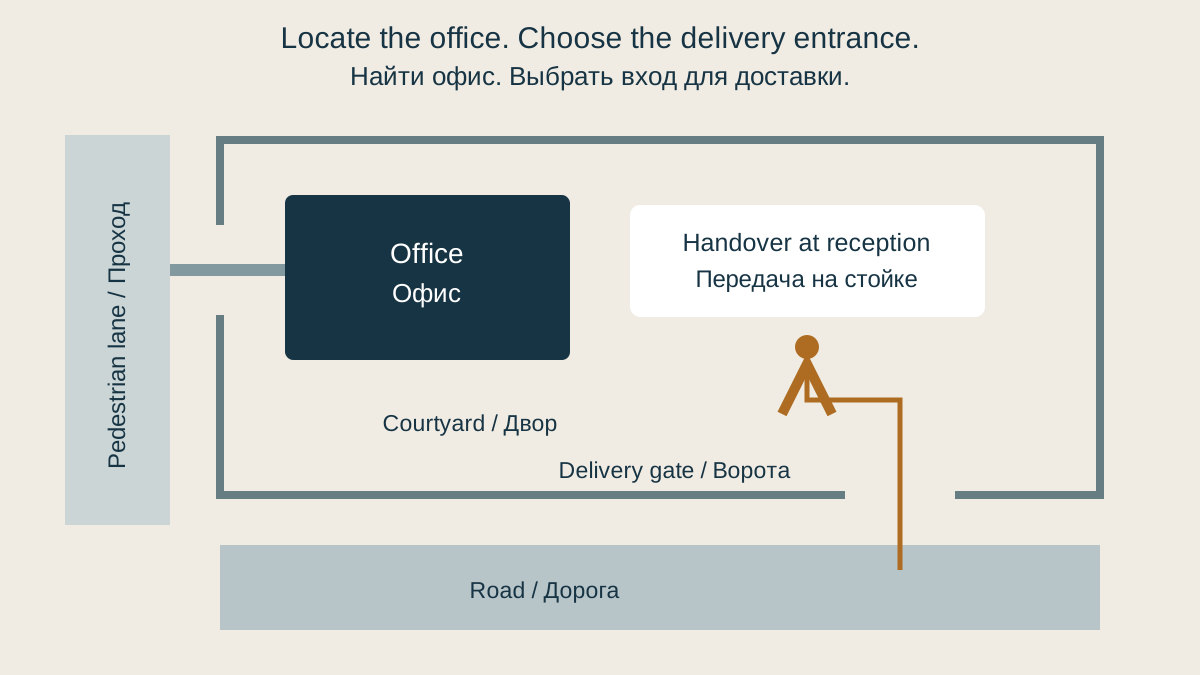
Consider an illustrative site with an office facing a narrow pedestrian lane and a delivery gate opening onto a wider road behind the courtyard. The office is the destination. The rear gate is the agreed entry for the delivery in this example. A reception point inside the courtyard is the agreed handover. This is a qualitative planning example, not a description of a particular customer, mapped site or observed DIGIPIN delivery.
If the route ends at the closest visible boundary to the office, the driver arrives on the pedestrian side. The destination position can still be correct. The failure lies in treating proximity to the destination as a sufficient instruction for access. Moving the destination point to the rear gate may help that journey, but it also changes what the point means. An office position has quietly become an arrival position, and another user might interpret it differently.
A cleaner arrangement keeps those meanings separate. The destination remains identified as the office, while the delivery record names the agreed gate and handover point. The approach can then be considered in relation to that gate. There is no need to pretend that the building has moved or that one coordinate can express every condition of the service. The improvement comes from giving each operational decision an explicit reference.
Compare two instructions, not two levels of precision
In the first version of this example, the order gives only the destination location. In the second, it also identifies the rear delivery gate and the reception handover. The two versions need not differ in positional precision at all. Their difference is that the second removes an entrance choice. This comparison helps a business test whether its unresolved problem concerns locating premises or deciding what to do after the premises have been located.
The example should not be turned into a universal rule that every delivery needs several map points. A simple destination may already be unambiguous. The point is to recognise the cases in which location and access diverge, then ask for the smallest additional instruction that resolves the divergence. A long compulsory form for every customer can create a new source of friction without improving the deliveries that were already straightforward.
Ask questions that the recipient can answer
Customer input is most useful when the question names an observable choice. Asking which entrance receives deliveries is more concrete than asking for a better address. Asking whether the agreed handover is at reception or another identified place can reveal an expectation that would otherwise remain implicit. The wording should not require the recipient to understand a carrier's routing terminology or diagnose the underlying data model.
A business also needs to decide when to ask. An entrance question may be relevant when a customer identifies a compound, shared building or separate receiving area. Requiring the same explanation for an ordinary street-front destination may add little. A conditional question can be useful if its trigger is understandable and if the customer can correct an incorrect assumption. The process should not infer a complicated site merely because the address contains an unfamiliar name.
Nor should the recipient be made responsible for decisions outside their knowledge. A person can identify an entrance without being able to confirm that a particular vehicle can approach it. Information about gates, reception and contact arrangements is not the same as a carrier's assessment of the route or service capability. The delivery record should distinguish what the customer supplied from what the operator has actually checked, rather than merging both into an undifferentiated instruction.
- Identify the premises without changing the meaning of their location reference.
- Ask for the delivery entrance when it is different or ambiguous.
- State the agreed handover point in ordinary language.
- Keep customer observations separate from operational checks.
- Provide a way to report that an instruction no longer matches the site.
These are proposed design checks, not a description of mandatory fields in the announced portals. They apply to the surrounding delivery workflow. The distinction prevents a business from attributing its own service rules to the location system, and it makes responsibility clearer when a field is missing. An incomplete delivery instruction and an invalid location reference are different problems with different remedies.
Test the chain beyond the map screen
A pilot should follow the information through the complete task. It is not enough to confirm that a location code can be entered and displayed. The business needs to see whether the relevant entrance instruction reaches the person making the approach, whether it is understandable at that point, and whether the handover expectation remains visible. A field can be present in an order record but absent from the practical view used during delivery.
Consider a limited trial that deliberately includes both straightforward destinations and sites with more than one plausible entrance. The purpose is not to produce an impressive success rate from the easiest cases. It is to discover whether the added information changes a specific decision. If the process works for a street-front shop but loses the entrance note for a courtyard delivery, that contrast identifies a workflow gap more clearly than an aggregate completion figure alone.
Observation should distinguish an instruction that was unavailable from one that was available but unclear. Those findings call for different changes. The first may require the information to be carried into the operational view. The second may require a better question, shorter wording or a more precise description of the intended entrance. Repeating the same request to the customer will not necessarily fix either problem if the point of failure is downstream.
The pilot also needs an ordinary fallback. A driver who encounters contradictory information should not be forced to choose silently between a mapped point and an entrance note. The operator needs a defined way to clarify the instruction within its existing service process. This is not an argument for collecting unlimited personal information. It is an argument for knowing what happens when the available destination information is insufficient to complete the agreed task.
Measure the missing decision
A general category such as unsuccessful delivery can hide several unrelated events. The destination might not have been found; the selected entrance might have been unsuitable; the receiving point might have differed from the agreed one; or the recipient might not have been available. Combining them makes it difficult to judge what more precise location information has changed. A business should choose categories that correspond to decisions it can realistically improve.
The categories should remain modest. They do not need to reconstruct every movement or claim certainty about a driver's reasoning. A short record that distinguishes an approach problem from a recipient-contact problem can already help prevent the wrong remedy. Adding another location field is unlikely to answer a question about an unavailable recipient. Conversely, repeating a contact request may leave a confusing entrance instruction untouched.
A before-and-after comparison also needs comparable tasks. If the later group contains mostly simple destinations while the earlier group contains many multi-entrance sites, a change in results cannot safely be attributed to the new information. The business can keep the comparison narrow, document obvious differences and resist converting a small operational trial into a broad claim. The aim is useful evidence for a specific workflow, not a headline about universal delivery improvement.
Entrances change without moving the destination
Access information can become outdated even when a building stays in the same place. In a planning example, a customer may change which gate receives parcels or move the receiving desk within the premises. That is a revision to the delivery arrangement, not necessarily a correction to the destination's geographic position. Treating every such change as a location error can corrupt the meaning of the record and obscure what actually needs updating.
A revision process should therefore identify the field being changed and the reason. The customer might correct an entrance name, clarify a handover instruction or report that a previously used access point is no longer appropriate. The operator should know whether the revised instruction applies to one order or to later deliveries as well. A one-off exception should not silently become a permanent description of the premises.
It is equally important to avoid unnecessary duplication. If several internal systems keep independent copies of entrance notes, a correction can reach one view while leaving another unchanged. The practical question is which record governs the next delivery and how the relevant view receives a revision. A business does not need to redesign its entire information system to ask that question, but it does need an answer before relying on the new field.
Precision should support the service promise
One further check concerns the lifetime of an instruction. A gate selected for this order should not automatically become the default for every kind of delivery to the same premises. The record can distinguish an enduring site description from a choice made for a particular service. Otherwise, information that was correct in one context can be reused in another without anyone noticing that the underlying agreement has changed.
The value of a precise location reference depends partly on the decisions around it. A clear destination, a usable entrance and an agreed handover can reinforce one another. They should not be collapsed into a single promise that greater positional precision automatically means a completed delivery. Each component removes a different uncertainty, and the weakest remaining component can still determine the customer's experience.
For a retailer or carrier, the practical next step is to identify where its own delivery information stops being sufficient. If the problem is finding the premises, a better location reference addresses that question. If the premises are known but the entrance remains ambiguous, an entrance instruction deserves attention. If expectations differ about where the parcel is accepted, the service agreement needs clarification. Diagnosing the missing decision is more useful than assuming that every failure is an address-format problem.
The May launch supplies a concrete reason to revisit that distinction, not proof that it has disappeared. Businesses can welcome better tools for describing position while remaining precise about the work those tools do not perform on their behalf. The useful endpoint is not a tidier marker on a screen. It is a delivery record that helps the people involved reach the agreed place and complete the agreed handover without guessing what the other party meant.
Source: ETGovernment, 28 May 2025. The operational examples and evaluation framework above are independent analysis, not reported delivery outcomes.
Your perspective
Share your thoughts on the story.