
A machine that completes several operations without handing a job to another workstation can make that job finish sooner. It does not follow that every collection of jobs will finish sooner. The missing question is what the previous arrangement could do at the same time. Combining steps changes not only a route through production, but also the opportunities for different jobs to overlap. That distinction is easy to miss when the comparison follows one item from its first operation to its last.
On 29 February 2024, Interfax reported equipment renewal at ODK-Saturn in Rybinsk, Russia. The company described combining previously separate operations as a way to reduce processing and setup work. This was a company account, not a comparative study of production schedules.
The following analysis takes that general question away from the named factory. Its times, jobs and resources are invented. They do not describe aircraft components, actual equipment capabilities or the reported installation. Their purpose is to separate two ordinary scheduling measures: the time taken by an individual job and the time taken to complete a collection of jobs. No technical operating method or recommendation to buy a particular machine follows from the example.
Follow one job, then follow the resources
Begin with a job requiring two operations in a fixed order. It cannot start the second before completing the first. If each operation occupies ten units of time and the transfer takes no time, the job needs twenty units from start to finish. That is a statement about its own route. It says nothing yet about how much other work the resources can complete while that job is moving through the system. To answer that question, the resources must be placed on the same clock.
Suppose the first operation has its own resource and the second has another. Once the first job moves to the second resource, the first resource can begin a different job. The two jobs are not individually skipping a step. They are progressing through different steps simultaneously. A drawing that places all operations in one long line would conceal this overlap. Conversely, a drawing that lets one resource perform two jobs at once would invent overlap that the model has not allowed.
A small example produces two different winners
Separate resources and one combined resource
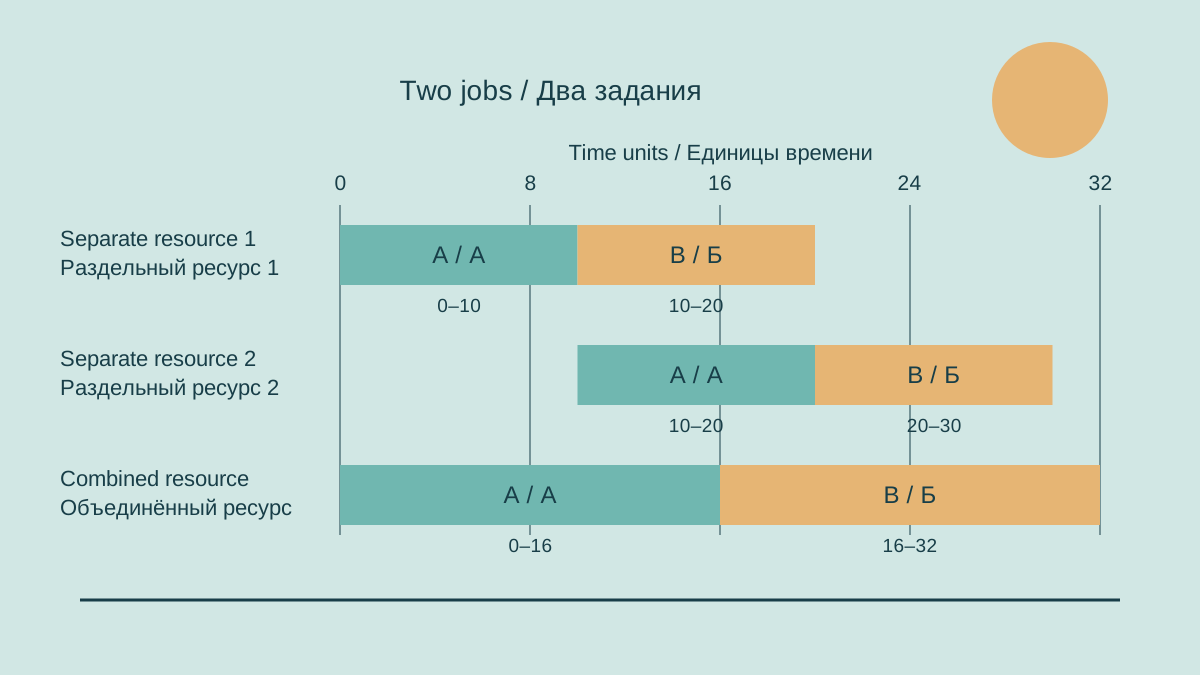
Assume two identical jobs, A and B, are available at time zero. Each needs the same two operations, each lasting ten time units on a dedicated resource. There is no setup, transport delay, inspection delay, breakdown or external queue. The resources can work independently, and completing an operation makes its job immediately available for the next. These are deliberately simple assumptions, not claims about what a real workshop can omit or how it should be staffed.
Job A occupies the first resource from zero to ten and the second from ten to twenty. Job B follows on the first resource from ten to twenty, then uses the second from twenty to thirty. A finishes at twenty and B at thirty. During the middle interval, both resources are working: one on B's first operation, the other on A's second. The pair takes thirty time units to complete, although each job has twenty units of processing.
Now replace those two resources with one combined resource. Assume, purely for comparison, that it can perform all the required work for one job in sixteen time units. A runs from zero to sixteen; B runs from sixteen to thirty-two. The first completion is earlier than before, but the last is later. Nothing has gone wrong with the arithmetic. The combined route is shorter for each job, while the two-job schedule has lost the overlap between separate operations.
For a customer waiting only for A, the first result may be the relevant one. For a customer requiring A and B together, the last completion may matter more. Neither customer's measure should be silently substituted for the other's. Even in this stripped-down example, saying that the new arrangement is simply faster leaves out the identity of the promised output. A complete job and a complete order containing several jobs are different delivery units.
A longer run changes the weight of the first completion
Extend the example to eight identical jobs, still all available at the start. In the separate arrangement, the first completes at twenty and another completes every ten time units. The eighth therefore finishes at ninety. The combined resource completes one every sixteen units, so the eighth finishes at one hundred and twenty-eight. This is not an estimate of industrial productivity. It shows how a fixed advantage in the first completion can be outweighed by a different interval between subsequent completions.
Under these particular assumptions, the separate arrangement finishes a run of n jobs at ten times n plus ten; the combined arrangement finishes at sixteen times n. Those expressions are descriptions of the invented schedule, not universal formulas for machine consolidation. Changing either operation time, allowing additional resources, introducing setup or changing when jobs become available changes the comparison. The useful habit is to construct a common schedule, not to carry these particular numbers into a procurement calculation.
A common denominator is especially important when a trial reports a reduction in processing time per item. That result can be genuine and valuable while remaining incomplete for an order-book question. A trial of one available job does not automatically measure a stream of jobs. Equally, a long uninterrupted run can miss the value of producing a single urgent item promptly. The trial's workload determines which of those questions it is equipped to answer.
Arrival times can reverse what the example seems to favour
The two-job comparison started with both jobs ready at zero. Suppose instead that A arrives at zero and B becomes available at twenty. In the separate arrangement, A completes at twenty and B completes at forty. On the combined resource, A completes at sixteen; the resource then waits until twenty, and B completes at thirty-six. The combined arrangement now completes both jobs earlier individually and finishes the pair earlier. The resource times have not changed. The arrival pattern has.
This does not prove that sparse demand is preferable. It shows that an assumed queue is part of the experiment. If the jobs are not available together, the opportunity for overlap can disappear before any equipment decision is considered. If they are available together, ignoring their competition for the same resource can overstate the benefit of a shorter route. Both effects can be represented without guessing demand: retain the actual release times in a retrospective comparison and identify hypothetical future arrivals separately.
The moment a job is released also needs a consistent meaning. A sales enquiry, a confirmed order and work with all required inputs available are not interchangeable starting points. A comparison starting one arrangement before its inputs arrive and the other after they arrive is measuring different intervals. The example avoids that problem by defining availability explicitly. A practical record needs an equally clear boundary, even if the chosen boundary differs from the one used here.
Independent resources are an assumption, not a free gift
The separate arrangement achieved overlap because its resources were permitted to operate independently. If a shared support resource prevents both operations from running at once, the displayed schedule is no longer feasible. That does not require a complicated theory to establish: two overlapping reservations for the same unavailable support cannot both be honoured. The combined alternative should not be compared with an old schedule that assumes independence the old arrangement never possessed.
The reverse error is also possible. A trial may compare a carefully prepared new workstation with an old process deprived of a support resource it normally has. The resulting difference mixes equipment, staffing and scheduling conditions. It can still describe what happened during that trial, but it cannot isolate the effect of combining operations. A fair account names what changed together, rather than assigning every improvement to the most visible new piece of equipment.
None of this implies that the two alternatives must use identical resources to be worth comparing. They may be intentionally different designs. The requirement is to describe those differences, including the resources counted outside the machine itself. A shorter route obtained with a different support arrangement remains a legitimate alternative; it simply answers a broader question than whether combining two nominal operations alone produced the observed result.
Queues and unfinished work belong on the same timeline
In the original example, B waits ten units before starting on the first separate resource. Its processing takes twenty units, but its time from initial availability to completion is thirty. On the combined resource it waits sixteen units and then runs for sixteen, finishing at thirty-two. This makes a third distinction visible: processing duration, waiting duration and total elapsed time are related, but they are not the same measurement. A shorter processing duration does not remove the need to identify waiting.
Unfinished work at the end of a reporting window introduces a related issue. If the clock stops at twenty-five, the separate arrangement has completed A and has B in its second operation. The combined arrangement has also completed A and is still working on B. Counting only finished jobs gives the same count at that instant, although the schedules lead to different later completion times. The unfinished jobs have not disappeared simply because they fall outside the chosen reporting cut-off.
A useful comparison therefore retains start and finish times for the same set of jobs, rather than combining a completed-job count from one window with a per-job duration from another. If some jobs remain unfinished when observation ends, that fact should be visible. It does not justify assuming an eventual finish time or treating work in progress as an equivalent completed unit. The treatment of incomplete jobs can materially change what a short trial appears to demonstrate.
The order promise determines what to compare
A production discussion can contain several valid objectives. One order may need its first usable item quickly; another may require the complete set together. A third may tolerate separate deliveries but assign priority to particular jobs. These are different scheduling questions even when the underlying operations are identical. A single average duration cannot encode all of them. The comparison should start with the delivery unit and deadline actually being evaluated, then identify the relevant completion times.
It is also important not to convert every time difference directly into money. Finishing an item earlier does not by itself establish an earlier sale, payment or avoided charge. Those outcomes depend on commercial circumstances outside the example. Likewise, a later batch completion is not automatically a lost order. The model can identify a difference in availability; it cannot supply the missing contractual or demand evidence needed to value that difference.
Keep the comparison reproducible
A compact record can preserve the logic without pretending to be a complete engineering study. The central requirement is that another reader can reconstruct which job occupied which resource at each stage. The following fields would support that reconstruction:
- The jobs included and the time each became available.
- The required operation order and resources counted in each arrangement.
- Start and finish times, with waiting distinguished from processing.
- The completion measure: first item, full order or another explicitly defined output.
- The observation cut-off and any jobs still unfinished at that point.
Quality, suitability and safe operation remain separate requirements; a scheduling example cannot establish them. If the alternatives produce outputs that are not accepted on the same basis, comparing their completion times alone is insufficient. Nor does this exercise decide how a real factory should organise its operations. It explains why a statement about a shorter route needs a defined workload and output before it becomes a statement about the performance of an entire production arrangement.
The point is not that combining operations helps or harms capacity in general. It changes the set of activities that can overlap, and that change must be evaluated alongside any reduction in processing or transfer time. Following one job reveals one part of the result. Following all relevant jobs on the same clock reveals another. Keeping both views visible makes an improvement claim more precise without turning an invented timetable into evidence about a named manufacturer.
Your perspective
Share your thoughts on the story.