

A cold store can have the same number of usable positions on two successive days and still offer very different room for incoming goods. The difference may have nothing to do with construction, refrigeration equipment or the nominal size of the building. It can arise because goods expected to leave are still occupying their places. A departure plan is therefore part of the explanation of future availability, not merely an administrative detail following storage.
In a feature dated 31 March 2026, ANTARA reported on Papua authorities' efforts to develop fisheries logistics, including cold-storage infrastructure, in Indonesia. The report described development initiatives and official expectations. It was not an operating account showing how a particular store's positions became available over time.
That distinction leaves room for a separate analytical question: how does the timing of release affect the next intake? The example below uses invented positions and events to answer it. None of its figures describes Papua, an actual operator, fish volumes or safe storage durations. It isolates a scheduling relationship, while leaving product handling requirements and the physical design of a real facility outside the model.
Capacity is a stock; movements happen in sequence
For the example, suppose a small store has ten identical usable positions. Each unit in the example occupies exactly one position. All positions are treated as interchangeable, and there are no separate restrictions on compatibility or handling. These assumptions are deliberately simple. They make it possible to follow the arithmetic without pretending that a real cold store can be represented adequately by a single count.
At any point, occupied positions plus empty positions equal ten. An intake occupies previously empty positions; a completed departure releases occupied positions. A planned departure does not yet release anything. That last distinction may sound obvious, but it becomes important when a promise about tomorrow's intake is based on something expected to leave before the new goods arrive.
The sequence of events matters even if daily totals are identical. A departure before an intake can make room for that intake. The same departure after it cannot make room at the earlier moment. A report that records only the day's combined arrivals and departures can therefore hide an intraday conflict. Net change describes the difference between two snapshots, not necessarily every constraint encountered between them.
In this article, release means that an occupied position has actually become usable again within the model. It is not defined as the time an order is entered or a vehicle is booked. In a real operation, the appropriate definition would need to reflect the relevant process and constraints. Here it is simply the event that reduces occupancy by one.
A ten-position example makes the dependency visible
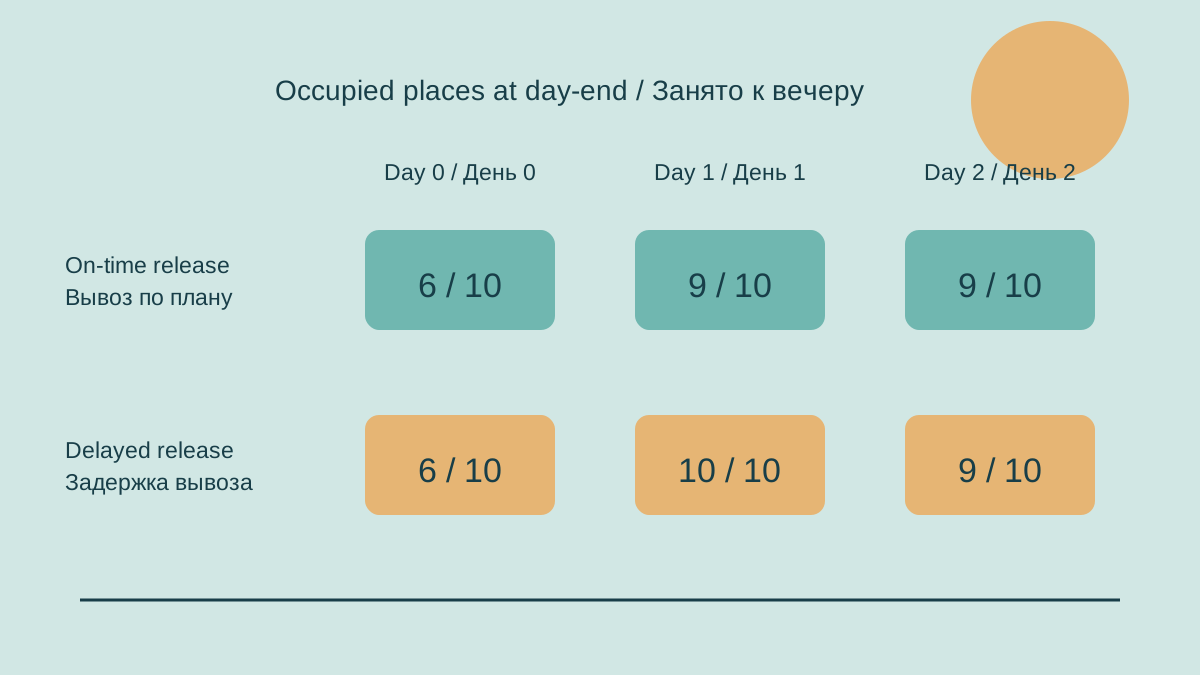
At the end of Day 0, six positions are occupied and four are empty. Four of the occupied positions are scheduled to be released on the morning of Day 1. Seven new units are expected that afternoon. To keep the example narrow, no other arrivals or departures occur during the two days that follow.
In the planned sequence, the four morning releases reduce occupancy from six to two. Eight positions are then empty. The seven afternoon units fit, increasing occupancy from two to nine. One position remains empty at the end of Day 1. On Day 2, with no further movements in this branch of the example, occupancy remains nine.
The new intake does not fit because the building has seven empty positions at the starting snapshot. It has only four then. It fits because an earlier event changes the available space before intake. The distinction is between current room and room that will exist if the release plan is carried out in the intended sequence.
Now delay the release by one day
Suppose the four planned releases do not happen on Day 1 and instead occur on the morning of Day 2. Occupancy remains six when the seven new units are due. Only four can be admitted within the ten-position limit. The other three cannot enter at that moment under the model's assumptions. Attempting to admit all seven would require thirteen positions, which the model does not have.
For the revised schedule, assume those three units can have their intake rescheduled to Day 2 under a separately suitable arrangement. This is a mathematical assumption, not advice to leave food waiting outside or to extend a product's permissible storage period. The example does not specify where the units remain, who bears any cost or whether a real shipment could be rescheduled safely.
After four units enter on Day 1, occupancy is ten. On the morning of Day 2, the delayed release of four reduces it to six. The three rescheduled units can then enter, bringing occupancy to nine. Both branches end Day 2 with nine occupied positions, but only the original branch accepted all seven incoming units on Day 1.
The same final occupancy can conceal different service
A final snapshot would not distinguish those branches. Both show nine occupied positions and one empty position. Both eventually admitted seven new units and released four old ones. Yet three units entered a day later in the revised schedule. The service difference appears in the timing of events, not in the final occupancy or the total number of movements alone.
This does not establish that one branch earned more revenue or incurred a particular penalty. Those conclusions would need commercial terms and other facts that the example does not contain. It does establish that equal final utilisation is compatible with different intake timing. A manager or reader interested in service availability therefore needs more than the closing occupancy percentage.
Nor is the delay evidence that the store needs a larger building. Additional positions would change the example, but they are not the only imaginable change. The timing of intake, the reliability of release or the accepted commitments could also differ. Selecting between real options would require information about costs, product requirements, customers and operational feasibility, none of which is supplied here.
The analytical result is narrower and more useful: a promise to accept goods can depend on another party's or another process's earlier movement. That dependency should be visible when the promise is discussed. Hiding it inside a forecast occupancy number makes a conditional intake look unconditional.
Separate a booking from a completed release
A departure booking is information about a proposed event. It is not the event itself. In a hypothetical planning record, the operator could retain the expected release time alongside the fact that the positions remain occupied. The two entries are not inconsistent. One describes the plan; the other describes the current state.
Replacing current occupancy with forecast occupancy too early would lose that distinction. The record might show eight available positions because four are expected to clear, even while only four are actually empty. A reader who cannot tell which meaning of available is being used could make an intake commitment against space that has not yet been released.
A useful discussion therefore names the condition: the seven-unit intake fits if the four-unit release happens first. That sentence communicates more than a green availability marker. It identifies both the dependency and the sequence needed for the plan to work. If the release time changes, the affected intake can be recognised without recalculating an unrelated part of the schedule.
There is no claim here that bookings are inherently unreliable. The issue exists even when most planned movements happen on time. A record can acknowledge a dependency without predicting that it will fail. The purpose is to preserve a clear distinction between a completed change in physical occupancy and a planned change that supports a later commitment.
Longer stays tie up positions, but the relationship needs boundaries
In the delayed branch, four older units remain in place for an extra day. Those positions cannot simultaneously accommodate four different units during that interval. This is a consequence of the one-unit-per-position assumption, not a claim about a particular type of fish or a recommended storage period.
It would nevertheless be misleading to turn the example into a universal formula promising a fixed annual throughput from ten positions. The model covers a short, explicitly ordered sequence. It does not describe arrival variability over a year, different product dimensions, unavailable positions or other operating restrictions. A capacity forecast would need assumptions about those features rather than silently extending the example.
Even an average stay can conceal important timing. Two schedules can have similar averages while concentrating releases differently. A clustered intake may face a shortage of available positions at a particular moment, even if an average over a longer period appears comfortable. The issue is not that averages are useless, but that they answer a different question from whether a specific intake fits at its scheduled time.
For the same reason, a day with high occupancy is not automatically evidence of strong commercial performance. It could reflect deliberate storage commitments, delayed release or another combination of circumstances. The position count describes a state. Explaining why that state exists requires information about the material and the movements that produced it.
Space is only one resource in a real operation
The invented schedule assumes that every allowed movement can take place when scheduled. It does not model loading areas, handling equipment, staffing or other constraints. Passing the ten-position test is therefore necessary within the example but not proof that a real operation could execute the same sequence.
Suppose the four planned releases occur before the afternoon intake in the record. That alone does not establish that a real operator has sufficient handling capacity to complete both activities in the available time. Conversely, an available loading slot does not establish that storage positions have cleared. The two resources answer different feasibility questions.
Product compatibility is also excluded from the simplified position count. A real empty location cannot be assumed suitable for any incoming product simply because it is unoccupied. This article provides no temperature, hygiene, segregation or shelf-life guidance. Those requirements must not be overridden to make a scheduling example appear workable.
The sensible use of the model is to expose one dependency before moving to the next relevant constraint. It is not a substitute for an operational plan. A clear boundary prevents a simple arithmetic explanation from acquiring an authority it does not have.
A concise movement record can show what a snapshot misses
For this example, a useful record would preserve the starting state and the ordered changes. It would not need to contain every detail of a real warehouse system to make the arithmetic inspectable. A few explicitly defined items would distinguish the planned branch from the delayed one:
- The ten-position limit and the assumption that each example unit occupies one interchangeable position.
- The six occupied positions at the end of Day 0, kept separate from forecast availability.
- The four-unit release, with planned timing distinguished from completed timing.
- The seven-unit intake and its dependence on the release happening first.
- The revised admission of four units on Day 1 and three on Day 2 if release is delayed.
- The final occupancy of nine in both branches, alongside the different intake timing.
This is not a mandatory reporting format. Its value comes from retaining the information needed to reconstruct the example. An unexplained final percentage would not do that. Nor would separate daily totals if they omitted the order of movements that determines whether the limit is respected.
A real scheduling conversation would also need to identify who can confirm a change and which commitments depend on it. Those relationships cannot be inferred from the physical count. The model can show that a revision is needed; it cannot decide which customer or shipment should bear the consequences. That remains a separate commercial and operational discussion.
Plan the release before treating future space as available
Infrastructure creates the possibility of storage, but a count of positions does not explain when those positions can accept the next goods. The distinction matters particularly when several movements are connected in time. A delayed departure can affect a later intake without changing the store's physical capacity at all.
The ten-position example demonstrates this without assuming a market forecast or an operating result. Four releases before seven arrivals leave one position empty. Delay those releases, and three incoming units need a revised intake time. The same final occupancy then records two different service histories.
For readers assessing a logistics plan, the useful question is not only how much space exists. It is which completed or conditional releases make the proposed intake possible, and whether those releases occur early enough. A departure plan makes future availability understandable. It does not guarantee that every constraint has been solved, but it prevents a promise about tomorrow's space from being mistaken for a fact about today's empty positions.
Your perspective
Share your thoughts on the story.