
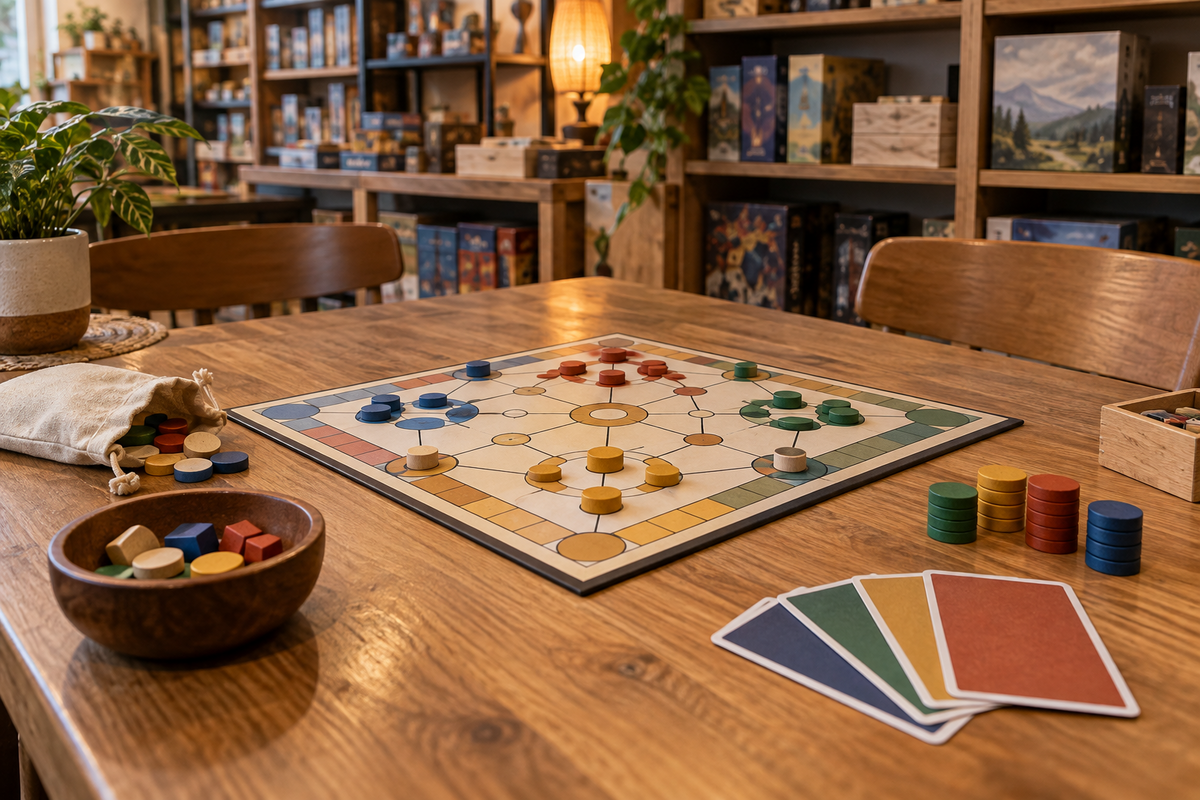
A customer can read a price label without help. Understanding whether a board game will suit a particular evening is harder. The box may describe player numbers and a suggested duration, but it cannot show how awkward the first turn feels, whether the rules are easy to explain, or how much conversation the game leaves room for. A demonstration table addresses that uncertainty. For a shop, however, the table is also a commercial commitment: space, an opened copy and the attention of somebody who could be serving another customer.
The issue has a concrete retail backdrop. In its February 2, 2026 report on board games in Russia, Kommersant described publishers' concern about losing physical opportunities to introduce games as sales move online. GaGa Games said it had retained one St Petersburg store while redirecting resources towards online sales. Those statements do not establish the profitability of any particular demonstration. They do identify the service whose economics deserve closer examination.
The table is a service, not just a display
A shelf holds products. A demonstration changes what a visitor knows about a product. That distinction should shape both the shop's offer and its measurement. If the customer already knows the exact edition wanted, an extended explanation may add little. If the customer is choosing a first game for a mixed group, a short encounter can answer a question that a row of sealed boxes leaves unresolved. The commercial task is to match the demonstration to that question, rather than give every visitor the longest available performance.
Consider two requests. One visitor wants something that can be explained before dinner gets cold. Another wants a demanding game for a regular group that enjoys learning together. The same demonstration would not serve both equally well. For the first, showing one decision and how a turn passes may be enough. For the second, the shop might explain how choices interact over a longer session. These are alternative service designs, not evidence that one customer is more valuable or deserves more attention.
The table also creates expectations. A visitor invited to try a game should not discover afterwards that sitting down carried an undisclosed charge or an obligation to buy. A shop can offer free short introductions, bookable paid sessions or both, provided the distinction is clear in advance. The business model depends on what has actually been promised. Counting a free introduction as if it were paid event attendance would hide the cost of the offer rather than explain it.
Start with the uncertainty the customer brings
A useful opening question is not simply which genre the customer likes. It is what the game needs to do in the intended setting. Will the group have a fixed amount of time? Does somebody need to leave midway? Is the buyer choosing a present without knowing the recipient's collection? A demonstration cannot resolve every uncertainty, but identifying the important one makes a brief interaction more purposeful. It can also reveal when opening a particular game would be unnecessary.
For example, a customer may be comparing two titles because their boxes look similar. Showing the different kind of decision each requires could be more useful than explaining every scoring rule. The shop can stop once the customer understands the distinction. Conversely, a visitor who needs a full learning session should not be rushed through a superficial presentation sold as complete tuition. Matching scope to the request protects the customer's time and helps the shop decide what level of staffing the service requires.
Define a small set of service formats
- A brief comparison answers a specific buying question without playing a complete game.
- A scheduled introduction reserves enough time to teach the opening sequence to a group.
- A longer event offers participation and hosting as a service in its own right.
- A self-guided sample lets visitors examine components without promising continuous staff support.
These formats need not all exist in one shop. Their purpose is to prevent one vague label, demonstration, from covering activities with very different costs. A quiet weekday comparison and a crowded evening event should not share a single average unless their differences remain visible underneath it. The format is also a useful boundary for staff: they can explain what is available now and what requires a booking without making arbitrary exceptions at the table.
The full cost is more than an opened box
The sample copy is the most visible expense. Once opened for repeated use, it belongs in the shop's demonstration inventory rather than silently remaining among new saleable stock. The relevant cost depends on how it was obtained and how long it remains useful. A publisher-supplied copy, a purchased copy and a borrowed event copy are different arrangements. None should be treated as an unlimited resource merely because no cash changes hands on the day of a particular session.
Staff time is less obvious. Preparation, learning the rules, putting components back, answering follow-up questions and checking the sample can all sit outside the minutes spent with visitors. A store that records only the public session may underestimate the service it is providing. A practical trial can track these activities in broad blocks rather than ask employees to account for every second. The aim is a usable estimate, not an administrative task that consumes more effort than it explains.
Floor space has an alternative use as well. A table may displace another display or make a narrow aisle harder to navigate. Yet it would be misleading to charge the table with the entire rent if the premises would be rented anyway and the unused corner has no realistic alternative purpose. The useful distinction is between costs that change because the service exists and costs that remain. Longer-term decisions can examine the premises as a whole; a short trial needs a clearly stated, narrower comparison.
The condition of the sample matters to the service itself. A missing card or mixed set of components can turn a useful introduction into a confusing one. A simple contents check between sessions helps separate a problem with the sample from a problem with the game. Where several staff members use the same copy, a shared note can identify what needs replacing. That is not a requirement for an elaborate asset system; it is a way to avoid repeatedly spending teaching time on a preventable interruption.

A small calculation with explicit assumptions
Suppose a shop is testing one afternoon of demonstrations. The following numbers are invented solely to illustrate the calculation; they are not a report of any retailer's results. Assume the extra hosting and preparation cost is 3,000 roubles. Allow another 600 roubles for sample wear and event consumables. The additional cost of this trial is therefore 3,600 roubles. Assume, separately, that an additional completed game sale contributes 900 roubles after the product's purchase cost and the variable selling costs relevant to that shop.
Under those assumptions, four genuinely additional sales would cover the trial's additional cost. This is not a claim that four visitors are sufficient. Some visitors may buy nothing, some may buy a product they had already planned to purchase, and some may return later. The calculation concerns incremental contribution, not headcount or total till receipts. If a sale would have happened without the table, assigning all its contribution to the trial would overstate what the demonstration achieved.
The example also shows why turnover is an unsuitable substitute. A game with a higher selling price can leave less contribution after purchasing and fulfilment costs. A discount given after the demonstration can change that contribution again. The shop does not need to publish its internal margin calculations to customers, but it needs a consistent internal definition before comparing sessions. Otherwise, a busy afternoon can look successful in revenue terms while producing little to fund the service that made it busy.
A paid session changes the arithmetic, not the need for clarity. If attendance revenue is included, the shop should subtract the costs attached to delivering that event before comparing it with a free introduction. If the attendance fee becomes a credit against a later purchase, the same money must not be counted twice. Recording the event payment and the product transaction as separate steps makes the relationship easier to understand without treating every participant as a prospective retail conversion.
Measure the result without building a surveillance project
Perfect attribution is rarely available from a small shop experiment. A visitor might try a game, discuss it at home and return another day. Another might attend because they already intended to buy. The uncertainty is real, but it does not justify collecting an extensive personal history. An anonymous tally of session format, approximate attendance, staff time and purchases voluntarily associated with the event can provide a useful starting point. Participation in a demonstration should not depend on agreeing to unrelated marketing contact.
A voluntary question at checkout can distinguish several situations: the demonstration helped choose this title, it confirmed a decision already made, or it was unrelated to the purchase. The answers are imperfect and should be described that way internally. Staff should not be rewarded for assigning every transaction to the table, because that would encourage a favourable number rather than an informative one. A small amount of honestly uncertain evidence is more useful than a precise-looking conversion rate built from optimistic classifications.
Comparison also needs context. A holiday weekend cannot fairly be compared with an ordinary wet Tuesday without acknowledging the difference. A shop could compare similar time windows, record major promotions and note when a featured game was unavailable. This does not turn the trial into a controlled scientific experiment. It does reduce obvious confusion between the effect of the demonstration and the effect of a full shelf, a seasonal rush or a price promotion happening at the same time.
Repeat visitors are not automatically a problem
A demonstration area can become a place people enjoy returning to. That may support the store's identity, but it creates a choice about what the business is offering. If the area is intended for short product discovery, repeated full-length play can occupy the resource needed for new visitors. If the shop wants to host a community programme, repeat attendance may be central to its purpose. The problem is not the visitor; it is an undefined service model.
Clear scheduling can separate the two. The store might reserve certain periods for brief introductions and other periods for longer events. A visitor can then understand the terms before arriving. Staff do not have to improvise a different rule for each group. A paid event should offer a recognisable service, such as hosting and reserved participation, rather than function as a surprise penalty for spending time in the shop. The value proposition and the charge need to describe the same activity.
The shop should also avoid assuming that all benefits must become an immediate purchase. A well-run event might be worth retaining as a deliberate marketing or community expense. That is a legitimate management decision if its cost and purpose are explicit. Calling it a retail profit centre while overlooking a recurring shortfall is a different decision disguised by language. The owner can choose to subsidise an activity; the accounts should make that choice visible.
A publisher can share the work without owning the recommendation
Suppliers may be interested in a shop's ability to introduce unfamiliar games. Possible arrangements include sample copies, teaching materials or support for a particular event. Any such arrangement needs a defined scope: what is supplied, who prepares the session, what happens to the sample afterwards and whether a particular title must be featured. These are matters for agreement, not benefits that every shop can assume it will receive.
Support also creates a boundary between promotion and advice. If a session is devoted to one publisher's title, visitors should understand that focus. A customer asking for an open comparison should not unknowingly receive a recommendation chosen solely because a supplier funded the table. Commercial support can make a useful service affordable, but it should not make the stated purpose of the interaction inaccurate. The shop's credibility rests partly on being willing to say that a featured game is not the right fit.
Joint evaluation can remain simple. The shop can report the number and type of sessions delivered, general questions visitors raised and whether the available stock matched the event's needs. It should not promise detailed personal information or claim sales causation it cannot establish. The publisher and retailer may value different outcomes: product familiarity, staff knowledge or direct purchases. Agreeing those objectives beforehand prevents a discussion about performance from becoming a disagreement about what the event was meant to accomplish.
Decide what to keep after the trial
A time-limited trial needs a decision date and a manageable set of observations. The owner can examine additional contribution, hosting effort, congestion, customer feedback and the condition of demonstration stock. Not every measure needs to improve at once. A format that produces useful conversations but overwhelms one employee might be shortened or scheduled differently. A popular long event might belong in a paid programme rather than compete with ordinary shopping at the busiest hour.
The final question is not whether physical demonstrations are universally superior to online descriptions. They solve a different problem and carry a different cost. A shop earns the right to keep the table when it can explain which uncertainty the service removes, what resources it uses and why the resulting benefit is worth paying for. That explanation may lead to a larger programme, a smaller table or no permanent table at all. What matters is that the decision follows the shop's own evidence rather than the reassuring sight of people gathered around a game.
Your perspective
Share your thoughts on the story.