

An auction can attract a larger audience while finding it harder to assemble its next sale. In a 24 January 2025 report by Evgenia Stogova for RBC, auction operators in Russia described strong previous-year trading, while Bidspirit head Alexander Kiselevsky warned about the availability of objects coming to market. Those were participants’ assessments, not a complete inventory of privately held collections. They nevertheless raise a useful commercial question: what replenishes an auction catalogue after a successful sale?
The answer cannot simply be more marketing to bidders. A bidder campaign and a consignment programme work on opposite sides of the transaction. One seeks people willing to compete for the offered objects; the other seeks owners willing to offer particular objects under an agreed selling arrangement. Success on either side may help the other, but neither automatically supplies what the other lacks. For an auction business, treating both activities as one undifferentiated growth campaign can conceal the constraint that actually determines the next catalogue.
The next catalogue is a separate commercial asset
Consider what a completed sale leaves behind. It produces transactions, experience, contacts and information about the response to individual lots. It does not leave the sold objects available to sell again on the same terms. A manufacturer may place another production order for a repeatable product. An auction organiser dealing with distinct objects cannot assume that a comparable collection will arrive because the previous collection found buyers. The next sale therefore needs a supply plan of its own, rather than an extrapolation from the last event’s receipts.
This distinction matters even when the catalogue looks full. A long list assembled from objects already offered elsewhere, owners who have not decided to proceed and items awaiting essential information is different from a shorter list of prepared consignments. Counting both lists as equivalent supply makes it difficult to judge whether advertising, specialist time or another round of owner conversations deserves attention. The useful question is not merely how many potential lots appear in the working document, but which decisions still stand between each object and a defensible public listing.
An organiser can keep a provisional view without pretending that uncertainty has disappeared. Early conversations belong in the working plan because they influence staffing and the possible shape of the sale. However, they should remain visibly separate from objects that owners have actually agreed to consign. A dated note explaining the unresolved decision is more informative than repeatedly carrying the same hopeful item forward. This is not an argument for discarding tentative opportunities; it is an argument for giving them the correct status.
Owners supply decisions as well as objects
An owner may be willing to discuss a collection without wanting to sell it now. Another may be prepared to sell only part of it. A third may prefer a particular sale context or need time to consider the proposed arrangement. These possibilities are not evidence of inefficiency or irrational behaviour. They reflect the fact that the auction house is dealing with someone else’s property and preferences, not ordering interchangeable goods from its own warehouse. A supply plan becomes more realistic when it records the owner’s decision rather than only the specialist’s enthusiasm.
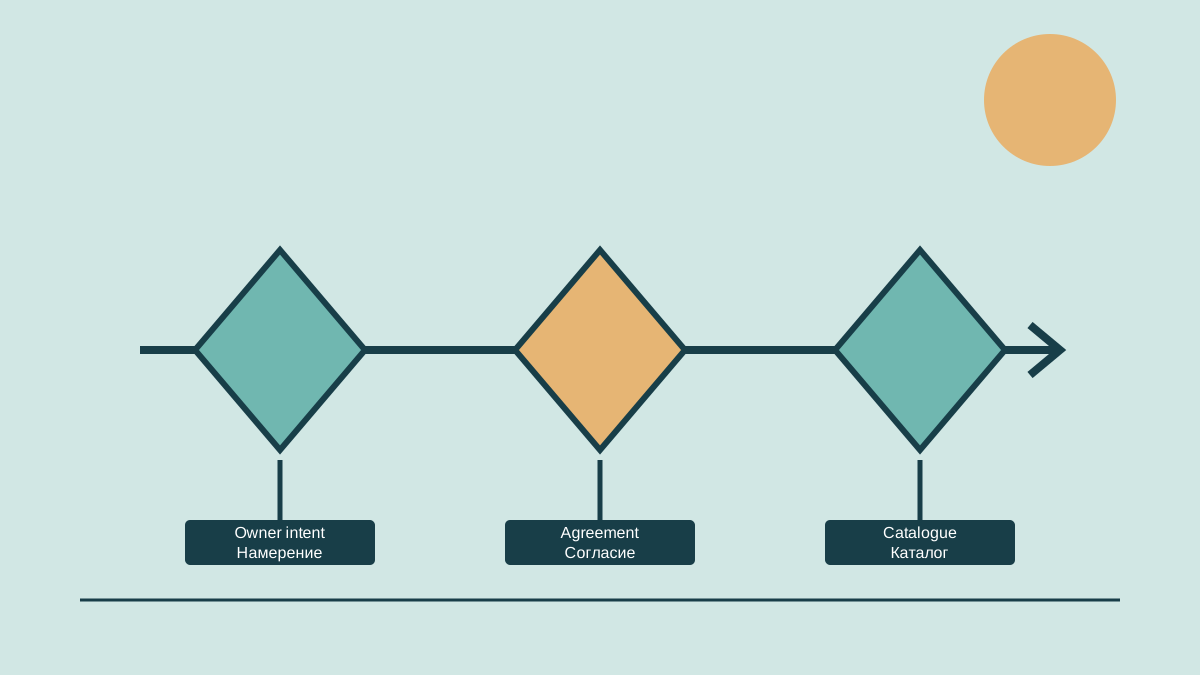
For example, an introductory conversation might establish which objects are under discussion and whether the owner is considering a sale at all. A later conversation might clarify what information the organiser needs before making a proposal. Agreement on the proposal is another decision again. Combining these steps into a single label such as “collection secured” removes useful distinctions. It can also create internal pressure to announce a sale around a collection whose owner has not made the decision on which the announcement depends.
Clear communication should not become a promise of a particular sale result. Explaining the proposed process, the intended audience and the work required to prepare a catalogue is different from assuring an owner that enthusiasm will translate into a specific price. An auction house can describe what it will do without claiming control over what bidders will do. Preserving that distinction gives the relationship a firmer basis than a competitive contest over optimistic expectations. The commercial proposition concerns the service and the selling arrangement, not a guaranteed future outcome.
A large collection can make supply look safer than it is
Suppose much of a proposed sale depends on a single collection. The working catalogue may contain many entries, but the decision to proceed could still rest largely with one owner. Counting the entries alone would miss this concentration. If that collection is withdrawn or postponed, the organiser does not lose one independent opportunity; it loses a connected group. This is why the number of objects and the number of independently committed consignors answer different planning questions.
Diversification does not mean assembling unrelated objects merely to increase the number of owners. It means recognising shared dependencies and deciding how much exposure the sale can carry. Several consignors may still depend on the same unresolved preparation issue, while one carefully prepared collection may be entirely appropriate for a dedicated event. The point is to describe the dependency honestly. Management can then choose a sale format and timetable that fit it, instead of reading a large spreadsheet as proof that the supply problem is solved.
There is also a distinction between a relationship and immediate inventory. A specialist may have a productive long-term conversation with a collector who is not currently consigning anything. That relationship can deserve attention without being included in the next sale’s committed supply. Maintaining a separate record of future owner conversations prevents the catalogue from becoming the sole measure of relationship work. Otherwise, staff may be encouraged to treat every contact as an imminent lot, which makes both the relationship record and the sale plan less credible.
Catalogue coherence is not the same as catalogue length
A sale needs a comprehensible proposition for its audience. Adding more objects can strengthen that proposition when the additions make the selection more useful or more coherent. It can weaken it when they are included only because empty space looks uncomfortable. This is a curatorial and commercial judgment, not a universal rule that small sales are better. The relevant test is whether the proposed selection gives a plausible reason for the intended audience to examine it, and whether the organiser can explain the connection without exaggerating the objects’ importance.
Preparation capacity also belongs in that judgment. Each extra entry can require descriptions, photographs, correspondence and review. Those tasks are not eliminated by calling the object a minor lot. If the team expands the catalogue beyond the work it can competently complete, the apparent supply gain can create a different shortage: insufficient attention to the material already accepted. The appropriate response might be a different sale date or a separate selection, not necessarily rejection of the owner. What matters is matching a public commitment to the actual preparation work.
Keep evidence and presentation distinct
Attractive presentation cannot replace information needed to describe an object responsibly. Equally, an internal checklist is not proof of authenticity, ownership or condition. Questions requiring specialist judgment must remain questions for appropriately qualified review. For planning purposes, the auction team can distinguish information received, information checked and matters still unresolved, without pretending that a completed administrative field settles a substantive issue. This article is about organising that work, not supplying an authentication method or a legal standard.
A useful internal handover identifies what a description relies on and who should resolve any open question before publication. If a photograph is replaced, the team needs to know which object and catalogue entry it belongs to. If an owner supplies new background information, the public description may need review rather than automatic expansion. These are basic controls on the relationship between an object and its presentation. Their value is that they make uncertainty visible at the moment someone can still act on it.
Two proposed sales can contain very different supply risks
Imagine two auction projects with working catalogues of similar length. These are illustrative projects, not observations of named firms. In the first, most entries come from one collection whose owner is still deciding whether to proceed. In the second, fewer entries are spectacular, but several owners have agreed to consign and the preparation work is clearly assigned. Neither project is necessarily the better commercial opportunity. They simply require different decisions before the organiser can responsibly describe either as ready.
For the first project, spending more on a bidder campaign does not resolve the owner’s outstanding decision. The immediate task is to clarify whether the collection will be available and what follows if it is not. For the second, the key issue may instead be whether the selected objects form a convincing catalogue and whether preparation can be completed. The same top-line lot count would conceal both differences. A useful review asks what must change for each project to advance, not which spreadsheet currently contains more rows.
The comparison also explains why a forecast should preserve alternatives. A collection-led sale might proceed in its proposed form, become a smaller event or move to a later date. These are different plans, not minor variations in a single optimistic number. Keeping them separate helps the organiser avoid spending on an event whose defining collection is still uncertain. It also makes conversations with consignors more concrete: the team can explain the proposed context without suggesting that every possible object has already been committed.
Repeated listings need their own record
An object offered again is still an object available for a possible transaction, but it is not automatically new supply. If a business counts every appearance as a fresh addition, its activity measures can rise while the underlying selection changes little. Separating distinct objects from catalogue appearances helps prevent that confusion. It does not imply that relisting is wrong. It means the organiser should understand whether the next sale is introducing material, presenting an existing object differently or revisiting an earlier attempt.
That distinction supports a more useful discussion of an unsold lot. The team can ask what has changed since the previous listing: the proposed context, the information available, the selling arrangement or simply the date. It should not invent an explanation for the earlier result when the evidence is insufficient. A single unsold object does not demonstrate that an entire category lacks demand, just as a successful object does not establish that every comparable-looking item will sell. The business decision needs an object-level explanation proportionate to what is actually known.
Owner communication after a sale belongs in the supply programme as well. A clear account of what happened and what remains undecided is more useful than treating the relationship as finished once the event ends. For an unsold item, the next step requires a new conversation, not silent inclusion in another catalogue. For a completed transaction, follow-through on the agreed process helps establish whether the owner has reason to consider the organiser again. Neither situation justifies assuming that a future collection has been secured.
Measure the supply side without turning it into a fictional forecast
A compact working record can be more useful than an elaborate score that converts every conversation into a predicted sale value. The record should help staff choose the next action. It can separate object identification, owner intent, preparation status and the proposed sale context. Combining these into one readiness percentage makes the result difficult to interpret: an object cannot compensate for missing owner agreement by having particularly good photographs. Some conditions are different kinds of requirement, not interchangeable contributions to an average.
- Count distinct objects separately from repeated catalogue appearances.
- Separate owners considering a sale from owners who have agreed to the proposed consignment.
- Identify collections whose withdrawal would materially change the event.
- Record unresolved preparation questions with a responsible reviewer and a next action.
- Review the catalogue’s intended audience alongside its composition, rather than relying on total entries.
- Keep proposed future relationships outside the committed inventory for the next sale.
These measures should not become targets that reward staff for inflating the early stages. More conversations are useful only if they produce a better understanding of possible supply. More objects are useful only if the business can responsibly prepare and offer them in an appropriate setting. Management should therefore read the counts together with a small number of concrete changes: which owner decision was made, which uncertainty was resolved and which proposed collection no longer belongs in the plan. Movement in the record should correspond to movement in the underlying work.
Build the next sale from commitments, not applause
A strong event can make an auction house more visible, but visibility is an invitation to future conversations rather than a warehouse of future consignments. The practical task is to turn appropriate conversations into well-understood selling arrangements and carefully prepared objects. That requires attention to owners before the public catalogue exists, and continued attention after an event has finished. It also requires accepting that an owner may decline, a collection may not fit and a proposed sale may need to change.
The central commercial distinction is straightforward: an audience is willing to look or bid, while a consignor makes a particular object available. An auction organiser needs both. Treating supply as an independent discipline makes it possible to choose a credible catalogue, explain its dependencies and avoid confusing yesterday’s transactions with tomorrow’s material. The aim is not to make every future sale predictable. It is to know which part of the next sale is genuinely prepared and which part still depends on a decision that has not been made.
Your perspective
Share your thoughts on the story.