
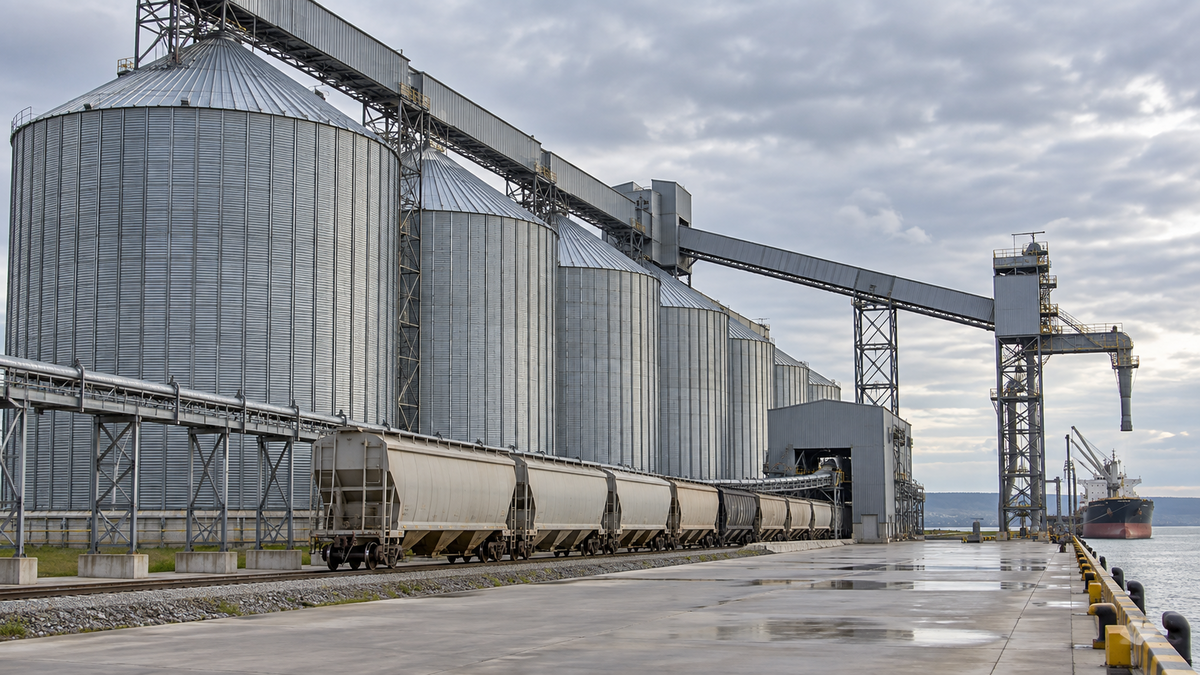
Russia added roughly 10 million tonnes of grain-handling capacity at its ports in 2024, bringing the total close to 85 million tonnes. Prime Minister Mikhail Mishustin gave the figures at a meeting in Chita on July 22, 2025, according to Interfax.
Rail access is also on the investment agenda
The Transport Ministry's account of the meeting describes a six-year plan to add more than 50 million tonnes of carrying capacity on the Azov-Black Sea and Eastern rail routes. It also gives separate specifications for the Trans-Baikal Grain Terminal: up to 8 million tonnes of annual throughput and storage for up to 80,000 tonnes. The terminal opened in September 2022.

What the different numbers measure
The following distinctions are an editorial explanation of the figures, not additional government forecasts. A terminal's storage capacity describes the quantity it can hold at a particular time. Throughput describes movement over a period. Grain can enter and leave the same storage space repeatedly, so a site's yearly throughput can be much larger than its stock at any one moment.
For the same reason, adding storage tonnes to annual handling tonnes would produce a meaningless total. Neither measure, by itself, identifies how much grain has been sold, the price received by a farmer or the income earned by a terminal operator.
- Capacity describes the infrastructure available for handling cargo.
- Actual dispatches require a separately measured reporting period.
- A planned railway expansion is not already available transport capacity.
From infrastructure to a shipment
Consider a grain consignment awaiting collection. An empty silo would address its storage requirement, but it would not itself provide a wagon or a departure slot. Equally, a transport booking would not prove that the buyer had accepted the consignment. These are different steps in a shipment, rather than interchangeable indicators of export performance.
The announcement therefore provides an infrastructure update. Assessing commercial results would require corresponding evidence about actual movements and transactions. It would be premature to convert the stated expansion into a forecast of export revenue or to treat the whole rail programme as capacity reserved for grain.
Your perspective
Share your thoughts on the story.